H.R. 3747 explained · 119th Congress · Pending in Congress
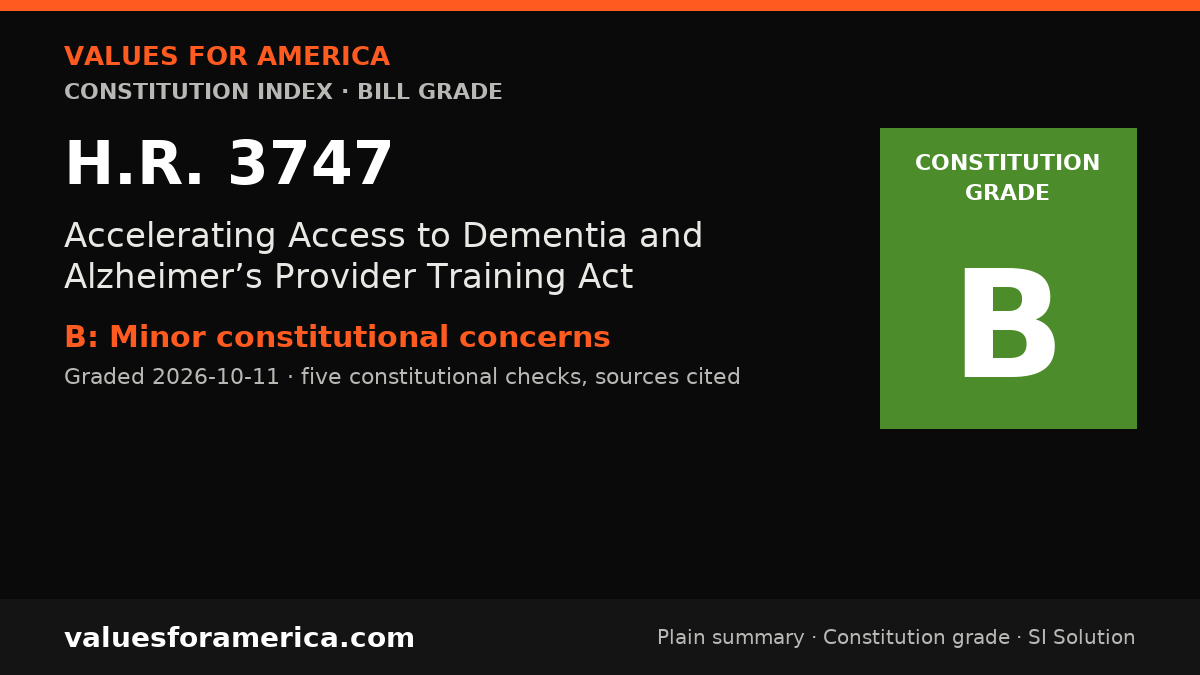
Accelerating Access to Dementia and Alzheimer’s Provider Training Act
Cosponsors: 97 (74 D, 23 R) · per Congress.gov, 2026-10-15
Introduced: 2025-06-05
Latest action (2026-07-21): Received in the Senate and Read twice and referred to the Committee on Health, Education, Labor, and Pensions.
What H.R. 3747 does, in plain terms
Accelerating Access to Dementia and Alzheimer’s Provider Training Act or the AADAPT Act This bill reauthorizes through FY2031 and revises the Technology-enabled Collaborative Learning Program, which is administered by the Health Resources and Services Administration. This program provides grants to support the use of technology that connects different health care professionals to improve access to health care, including specialty care, for certain rural and medically underserved populations. The bill explicitly adds dementia care to the types of specialty care that the program may address.
Official summary by the Congressional Research Service, via Congress.gov.
Constitution Index
“VFA Constitution grade”
Minor constitutional concerns
Graded 2026-10-11
SI-generated grade · five published checks · not individually reviewed by a person · methodology
The bill is a federal grant program for telehealth training in dementia care, which falls under the spending power and is a permissible use of federal funds to support health care in underserved areas. It does not infringe on individual rights, and while it involves federal involvement in health care, it does not mandate or coerce states or individuals, preserving state flexibility. The main constitutional tension is the expansion of federal involvement in health care, but it is not a direct violation of enumerated powers or the Tenth Amendment.
-
✓ Passes · Enumerated powers
The federal government has the power to spend for the general welfare under Article I, Section 8, Clause 1. This bill authorizes grants to support telehealth training for dementia care, which is a permissible use of the spending power. It does not regulate or mandate, but rather incentivizes through conditional grants, which is within established precedent (South Dakota v. Dole). -
✓ Passes · Bill of Rights
The bill does not implicate any of the first ten amendments. It does not restrict speech, religion, assembly, press, petition, arms, quartering, search and seizure, self-incrimination, due process, takings, trial rights, or cruel and unusual punishment. It is a voluntary grant program that does not infringe on any enumerated rights. -
✓ Passes · Individual sovereignty
The bill does not restrict individual liberty. It provides funding for training and does not impose any mandates on individuals. Participation is voluntary, and there is no burden on personal autonomy, property, or labor. The government is not restricting any freedom but rather facilitating access to care. -
✗ Concern · Decentralization
The bill fails the decentralization test because it consolidates decision-making at the federal level for a program that could be handled by states or localities. However, it does not directly violate the Tenth Amendment because it is a voluntary grant program, not a command. The questions reveal that while individuals and local communities cannot fully handle the program, states could, and the fe… -
✓ Passes · Due process and takings
The bill does not deprive anyone of life, liberty, or property without due process. It does not take property without just compensation. It is a grant program that provides benefits, not a regulatory or enforcement action. There is no procedural or substantive due process concern.
Sources: Congress.gov: HR 3747 summary
Report an error in this grade
The Framers
“Founders’ Verdict”
Confidence 0.60
Archived SI output (machine-generated)No editorial review recorded. This historical SI verdict was machine-generated by software and predates the review desk; check it against the official bill text.
Synthesis
The bill is constitutional as a valid exercise of Congress's spending power under Article I, Section 8, Clause 1, and the Necessary and Proper Clause, to promote the general welfare through conditional grants for health care professional training, including dementia care.
The bill constitutes a valid exercise of Congress's power to lay and collect Taxes, Duties, Imposts, and Excises, and to provide for the common Defence and general Welfare, as enumerated in Article I, Section 8, Clause 1. The Technology-enabled Collaborative Learning Program is a conditional grant-in-aid that promotes the training of health care professionals and the improvement of health care access in underserved areas, which is a proper object of the general welfare. The Tenth Amendment reserves to the States powers not delegated, but the spending power is expressly delegated and, when exer…
The Constitution grants only limited and enumerated powers to the federal government. The power to regulate health care, including the training of providers for dementia and Alzheimer’s care, is not among those enumerated. The Tenth Amendment reserves all such matters to the states or to the people. While the Congress may tax and spend for the general welfare, that power may not be used to assume authority over subjects not delegated, such as the internal police and health of the states. This bill creates a federal grant program for medical education and technology, which is a matter of local …
The bill's reauthorization and revision of a grant program to include dementia care falls within the enumerated power of Congress to provide for the general welfare through spending, as per Article I, Section 8, Clause 1. However, the Constitution requires that such spending be for the common defense or general welfare, not for particular local or private interests. The program's focus on rural and medically underserved populations may align with the general welfare, but if the grants are not truly national in scope or if they unduly favor certain states or factions, they could exceed the prop…
The Congress possesses the power to lay and collect taxes to provide for the general welfare, and to make all laws necessary and proper for executing that power. The present bill, by reauthorizing grants to support technology-enabled collaborative learning for health care professionals, is a legitimate exercise of the spending power to promote the health and welfare of the people, particularly those in rural and underserved areas. Moreover, as established in McCulloch v. Maryland, the means chosen are appropriate and plainly adapted to the legitimate end of improving access to specialty care. …
Report an error in this Founders' Verdict
What should pass
“VFA SI Solution”
No solution yet
A sourced SI draft appears here once it passes automated checks (Constitution citation, source verification, independent SI critic). How publication works.
Related on VFA

For journalists and bloggers
“Embed this grade”
Free to use with the link back. The badge and card update when the grade changes. Embed terms →
