H.R. 368 explained · 119th Congress · Pending in Congress
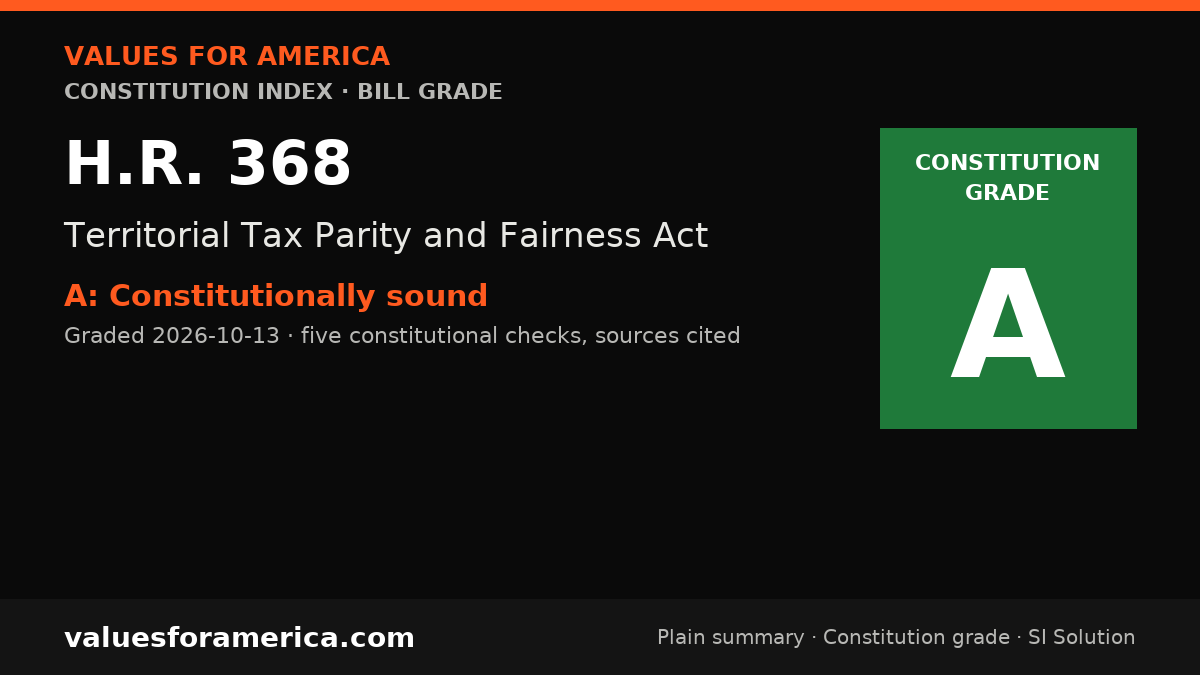
Territorial Tax Parity and Fairness Act
Cosponsors: none · per Congress.gov, 2026-10-12
Introduced: 2025-01-13
Latest action (2025-01-13): Referred to the House Committee on Ways and Means.
What H.R. 368 does, in plain terms
Territorial Tax Parity and Fairness Act This bill excepts individuals who are bona fide residents of the Virgin Islands from including in gross income for U.S. federal tax purposes subpart F income received from certain corporations if such income may be sourced to the Virgin Islands. Under current law, a U.S. shareholder of a controlled foreign corporation generally is required to include in gross income their pro rata share of dividends, interest, rent, royalties, and certain other types of income of the controlled foreign corporation (collectively known as subpart F income). A U.S. shareholder is a U.S. person (citizen, resident, domestic partnership or corporation, trust, or estate) that owns a certain percentage of stock in the controlled foreign corporation. However, under current law, the definition of a U.S. person does not include individuals who are bona fide residents of the U.S. territories of Puerto Rico, Guam, America Samoa, and the Northern Mariana Islands who receive subpart F income from controlled foreign corporations that meets certain requirements for being sourced to the territory or being connected to or derived from a trade or business in the territory. This bill expands the exceptions from the definition of a U.S. person for purposes of the subpart F income tax rules, to include individuals who are bona fide residents of the Virgin Islands and receive subpart F income from a controlled foreign corporation organized under the laws of the Virgin Islands if the subpart F income may be sourced to the Virgin Islands.
Official summary by the Congressional Research Service, via Congress.gov.
Constitution Index
“VFA Constitution grade”
Constitutionally sound
Graded 2026-10-13
SI-generated grade · five published checks · not individually reviewed by a person · methodology
The bill is a narrow tax measure that aligns the treatment of bona fide residents of the Virgin Islands with that of residents of other U.S. territories under the subpart F income rules. It does not expand federal power beyond the taxing authority granted by the Constitution, does not infringe on individual rights, and does not centralize authority. The bill is fully consistent with the Constitution.
-
✓ Passes · Enumerated powers
The federal government has explicit constitutional authority to lay and collect taxes under Article I, Section 8, Clause 1. This bill exercises that power by modifying the tax treatment of certain income for residents of the Virgin Islands. It does not exceed the enumerated power to tax. -
✓ Passes · Bill of Rights
The bill does not implicate any of the first ten amendments. It does not restrict speech, religion, assembly, press, petition, arms, quartering, search and seizure, self-incrimination, due process, takings, trial rights, or cruel and unusual punishment. It is a purely fiscal measure. -
✓ Passes · Individual sovereignty
The bill does not restrict individual liberty. Instead, it provides a tax exemption for certain income, which is a benefit to individuals. It does not compel any action or prohibit any conduct, and the burden of proof for any restriction is not relevant here because there is no restriction. -
✓ Passes · Decentralization
The bill does not consolidate decision-making at a higher level of government. It is a federal tax law, which is appropriate because taxation is a federal power. The bill does not prevent individuals, local communities, or states from handling their own affairs; it simply adjusts federal tax rules. It passes all four questions. -
✓ Passes · Due process and takings
The bill does not deprive any person of life, liberty, or property without due process of law. It does not take property without just compensation. It provides a tax exemption, which is not a taking. There is no procedural or substantive due process concern.
Sources: Congress.gov: HR 368 summary
Report an error in this grade
What should pass
“VFA SI Solution”
No solution yet
A sourced SI draft appears here once it passes automated checks (Constitution citation, source verification, independent SI critic). How publication works.
Related on VFA

For journalists and bloggers
“Embed this grade”
Free to use with the link back. The badge and card update when the grade changes. Embed terms →
