H.R. 3668 explained · 119th Congress · Pending in Congress
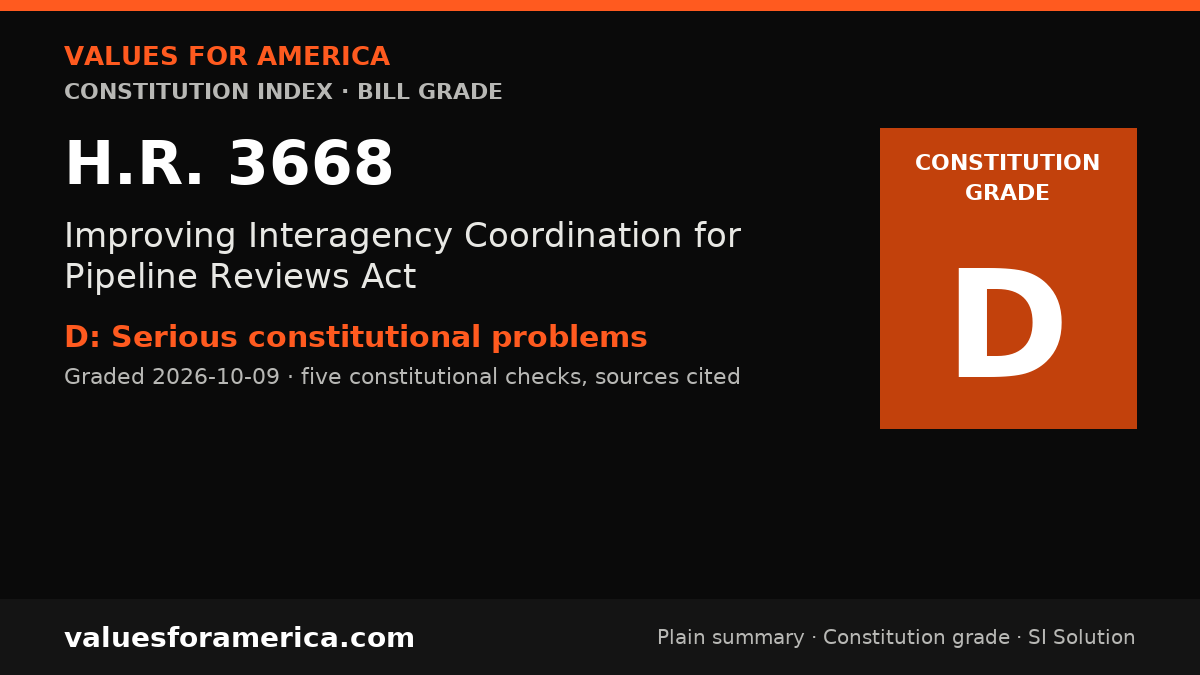
Improving Interagency Coordination for Pipeline Reviews Act
Cosponsors: 3 (0 D, 3 R) · per Congress.gov, 2026-10-09
Introduced: 2025-06-02
Latest action (2025-12-15): Received in the Senate and Read twice and referred to the Committee on Commerce, Science, and Transportation.
What H.R. 3668 does, in plain terms
Improving Interagency Coordination for Pipeline Reviews Act This bill expedites the environmental review of certain natural gas pipeline projects or liquefied natural gas (LNG) import or export terminals for authorizations under the Natural Gas Act. Specifically, the bill makes the Federal Energy Regulatory Commission (FERC) the only lead agency for the purpose of coordinating the environmental review of such projects under the National Environmental Policy Act of 1969 (NEPA). Thus, agencies involved in the environmental review process must defer to FERC's approved scope for a NEPA review. FERC must invite certain federal, state, local, or tribal governmental agencies to participate in the review process for an authorization and designate the applicable governments as participating agencies by deadlines established by the bill. In addition, FERC must consult with the Transportation Security Administration regarding various pipeline security measures. The bill prohibits FERC from establishing a deadline for authorizing a project that is more than 90 days after the completion of the NEPA review. It also requires concurrent reviews when multiple federal or state agencies are involved. Applicants for projects do not have to obtain a water quality certification from states under Section 401 of the Clean Water Act. FERC must coordinate its NEPA review with states where a potential discharge into navigable waters may occur. If a federal or state agency requires an applicant for a pipeline authorization to submit data, the agency must consider any such data gathered by aerial or other remote means that is submitted.
Official summary by the Congressional Research Service, via Congress.gov.
Constitution Index
“VFA Constitution grade”
Serious constitutional problems
Graded 2026-10-09
SI-generated grade · five published checks · not individually reviewed by a person · methodology
The bill likely violates the Tenth Amendment by preempting state water quality certification under Section 401 of the Clean Water Act, removing a traditional state police power without a compelling constitutional justification. While Congress has Commerce Clause authority over interstate pipelines, the consolidation of decision-making at the federal level and the elimination of state authority represent federal overreach. The bill passes the Enumerated Powers, Bill of Rights, Individual Sovereignty, and Due Process checks, but fails the Decentralization check significantly.
-
✓ Passes · Enumerated powers
Congress has authority under the Commerce Clause (Article I, Section 8, Clause 3) to regulate interstate natural gas pipelines and LNG terminals. The bill's provisions, including preemption of state water quality certification, fall within the scope of interstate commerce regulation. -
✓ Passes · Bill of Rights
The bill does not infringe any of the first ten amendments. It addresses administrative procedures for pipeline reviews and does not restrict speech, religion, press, assembly, petition, arms, quartering, search and seizure, self-incrimination, due process (procedural), fair trial, jury, cruel and unusual punishment, unenumerated rights, or reserved powers in a manner that violates the Bill of Rig… -
✓ Passes · Individual sovereignty
The bill regulates corporate permit processes for pipeline projects, not individual conduct. It does not restrict what a person can do with their own person, property, speech, labor, or belief. The government has not imposed a restriction on individual freedom that requires compelling justification. -
✗ Concern · Decentralization
The bill consolidates decision-making at the federal level by making FERC the sole lead agency and removing state water quality certification under Section 401 of the Clean Water Act. While interstate pipelines require some federal coordination, states have traditionally regulated water quality under their police powers. The Tenth Amendment reserves such powers to the states. The bill fails the de… -
✓ Passes · Due process and takings
The bill does not bypass due process or take property without just compensation. It sets a 90-day deadline after NEPA review, which could be seen as rushing but does not deny notice or hearing. The removal of state water quality certification is a preemption of state regulatory authority, not a taking of private property. Procedural due process is maintained through FERC's review process.
Sources: Congress.gov: HR 3668 summary
Report an error in this grade
What should pass
“VFA SI Solution”
No solution yet
A sourced SI draft appears here once it passes automated checks (Constitution citation, source verification, independent SI critic). How publication works.
Related on VFA

For journalists and bloggers
“Embed this grade”
Free to use with the link back. The badge and card update when the grade changes. Embed terms →
