H.R. 365 explained · 119th Congress · Pending in Congress
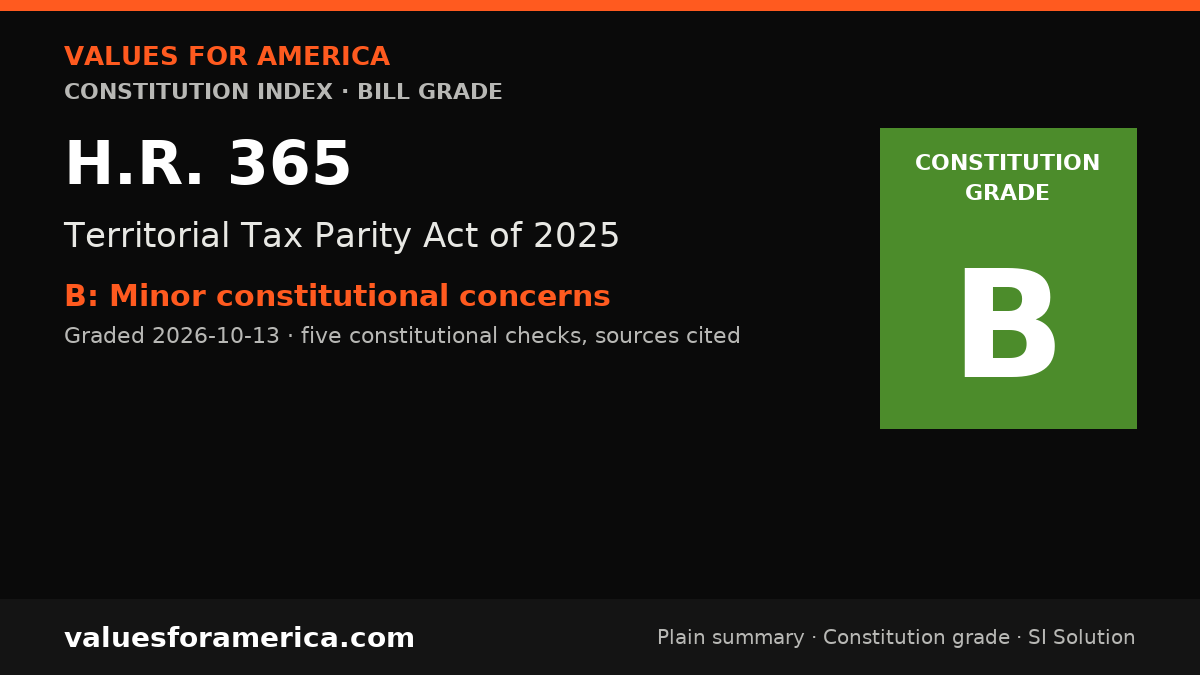
Territorial Tax Parity Act of 2025
Cosponsors: none · per Congress.gov, 2026-10-12
Introduced: 2025-01-13
Latest action (2025-01-13): Referred to the House Committee on Ways and Means.
What H.R. 365 does, in plain terms
Territorial Tax Equity Parity Act of 2025 This bill modifies the income sourcing rules related to taxation of income from U.S. territories. Under the bill, income is U.S.-sourced income or effectively connected to a U.S. trade or business only if attributable to an office or fixed place of business in the United States. (Currently, income is sourced to a U.S. territory and, thus, may be excluded from the gross income of a bona fide resident of a U.S. territory in calculating U.S. federal income tax if it is not U.S.-sourced income or effectively connected with a U.S. trade or business.) Further, the bill authorizes the Internal Revenue Service (IRS) to limit the income tax payment to the Virgin Islands required to treat income from the sale of certain personal property as foreign-sourced income for federal tax purposes. (Currently, income from certain personal property sales from a fixed place of business in a U.S. territory by a U.S. resident may be U.S.-sourced income unless an income tax of at least 10% is paid to the U.S. territory. The Internal Revenue Service (IRS) may limit the 10% tax payment requirement related to income from personal property sales in Guam, American Samoa, the Northern Mariana Islands, and Puerto Rico.)
Official summary by the Congressional Research Service, via Congress.gov.
Constitution Index
“VFA Constitution grade”
Minor constitutional concerns
Graded 2026-10-13
SI-generated grade · five published checks · not individually reviewed by a person · methodology
The bill is a federal tax measure that falls within Congress's enumerated power to lay and collect taxes under Article I, Section 8, Clause 1. It does not directly infringe on individual rights, but it does alter the tax treatment of U.S. territory residents and businesses, potentially increasing their federal tax burden. The bill also grants the IRS discretionary authority to limit certain tax payments, which raises minor due process concerns regarding notice and consistency. The decentralization check is mixed: while tax policy is inherently federal, the bill's effect on territorial self-governance and the IRS's discretionary power warrant a 'mostly sound' grade.
-
✓ Passes · Enumerated powers
Congress has the explicit power to 'lay and collect Taxes, Duties, Imposts and Excises' under Article I, Section 8, Clause 1. This bill modifies federal income tax sourcing rules and IRS authority, which is squarely within that enumerated power. The bill does not exceed federal authority because it concerns federal taxation, not regulation of intrastate commerce or other areas outside Congress's p… -
✓ Passes · Bill of Rights
The bill does not implicate the First, Second, Third, Fourth, Fifth, Sixth, Seventh, Eighth, Ninth, or Tenth Amendments. It does not restrict speech, religion, assembly, press, petition, arms, quartering, search and seizure, self-incrimination, trial rights, jury rights, or cruel and unusual punishment. The Fifth Amendment's Due Process Clause is not directly violated because the bill provides a l… -
✓ Passes · Individual sovereignty
The bill does not restrict an individual's control over their person, property, speech, labor, or belief. It changes the tax treatment of income, which is a legitimate exercise of the taxing power. While it may increase tax liability for some individuals, the government has a compelling interest in collecting revenue and ensuring tax compliance. The burden is on the government to justify the restr… -
✗ Concern · Decentralization
The bill fails the decentralization test because it consolidates decision-making at the federal level regarding tax treatment of income from U.S. territories. While federal tax policy is inherently national, the bill reduces the ability of territories to set their own tax rules and grants the IRS discretionary authority to limit tax payments, which could undermine territorial fiscal autonomy. The … -
✓ Passes · Due process and takings
The bill does not bypass procedural due process because it is a legislative change that applies prospectively and does not target specific individuals. It does not violate substantive due process because it is rationally related to the legitimate government interest of ensuring consistent tax treatment. The Takings Clause is not implicated because tax liability is not a taking of property. However…
Sources: Congress.gov: HR 365 summary
Report an error in this grade
What should pass
“VFA SI Solution”
No solution yet
A sourced SI draft appears here once it passes automated checks (Constitution citation, source verification, independent SI critic). How publication works.
Related on VFA

For journalists and bloggers
“Embed this grade”
Free to use with the link back. The badge and card update when the grade changes. Embed terms →
