H.R. 364 explained · 119th Congress · Pending in Congress
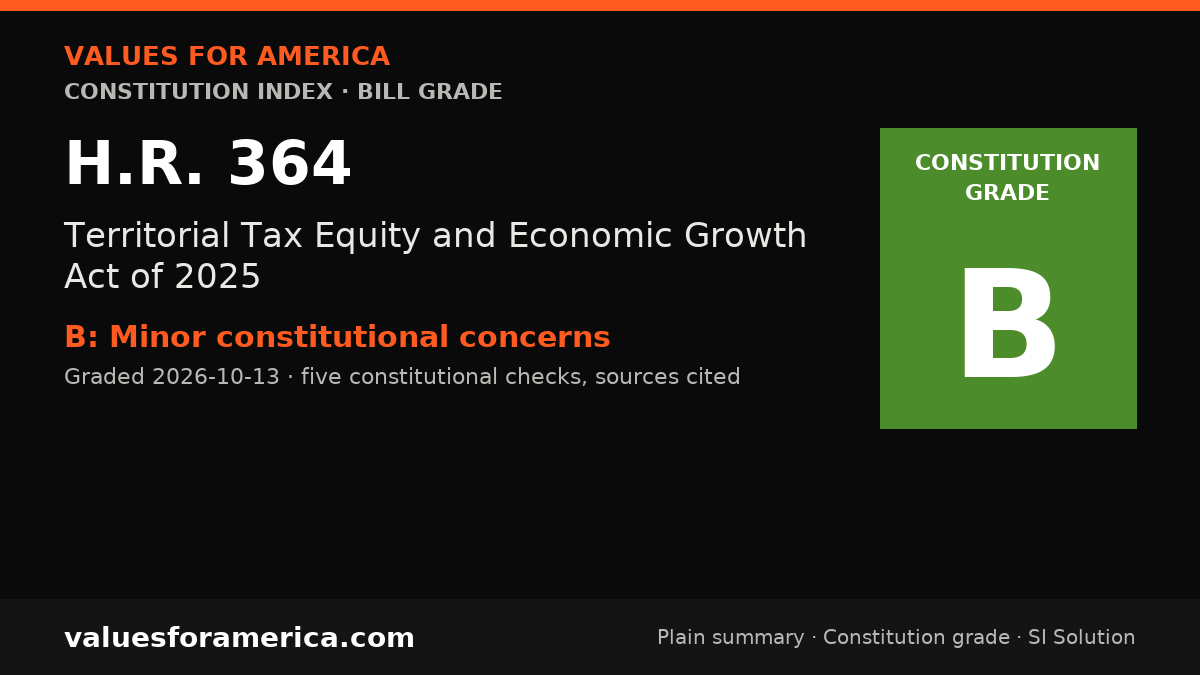
Territorial Tax Equity and Economic Growth Act of 2025
Cosponsors: none · per Congress.gov, 2026-10-12
Introduced: 2025-01-13
Latest action (2025-01-13): Referred to the House Committee on Ways and Means.
What H.R. 364 does, in plain terms
Territorial Tax Equity and Economic Growth Act of 2025 This bill lowers the residency requirements and modifies the income sourcing rules related to taxation of income from U.S. territories. Currently, bona fide residents of a U.S. territory may exclude income sourced to the territory in calculating U.S. federal income tax. A bona fide resident of a territory is a person that, in part, is present in the territory for at least 183 days in a tax year. Income is sourced to a U.S. territory if it is not U.S.-sourced income or effectively connected with a U.S. trade or business. This bill reduces the presence requirement to 122 days, specifies that income is U.S.-sourced income or effectively connected to a U.S. trade or business only if attributable to an office or fixed place of business in the United States, and specifies that income from U.S.-based activities that are preparatory or auxiliary may not be considered U.S.-sourced income. Currently, income from certain personal property sales from a fixed place of business in a U.S. territory by a U.S. resident may be U.S.-sourced income unless an income tax of at least 10% is paid to the U.S. territory. The Internal Revenue Service (IRS) may limit the 10% tax payment requirement related to income from personal property sales in Guam, American Samoa, the Northern Mariana Islands, and Puerto Rico. This bill expands the IRS’s authority to include limiting the tax requirement for personal property sales in the Virgin Islands.
Official summary by the Congressional Research Service, via Congress.gov.
Constitution Index
“VFA Constitution grade”
Minor constitutional concerns
Graded 2026-10-13
SI-generated grade · five published checks · not individually reviewed by a person · methodology
The bill is a federal tax measure that falls within Congress's enumerated power to lay and collect taxes under Article I, Section 8, Clause 1. It does not infringe on individual rights, and it does not raise due process or takings concerns. The main constitutional tension is decentralization: while the bill adjusts tax rules for territories, it does not fundamentally alter the federal-territorial relationship, and the changes are within the scope of federal authority over territories under Article IV, Section 3, Clause 2. The bill is mostly sound, with minor concerns about the complexity of tax rules and the potential for unintended economic effects, but these are not constitutional defects.
-
✓ Passes · Enumerated powers
Congress has the explicit power to lay and collect taxes under Article I, Section 8, Clause 1. The bill modifies federal income tax rules for U.S. territories, which is a direct exercise of this enumerated power. Additionally, Article IV, Section 3, Clause 2 grants Congress authority over U.S. territories, further supporting the federal action. -
✓ Passes · Bill of Rights
The bill does not implicate any of the first ten amendments. It does not restrict speech, religion, assembly, press, petition, arms, quartering, search and seizure, self-incrimination, due process, takings, fair trial, jury, or cruel and unusual punishment. It is a purely fiscal measure that adjusts tax residency and sourcing rules. -
✓ Passes · Individual sovereignty
The bill does not restrict individual liberty. It modifies tax rules, which are a legitimate exercise of government power, and does not impose new restrictions on personal conduct, property, speech, labor, or belief. The changes are tax incentives and clarifications, not prohibitions or mandates. -
✓ Passes · Decentralization
The bill does not consolidate decision-making at a higher level of government than necessary. Taxation of income from U.S. territories is inherently a federal matter due to the unique status of territories under Article IV, Section 3, Clause 2. Individuals and local communities cannot set federal tax policy, and states are not involved in territorial taxation. The bill does not shift power from lo… -
✓ Passes · Due process and takings
The bill does not deprive individuals of property without due process. It changes tax rules prospectively and does not involve confiscation or retroactive application. The modifications to income sourcing and residency requirements are clear and provide notice to taxpayers. There is no taking of private property for public use without just compensation.
Sources: Congress.gov: HR 364 summary
Report an error in this grade
What should pass
“VFA SI Solution”
No solution yet
A sourced SI draft appears here once it passes automated checks (Constitution citation, source verification, independent SI critic). How publication works.
Related on VFA

For journalists and bloggers
“Embed this grade”
Free to use with the link back. The badge and card update when the grade changes. Embed terms →
