H.R. 3633 explained · 119th Congress · Pending in Congress
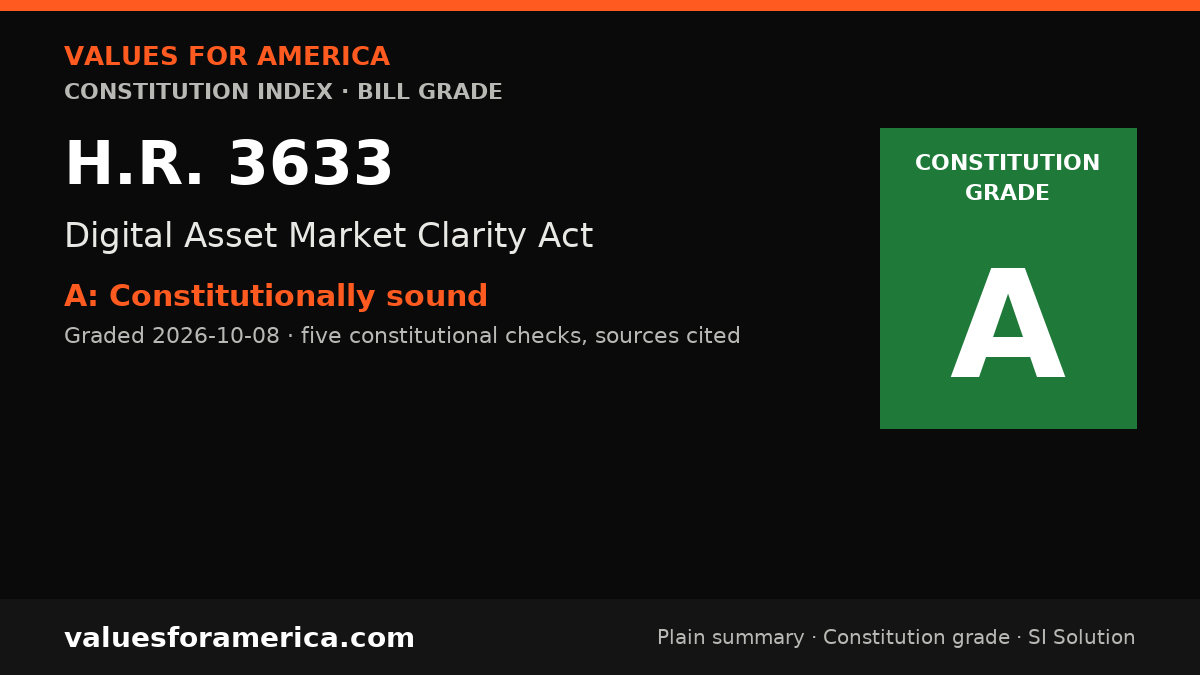
Digital Asset Market Clarity Act
Cosponsors: 21 (7 D, 14 R) · per Congress.gov, 2026-10-14
Introduced: 2025-05-29
Latest action (2026-09-15): Motion by Senator Tillis to reconsider the vote by which cloture on the motion to proceed to the measure was not invoked (Record Vote No. 234) entered in Senate.
What H.R. 3633 does, in plain terms
Digital Asset Market Clarity Act of 2025 or the CLARITY Act of 2025 This bill establishes a regulatory framework for digital commodities, defined by the bill as digital assets that rely upon a blockchain for their value. The Commodity Futures Trading Commission must generally regulate digital commodities transactions, including digital commodity exchanges, brokers, and dealers. To qualify for trade on an exchange (1) a digital commodity’s blockchain must be mature, or on a blockchain system that has achieved decentralized control as defined by the bill; or (2) the issuer of the digital commodity must file certain reports. The bill establishes requirements for trade monitoring, recordkeeping, and the commingling of customer assets. The bill exempts digital commodities on mature blockchains (and digital commodities on blockchains expected to mature within certain timeframes) from Securities and Exchange Commission (SEC) registration requirements if annual sales fall under a certain amount and other requirements are met. The bill provides the SEC with jurisdiction over digital commodity activities and transactions engaged in by certain brokers and dealers on alternative trading systems and by national securities exchanges. Digital commodity exchanges, brokers, and dealers are subject to the Bank Secrecy Act for anti-money laundering and related purposes. The bill also sets forth requirements for alternative trading systems, previously issued digital commodities, and provisional registration until the bill is implemented. For more information on this bill, see CRS Insight IN12583, Crypto Legislation: An Overview of H.R. 3633, the CLARITY Act.
Official summary by the Congressional Research Service, via Congress.gov.
Constitution Index
“VFA Constitution grade”
Constitutionally sound
Graded 2026-10-08
SI-generated grade · five published checks · not individually reviewed by a person · methodology
Federal market-structure bill within Commerce Clause authority that sets CFTC and SEC jurisdiction, maturity-based exemptions, and intermediary safeguards without restricting speech, ownership, or due process. Minor recordkeeping tension is fixable through supervision.
-
✓ Passes · Enumerated powers
Congress acts under Article I, Section 8, Clause 3, the Commerce Clause, over interstate exchange, broker, and dealer activity in digital commodities, plus Clause 18, Necessary and Proper, to empower the Commodity Futures Trading Commission and Securities and Exchange Commission to register venues and police fraud. Bank Secrecy Act duties rest on Clause 3 and Article I, Section 8, Clause 5 on regu… -
✓ Passes · Bill of Rights
No speech, religion, press, assembly, arms, search, trial, or punishment restriction. Recordkeeping and Bank Secrecy Act reporting apply to regulated intermediaries, not general warrantless seizure of private papers. No prior restraint under First Amendment. No Second, Third, Sixth, Seventh, or Eighth Amendment issue. Any Fourth Amendment recordkeeping burden is narrow, industry-specific, and subj… -
✓ Passes · Individual sovereignty
The bill regulates intermediaries and issuers seeking public market access, not private possession, personal use, self-custody, or belief. Mature-blockchain exemptions and sale-threshold relief reduce burdens on decentralized protocols. Government bears burden under Fifth Amendment liberty and Ninth Amendment retained rights, and meets it with fraud prevention, customer-asset protection, and marke… -
✓ Passes · Decentralization
Digital commodity markets are interstate and global by design. Individuals cannot enforce exchange solvency or prevent commingling alone. Counties and single states cannot set uniform listing, custody, and surveillance rules for borderless networks without fragmentation. Federal baseline under Tenth Amendment reserved-powers principles is the minimum effective level, leaving states free to enforce… -
✓ Passes · Due process and takings
No criminal presumption, summary seizure, or physical appropriation. Registration, disclosure, trade monitoring, and provisional registration provide notice and orderly transition. Enforcement must proceed through existing Commodity Exchange Act and Securities Exchange Act procedures satisfying Fifth Amendment procedural due process and Fourteenth Amendment due process incorporation. No Fifth Amen…
Sources: Congress.gov: HR 3633 summary
Report an error in this grade
The Framers
“Founders’ Verdict”
Confidence 0.75
Archived SI output (machine-generated)No editorial review recorded. This historical SI verdict was machine-generated by software and predates the review desk; check it against the official bill text.
Synthesis
The bill is constitutional as a valid exercise of Congress's power to regulate interstate commerce under Article I, Section 8, Clause 3, and the Necessary and Proper Clause (Clause 18). The regulatory framework for digital commodities, including CFTC/SEC oversight and Bank Secrecy Act obligations, is an appropriate means to prevent fraud and maintain market integrity. The delegation of rulemaking authority to expert agencies with defined standards is permissible, provided definitions such as 'mature blockchain' are clear to avoid arbitrary enforcement.
The bill's division of regulatory authority between the CFTC and SEC is consistent with the constitutional vesting of legislative power in Congress to regulate interstate commerce (Article I, Section 8, Clause 3) and to define the jurisdiction of federal courts and agencies. However, the exemption of certain digital commodities from SEC registration may undermine the uniformity of securities laws and the protection of investors, which the Constitution's Necessary and Proper Clause (Article I, Section 8, Clause 18) empowers Congress to secure. The bill must ensure that any exemption does not cr…
This bill proposes to create a vast new federal regulatory apparatus over digital commodities, granting the Commodity Futures Trading Commission and the Securities and Exchange Commission powers to license, monitor, and enforce rules on exchanges, brokers, and dealers. Such an extension of federal authority is not enumerated in the Constitution. The Tenth Amendment reserves to the States or to the people all powers not delegated to the United States. The regulation of internal commerce and property—including digital assets—falls within the police powers of the several States, unless the activi…
The bill regulates digital commodities, which are instruments of interstate commerce. Congress possesses the authority to regulate such commerce under Article I, Section 8, Clause 3, and may enact all laws necessary and proper for executing that power under Clause 18. The establishment of a federal regulatory framework for digital commodity exchanges, brokers, and dealers, and the imposition of anti-money laundering requirements, are appropriate means to prevent fraud and maintain market integrity, consistent with the principles of controlling faction and promoting the general welfare as discu…
The Constitution vests in Congress the power to regulate commerce among the several states. This power, as expounded in Gibbons v. Ogden, is plenary and extends to all commercial intercourse. Digital commodities, by their very nature, are instruments of interstate and international commerce, and their regulation by the federal government is both necessary and proper. The establishment of a regulatory framework through the Commodity Futures Trading Commission and the Securities and Exchange Commission, coupled with requirements under the Bank Secrecy Act, constitutes a legitimate means to execu…
Report an error in this Founders' Verdict
What should pass
“VFA SI Solution”
Archived SI output (machine-generated) · No editorial review recorded
This historical draft has no editorial review time on record. Check its claims against the original bill and current law.
Digital Asset Market Clarity and Consumer Protection Act of 2025
Generated by VFA SI Solutions
To establish a clear federal regulatory framework for digital commodities that allocates jurisdiction between the CFTC and SEC, imposes anti-money laundering obligations, and provides market integrity protections, while allowing innovation.
Bipartisan rationale: Honors Democratic priorities: strong consumer protections, anti-money laundering safeguards, and market integrity through clear rules and enforcement. Honors Republican priorities: regulatory clarity, reduced uncertainty for innovators, a sunset provision to prevent permanent overreach, and a fee-based funding mechanism that does not rely on general tax revenue.
Article I, Section 8, Clause 3 Article I, Section 8, Clause 18 Amendment V
Report an error in this Solution
Citizen Consensus
“Do you support this VFA SI Solution?”
One vote per verified account; you can change it any time. Only verified accounts count, results publish once 30 verified people have voted, and state and district results count only people who attested a home ZIP code. How this works.
Email verification is not switched on yet, so no vote counts toward results yet. Votes cast now are saved and count once the voter verifies their email address.
Sign in or create a free account to vote.
Add a short reason (optional)
/280 · no links or contact details · reasons are reviewed before anyone sees them, and many never are shown.
Your vote is saved but held out of published results by an automated integrity check (for example, several accounts voting from one browser).
Your vote is saved. It will count once you verify your email address. Verify on your account page.
Your vote counts nationally. Add your home ZIP code to count in your state and district too.
Your vote counts nationally and in .
Reason saved privately; it is shown only if it passes review.
Verified participants nationwide · n =
Self-selected participants, not a random sample; ± is the 95% sampling margin.
Not enough verified votes yet. Results publish at verified votes.
A sudden surge of votes on this item was flagged and is under review; votes from new accounts in that surge are held out until it is resolved.
Related on VFA

For journalists and bloggers
“Embed this grade”
Free to use with the link back. The badge and card update when the grade changes. Embed terms →
