H.R. 3632 explained · 119th Congress · Pending in Congress
Power Plant Reliability Act of 2025
Cosponsors: 4 (0 D, 4 R) · per Congress.gov, 2026-10-09
Introduced: 2025-05-29
Latest action (2025-12-17): Received in the Senate and Read twice and referred to the Committee on Energy and Natural Resources.
What H.R. 3632 does, in plain terms
Power Plant Reliability Act of 2025 This bill modifies the process that the Federal Energy Regulatory Commission (FERC) uses to determine, upon a complaint from a state commission, whether a public utility (i.e., power plant) must remain open because the retirement of the power plant will make the bulk power system unreliable, including by allowing transmission organizations to also file complaints with FERC. If FERC finds that any interstate service of any public utility is inadequate or insufficient, or is likely to become inadequate or insufficient within five years of receiving such complaint, then FERC must determine the proper, adequate, or sufficient service to be furnished through an order, rule, or regulation (order). The bill specifies that FERC may order a power plant to remain open for up to five years. Any affected state commission, transmission organization, or power plant may request that FERC extend such order. A FERC order must determine (1) any rate or charge necessary to provide compensation for the additional costs of the service, and (2) the cost allocation of any rate or charge. A power plant owner or operator must notify FERC and affected state commissions or transmission organizations at least five years before any planned retirement of a unit of an electric generating facility except in the case of an emergency or similar event that renders a unit inoperable. The bill exempts from federal, state, and local environmental laws and regulations any action taken by a generating facility to comply with such orders.
Official summary by the Congressional Research Service, via Congress.gov.
Constitution Index
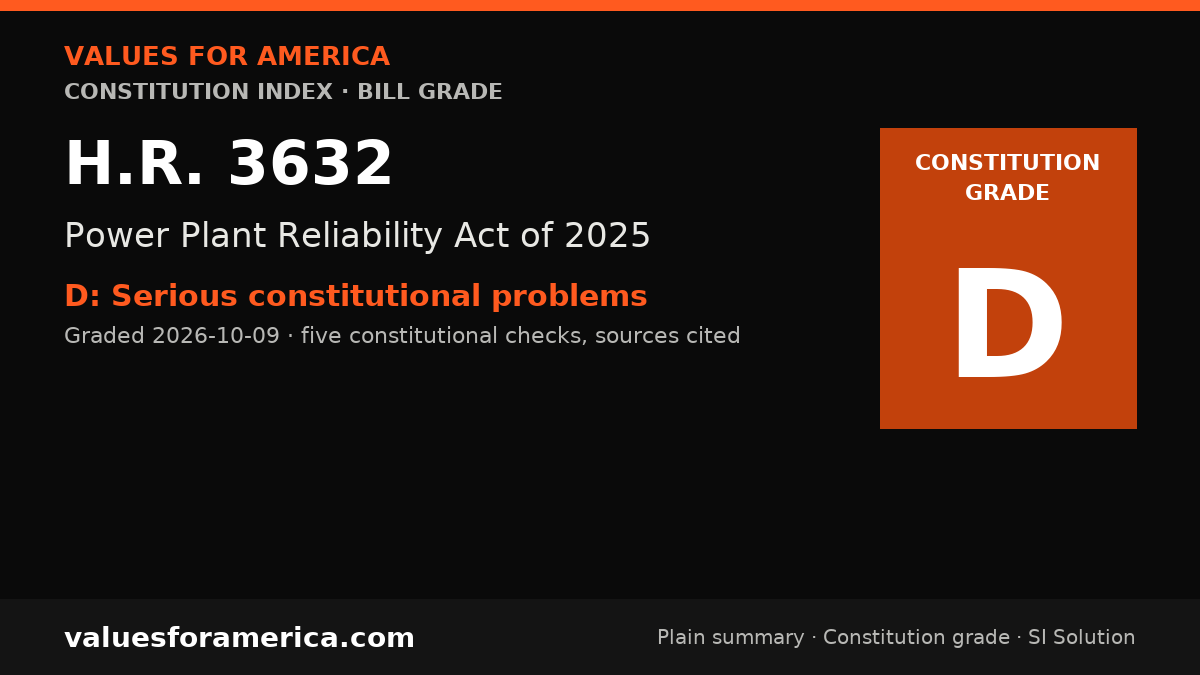
“VFA Constitution grade”
Serious constitutional problems
Graded 2026-10-09
SI-generated grade · five published checks · not individually reviewed by a person · methodology
The Power Plant Reliability Act raises serious constitutional concerns because it compels private power plants to remain in service and strips away state and local environmental protections without guaranteeing full just compensation. While the federal government has enumerated authority over interstate electricity commerce, the bill's forced-operation provisions implicate the Fifth Amendment's Takings Clause, and its broad environmental preemption consolidates power at the federal level beyond what is necessary.
-
✓ Passes · Enumerated powers
Congress may regulate interstate commerce, including the interstate bulk-power system, under Article I, Section 8, Clause 3, and may enact laws necessary and proper to carry out that authority under Article I, Section 8, Clause 18. FERC already exercises jurisdiction over interstate electricity transmission and wholesale sales, so the core complaint-and-order process is within Congress's commerce … -
✗ Concern · Bill of Rights
The bill allows FERC to order a private power plant to remain open and operating for up to five years, with possible extensions. That order takes or restricts the owner's right to retire or dispose of its property. The Fifth Amendment requires just compensation for such a taking. The bill's compensation language, limited to 'additional costs,' does not clearly include lost going-concern value, los… -
✗ Concern · Individual sovereignty
The bill restricts what a private owner may do with its own property and business. A power plant owner cannot retire a generating unit on its own schedule and may be forced to continue operating for years. Grid reliability is a legitimate public-interest justification, but the burden rests on the government to prove that the restriction is necessary and properly compensated. The bill does not ensu… -
✗ Concern · Decentralization
The interstate bulk-power system is a legitimate federal concern, but the bill centralizes authority in FERC while exempting compliance actions from federal, state, and local environmental laws. This goes beyond the minimum necessary level of government. States already regulate generation retirements and resource adequacy, and federal reliability interests can be protected without nullifying envir… -
✗ Concern · Due process and takings
The bill provides some procedural process through FERC complaint and order, but it raises serious substantive due process and Takings Clause problems. Compelling private property to remain in service is a taking that requires just compensation and a non-arbitrary justification. The bill's compensation mechanism appears to cover only 'additional costs' and may not account for all losses caused by f…
Sources: Congress.gov: HR 3632 summary
Report an error in this grade
What should pass
“VFA SI Solution”
No solution yet
A sourced SI draft appears here once it passes automated checks (Constitution citation, source verification, independent SI critic). How publication works.
Related on VFA

For journalists and bloggers
“Embed this grade”
Free to use with the link back. The badge and card update when the grade changes. Embed terms →
