H.R. 363 explained · 119th Congress · Pending in Congress
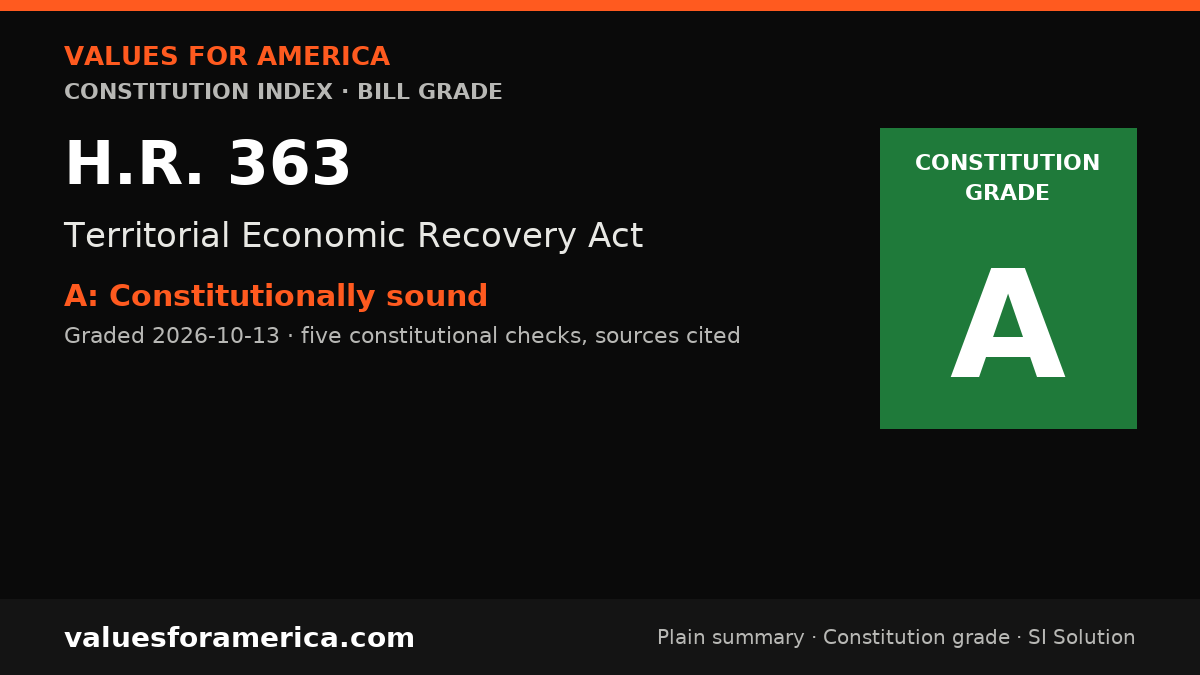
Territorial Economic Recovery Act
Cosponsors: none · per Congress.gov, 2026-10-12
Introduced: 2025-01-13
Latest action (2025-01-13): Referred to the House Committee on Ways and Means.
What H.R. 363 does, in plain terms
Territorial Economic Recovery Act This bill excludes the income of certain controlled foreign corporations in U.S. territories from the calculation of global intangible low-taxed income (GILTI) for federal tax purposes. Under current law, a U.S. shareholder of a controlled foreign corporation is required to include in gross income the GILTI of the shareholder. The calculation of GILTI is based, in part, on the controlled foreign corporation’s tested income (the controlled foreign corporation’s gross income less certain exclusions). Under the bill, the income from a qualified possession corporation that is effectively connected with an active trade or business within a U.S. territory (Puerto Rico, U.S. Virgin Islands, Guam, American Samoa, and the Northern Mariana Islands) is excluded from gross income for purposes of calculating a controlled foreign corporation’s tested income. The bill defines a qualified possession corporation as any controlled foreign corporation if, for a three-year period ending in the prior tax year (or for the existence of the controlled foreign corporation if less than three years) (1) 80% or more of the controlled foreign corporation’s gross income was derived from a U.S. territory, and (2) 75% or more of the controlled foreign corporation’s gross income was effectively connected to the active conduct of a trade or business within a U.S. territory.
Official summary by the Congressional Research Service, via Congress.gov.
Constitution Index
“VFA Constitution grade”
Constitutionally sound
Graded 2026-10-13
SI-generated grade · five published checks · not individually reviewed by a person · methodology
The bill is a federal tax measure that falls squarely within Congress's enumerated power to lay and collect taxes under Article I, Section 8, Clause 1. It does not infringe on any constitutional right, does not restrict individual sovereignty, and does not consolidate power upward beyond the federal tax authority already exercised. The bill merely adjusts the tax treatment of certain foreign corporations' income, which is a routine exercise of federal tax policy.
-
✓ Passes · Enumerated powers
The Constitution grants Congress the power to 'lay and collect Taxes, Duties, Imposts and Excises' (Article I, Section 8, Clause 1). This bill modifies the federal tax code's treatment of global intangible low-taxed income (GILTI) for controlled foreign corporations operating in U.S. territories. Such tax legislation is a direct exercise of Congress's enumerated taxing power. There is no overreach… -
✓ Passes · Bill of Rights
The bill does not implicate any provision of the Bill of Rights. It does not affect speech, religion, assembly, press, petition (First Amendment), the right to keep and bear arms (Second Amendment), quartering of soldiers (Third Amendment), search and seizure (Fourth Amendment), self-incrimination or due process (Fifth Amendment), trial rights (Sixth and Seventh Amendments), cruel and unusual puni… -
✓ Passes · Individual sovereignty
The bill does not restrict what individuals can do with their person, property, speech, labor, or belief. It only affects the tax treatment of certain corporations' income, which is a matter of federal tax law. Tax laws do impose obligations, but they are not restrictions on individual sovereignty in the sense of prohibiting or compelling personal conduct. The bill does not impose new burdens on i… -
✓ Passes · Decentralization
The bill concerns federal taxation of income from U.S. territories. Taxation is a federal function under the Constitution, and the bill does not consolidate decision-making at a higher level than necessary. The federal government already has the authority to tax GILTI, and this bill simply refines that authority. It does not involve matters that individuals, local communities, or states could hand… -
✓ Passes · Due process and takings
The bill does not deprive any person of life, liberty, or property without due process of law. It does not take private property for public use without just compensation. The bill merely changes the tax treatment of certain income, which is not a taking. Tax legislation is subject to the Due Process Clause, but this bill provides clear rules and does not operate retroactively or arbitrarily. It pr…
Sources: Congress.gov: HR 363 summary
Report an error in this grade
What should pass
“VFA SI Solution”
No solution yet
A sourced SI draft appears here once it passes automated checks (Constitution citation, source verification, independent SI critic). How publication works.
Related on VFA

For journalists and bloggers
“Embed this grade”
Free to use with the link back. The badge and card update when the grade changes. Embed terms →
