H.R. 3628 explained · 119th Congress · Pending in Congress
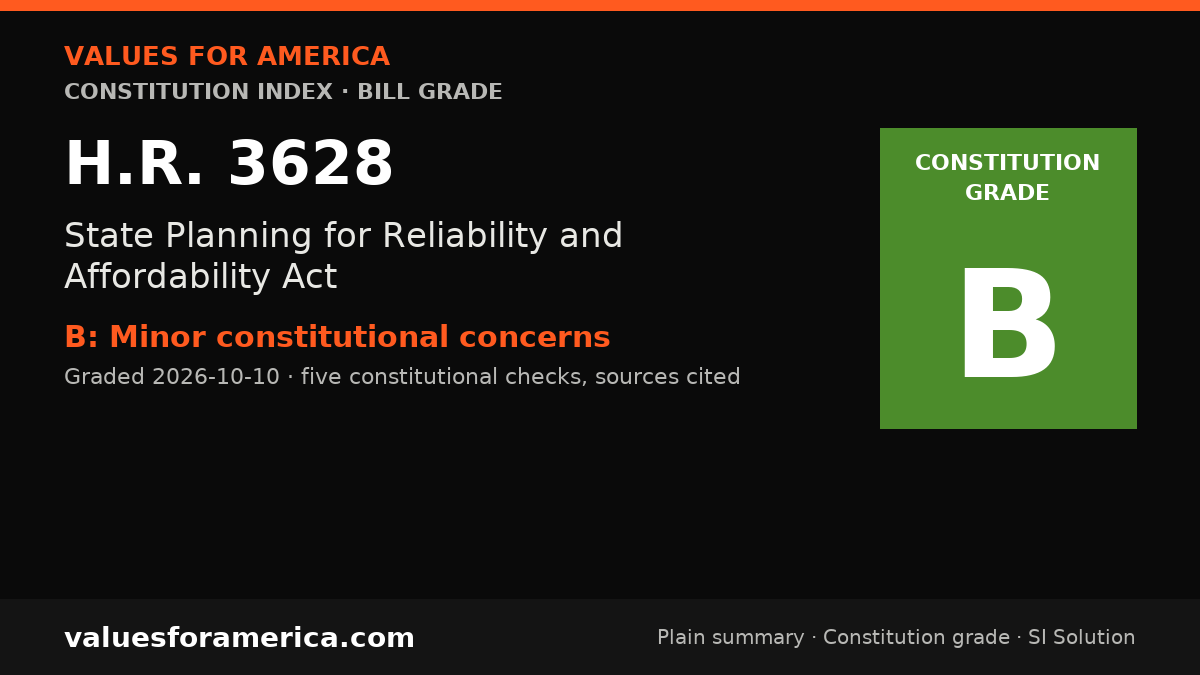
State Planning for Reliability and Affordability Act
Cosponsors: 1 (0 D, 1 R) · per Congress.gov, 2026-10-09
Introduced: 2025-05-29
Latest action (2025-12-15): Received in the Senate and Read twice and referred to the Committee on Energy and Natural Resources.
What H.R. 3628 does, in plain terms
State Planning for Reliability and Affordability Act This bill requires certain state authorities that regulate electric utilities to consider the establishment of measures regarding the reliable availability of electricity over specified time periods. These requirements would apply to electric utilities that use integrated resource plans—plans that project future electricity use to ensure resource adequacy, as opposed to utilities that rely on capacity markets, which use price trends for resource planning. Specifically, the state authorities must consider requiring the integrated resource plans of electric utilities to include measures to ensure the reliable availability of electric energy over a 10-year period to maintain the operation of reliable generation facilities or the procurement of electric energy from reliable generation facilities. The bill defines reliable generation facilities as facilities that enable the generation of electric energy on a continuous basis over a period of not fewer than 30 days; have adequate fuel or a continuously available energy source on-site to enable the continuous generation of electric energy for at least 30 days, or have contractual obligations that achieve the same; have operational characteristics to enable the generation of electric energy during emergency and severe weather conditions; and provide services such as frequency support and voltage support.
Official summary by the Congressional Research Service, via Congress.gov.
Constitution Index
“VFA Constitution grade”
Minor constitutional concerns
Graded 2026-10-10
SI-generated grade · five published checks · not individually reviewed by a person · methodology
The bill is a conditional directive to state utility regulators, not a direct federal mandate on individuals or utilities. It requires states to 'consider' certain reliability measures in integrated resource plans, which is a modest federal nudge within the broad scope of interstate commerce and energy regulation. It does not infringe on individual rights, and it leaves substantial discretion to states. However, it does represent a federal incursion into an area traditionally reserved to the states, and it could be seen as an unnecessary federal layer on state energy policy, warranting a 'B' rather than an 'A'.
-
✓ Passes · Enumerated powers
The federal government has authority over interstate commerce (Article I, Section 8, Clause 3), and electricity generation and reliability have a direct impact on interstate commerce. The bill's requirement that states 'consider' certain measures is a conditional exercise of this power, similar to other federal energy statutes. It does not commandeer state legislatures but conditions state regulat… -
✓ Passes · Bill of Rights
The bill does not implicate any of the first ten amendments. It does not restrict speech, religion, assembly, press, petition, arms, quartering, search and seizure, self-incrimination, due process, takings, trial rights, or cruel and unusual punishment. It is a purely economic/regulatory measure. -
✓ Passes · Individual sovereignty
The bill does not directly restrict individual liberty. It imposes obligations on state authorities and, indirectly, on utilities, but it does not limit what individuals can do with their person, property, or labor. The burden is on the government to justify restrictions, and here there is no direct restriction on individuals. -
✗ Concern · Decentralization
The bill fails the decentralization test because it inserts the federal government into a matter that states and local communities have traditionally handled. While states retain discretion, the federal government is setting the agenda and defining 'reliable generation facilities,' which is a federal consolidation of decision-making. However, it does not fully preempt state authority, so it fails … -
✓ Passes · Due process and takings
The bill does not bypass due process or take property without just compensation. It merely requires state authorities to 'consider' measures, which does not directly affect property rights. Any subsequent state action would be subject to state and federal due process protections.
Sources: Congress.gov: HR 3628 summary
Report an error in this grade
What should pass
“VFA SI Solution”
No solution yet
A sourced SI draft appears here once it passes automated checks (Constitution citation, source verification, independent SI critic). How publication works.
Related on VFA

For journalists and bloggers
“Embed this grade”
Free to use with the link back. The badge and card update when the grade changes. Embed terms →
