H.R. 3620 explained · 119th Congress · Sent to the President
Southcentral Foundation Land Transfer Act of 2025
Cosponsors: none · per Congress.gov, 2026-10-14
Introduced: 2025-05-29
Latest action (2026-10-15): Presented to President.
What H.R. 3620 does, in plain terms
Southcentral Foundation Land Transfer Act of 2025 This bill directs the Department of Health and Human Services (HHS) to convey approximately 3.4 acres in Anchorage, Alaska, to the Southcentral Foundation (SCF) for use in connection with health and social services programs. The conveyance must be made by warranty deed. The conveyance may not (1) require any consideration (such as payment) from the SCF for the property; (2) impose any obligation, term, or condition on the SCF relating to that property; or (3) allow for any U.S. reversionary interest in the property. HHS must be accorded any easement or access to the property as may be reasonably necessary to satisfy any retained obligation or liability of HHS. The bill prohibits the SCF from being liable for certain environmental contamination that occurred on or before the date on which the property is conveyed to the SCF. In turn, HHS may not be liable for any contamination that occurred after the date that the SCF controlled, occupied, and used the property.
Official summary by the Congressional Research Service, via Congress.gov.
Constitution Index
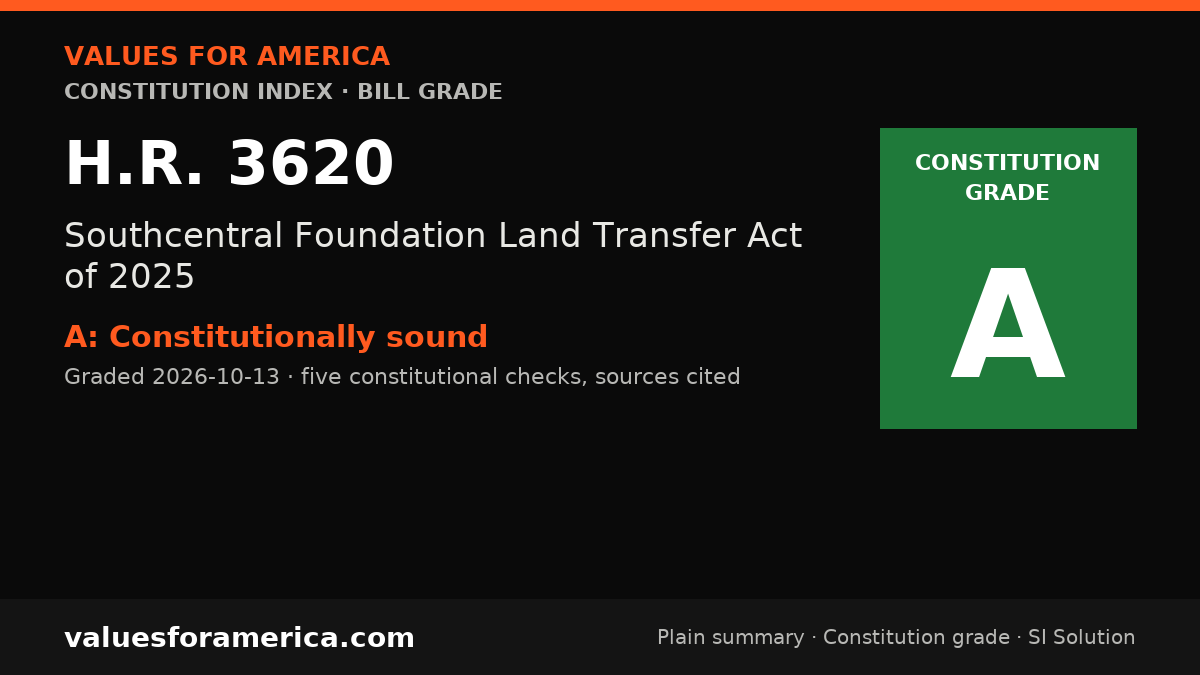
“VFA Constitution grade”
Constitutionally sound
Graded 2026-10-13
SI-generated grade · five published checks · not individually reviewed by a person · methodology
The bill is a narrow, specific land conveyance from the federal government to a private Alaska Native nonprofit for health and social services. It falls within Congress's enumerated power over federal property under Article IV, Section 3, Clause 2, and does not infringe on any constitutional rights. The transfer is a voluntary disposition of federal land, not a taking or a restriction on individual liberty. It does not consolidate power upward; rather, it devolves federal property to a local entity. Due process is satisfied because the bill is a specific legislative act, and the environmental liability provisions are reasonable allocations of risk between the parties.
-
✓ Passes · Enumerated powers
Congress has explicit authority to dispose of federal property under Article IV, Section 3, Clause 2, which grants Congress power to 'dispose of and make all needful Rules and Regulations respecting the Territory or other Property belonging to the United States.' The bill directs the conveyance of a specific parcel of federal land in Alaska, which is a direct exercise of this enumerated power. The… -
✓ Passes · Bill of Rights
The bill does not implicate any of the first ten amendments. It does not restrict speech, religion, assembly, press, petition, arms, quartering, search and seizure, self-incrimination, due process (in a criminal or civil context), takings (it is a voluntary transfer, not a taking), trial rights, or cruel and unusual punishment. The transfer of property to a private entity does not infringe on any … -
✓ Passes · Individual sovereignty
The bill does not restrict any individual's use of their person, property, speech, labor, or belief. It is a voluntary transfer of federal property to a private nonprofit, which enhances the ability of the Southcentral Foundation to provide health and social services. No individual is compelled to do anything, and no property is taken from any private citizen. The bill imposes no restrictions on i… -
✓ Passes · Decentralization
The bill transfers federal property to a local Alaska Native nonprofit, which is a devolution of control from the federal government to a local entity. This does not consolidate decision-making at a higher level; rather, it moves it to a lower level. The individual or family cannot handle this because it involves federal land, but the local community (SCF) can handle the property after transfer. T… -
✓ Passes · Due process and takings
The bill is a specific legislative conveyance, not a taking of private property. It does not deprive any person of life, liberty, or property without due process. The environmental liability provisions are contractual allocations of risk between the federal government and the SCF, which are reasonable and do not deprive either party of property without consent. The bill provides for easements to H…
Sources: Congress.gov: HR 3620 summary
Report an error in this grade
The Framers
“Founders’ Verdict”
Confidence 1.00
SI-generated · automated checksSI-generated · passed automated checks (Constitution citation, source verification, independent SI critic) · not individually reviewed by a person · Report an error: hello@valuesforamerica.com
Synthesis
Article IV, Section 3, Clause 2 grants Congress plenary power to dispose of federal property, and it authorizes this conveyance. The bill passed Congress and was presented to the President on 2026-10-15, not yet signed, and would require conveyance by warranty deed of approximately 3.4 acres in Anchorage, Alaska, to the Southcentral Foundation for use in connection with health and social services programs, without consideration, without imposed obligation, term, or condition, and without any United States reversionary interest, while preserving necessary HHS easement or access and dividing environmental liability for contamination on or before conveyance versus after the Foundation controlled, occupied, and used the property. That disposition with needful rules falls squarely within the enumerated power to dispose of and make all needful rules respecting property belonging to the United States, respecting federalism by ending rather than extending federal administration. The strongest objection is that conveyance without payment, condition, or reversion surrenders supervision and wastes public resources. The answer is that generosity does not defeat legality: where the end is legitimate, appropriate means adapted to it are constitutional, and wisdom of terms belongs to the legislature. Conservatives gain limited government and fiscal clarity through transfer out of federal hands; progressives gain sustained health and social services for the community served.
As SI analysis describes this measure, Congress directs disposition of a small parcel of federal property to support health and social services. Article IV, Section 3, Clause 2 grants Congress power to dispose of and make all needful rules respecting property belonging to the United States, which plainly encompasses conveyance by warranty deed of 3.4 acres in Anchorage. Article I, Section 8, Clause 1 further supports provision for the general welfare through health services, as expounded in Federalist No. 34 and Federalist No. 32 on the concurrent yet supreme operation of federal powers where …
Under Article IV, Section 3, Congress holds power to dispose of property belonging to the United States, and this conveyance of 3.4 acres in Anchorage for health and social services falls within that enumerated authority. Under Amendment X, powers not delegated remain reserved, yet disposal of federal land is expressly delegated, so no reserved state authority is invaded. Under Amendment V, no taking of private property occurs, as the property passes from the United States by warranty deed without seizure. The grant without payment or reversion is improvident perhaps, but strict construction d…
The power to dispose of territory and other property belonging to the United States is expressly enumerated, and this conveyance exercises that power for a defined public object connected to health and social services. Under the principle of enumerated powers explained in Federalist No. 44 and the division between general and state concerns in Federalist No. 45, a limited transfer of 3.4 acres by warranty deed, without reservation of general regulatory authority, respects federalism by removing rather than extending federal administration. The allocation of liability before and after transfer …
The official summary states that the measure directs conveyance of a small parcel held by the United States to the Southcentral Foundation for health and social services. By Article IV, Section 3, Clause 2, the legislature is granted power to dispose of and make all needful rules respecting the territory or other property belonging to the United States. That power is plenary as to disposition, encompassing sale, grant, and conveyance upon such terms as the legislature deems conducive to the public good. As expounded in McCulloch v. Maryland, where the end is legitimate and within the scope of …
Report an error in this Founders' Verdict
What should pass
“VFA SI Solution”
No solution yet
A sourced SI draft appears here once it passes automated checks (Constitution citation, source verification, independent SI critic). How publication works.
Related on VFA

For journalists and bloggers
“Embed this grade”
Free to use with the link back. The badge and card update when the grade changes. Embed terms →
