H.R. 359 explained · 119th Congress · Pending in Congress
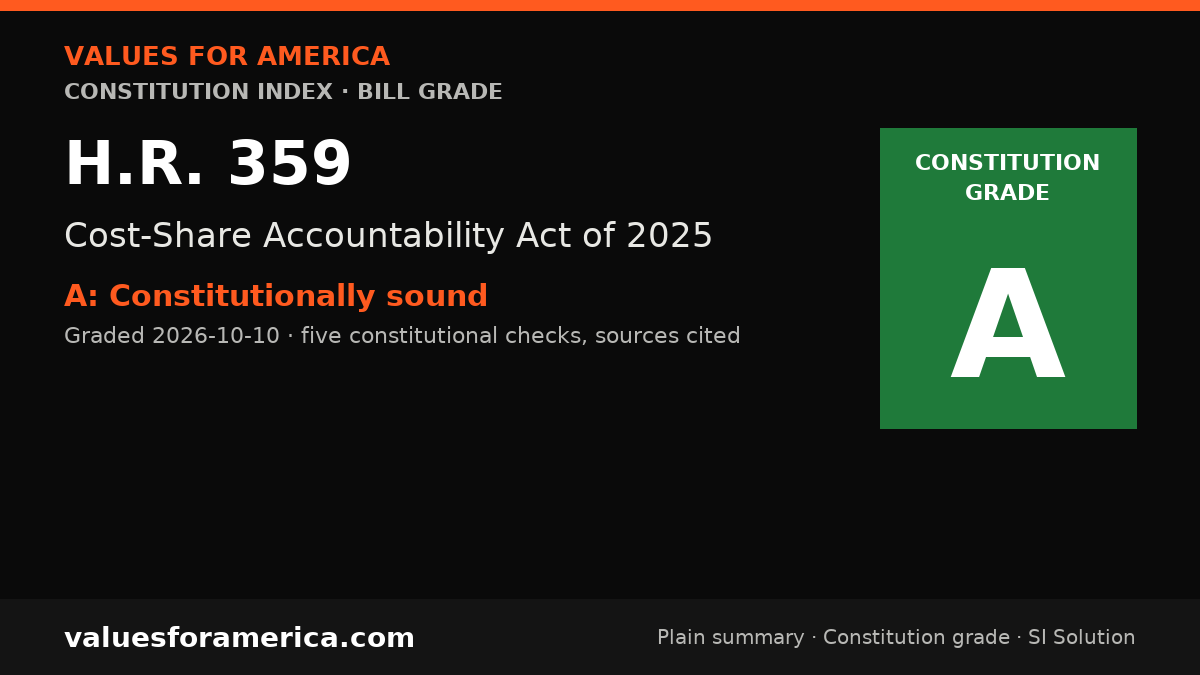
Cost-Share Accountability Act of 2025
Cosponsors: 1 (1 D, 0 R) · per Congress.gov, 2026-10-12
Introduced: 2025-01-13
Latest action (2025-03-25): Received in the Senate and Read twice and referred to the Committee on Energy and Natural Resources.
What H.R. 359 does, in plain terms
Cost-Share Accountability Act of 2025 This bill requires the Department of Energy (DOE) to report on the use of its authority to reduce or eliminate the nonfederal cost-sharing requirements for federally-funded projects regarding research, development, demonstration, and commercial application activities under the Energy Policy Act of 2005. DOE must submit a report within 120 days of the enactment of this bill and at least quarterly thereafter.
Official summary by the Congressional Research Service, via Congress.gov.
Constitution Index
“VFA Constitution grade”
Constitutionally sound
Graded 2026-10-10
SI-generated grade · five published checks · not individually reviewed by a person · methodology
This bill is a routine congressional oversight measure requiring the Department of Energy to report on its use of existing authority to waive cost-sharing requirements. It does not expand federal power, restrict rights, or consolidate decision-making. It is fully consistent with the Constitution.
-
✓ Passes · Enumerated powers
Congress has the enumerated power to legislate regarding energy policy under the Commerce Clause (Article I, Section 8, Clause 3) and the Spending Clause (Article I, Section 8, Clause 1). The bill merely requires reporting on the use of existing authority under the Energy Policy Act of 2005, which is within Congress's power to oversee the execution of laws it has enacted. No new substantive author… -
✓ Passes · Bill of Rights
The bill imposes no restriction on speech, religion, press, assembly, petition, arms, quartering, search and seizure, self-incrimination, due process, trial by jury, or cruel and unusual punishment. It is a reporting requirement on a federal agency and does not implicate any provision of the Bill of Rights. -
✓ Passes · Individual sovereignty
The bill does not restrict any individual's use of their person, property, speech, labor, or belief. It merely requires a federal agency to report on its waiver authority. No individual is compelled to act or refrain from acting. The burden of government justification is not triggered because no individual liberty is affected. -
✓ Passes · Decentralization
The bill does not consolidate decision-making at a higher level of government. It is a federal oversight measure over a federal program that already exists. The reporting requirement does not shift authority from individuals, local communities, or states to the federal government. It simply provides transparency regarding existing federal discretion. -
✓ Passes · Due process and takings
The bill does not deprive any person of life, liberty, or property, nor does it take private property for public use. It imposes no penalty and requires no adjudication. It is a straightforward reporting requirement that does not implicate the Due Process Clause of the Fifth Amendment or the Takings Clause.
Sources: Congress.gov: HR 359 summary
Report an error in this grade
What should pass
“VFA SI Solution”
No solution yet
A sourced SI draft appears here once it passes automated checks (Constitution citation, source verification, independent SI critic). How publication works.
Related on VFA

For journalists and bloggers
“Embed this grade”
Free to use with the link back. The badge and card update when the grade changes. Embed terms →
