H.R. 35 explained · 119th Congress · Pending in Congress
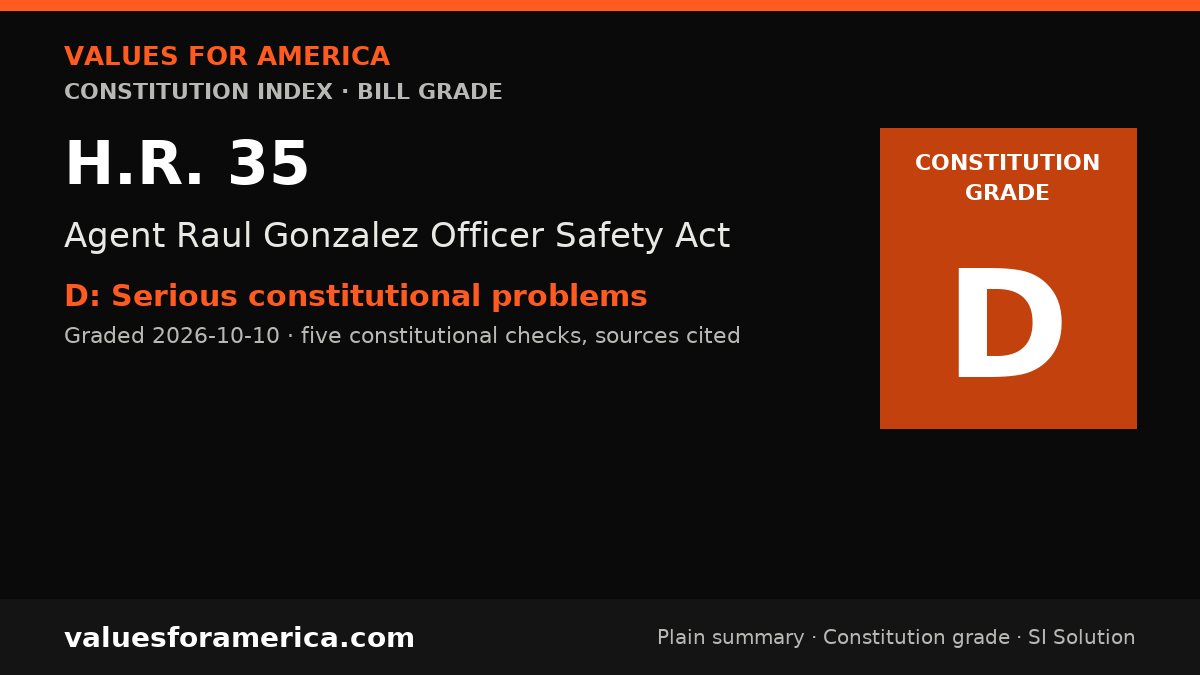
Agent Raul Gonzalez Officer Safety Act
Cosponsors: 32 (0 D, 32 R) · per Congress.gov, 2026-10-12
Introduced: 2025-01-03
Latest action (2025-02-13): Received in the Senate and Read twice and referred to the Committee on the Judiciary.
What H.R. 35 does, in plain terms
Agent Raul Gonzalez Officer Safety Act This bill establishes new federal criminal offenses for operating a motor vehicle within 100 miles of the U.S. border while fleeing from a U.S. Border Patrol agent or a federal, state, or local law enforcement officer who is actively assisting or under the command of the U.S. Border Patrol. The bill establishes criminal penalties for an offense, including a mandatory minimum prison term for an offense resulting in death or serious bodily injury. Additionally, a non-U.S. national who is convicted of or admits to committing an offense is inadmissible, deportable, and ineligible for immigration relief (including asylum).
Official summary by the Congressional Research Service, via Congress.gov.
Constitution Index
“VFA Constitution grade”
Serious constitutional problems
Graded 2026-10-10
SI-generated grade · five published checks · not individually reviewed by a person · methodology
This bill likely violates the Constitution by exceeding federal enumerated powers, infringing on the Tenth Amendment, and undermining due process and individual sovereignty. The creation of a 100-mile federal criminal zone and mandatory immigration penalties for fleeing from law enforcement within that zone represents a significant federal overreach into areas traditionally reserved to the states, and imposes punitive measures without adequate procedural safeguards.
-
✗ Concern · Enumerated powers
The bill creates new federal criminal offenses for fleeing from law enforcement within 100 miles of the U.S. border. While the federal government has broad authority over immigration and border security under Article I, Section 8, Clause 4 (Naturalization) and the plenary power doctrine, this bill criminalizes conduct that is not inherently tied to immigration or border crossing. Fleeing from law … -
✗ Concern · Bill of Rights
The bill violates the Fourth Amendment by creating a de facto 'border zone' where fleeing from law enforcement triggers federal criminal penalties. The Fourth Amendment protects against unreasonable searches and seizures, and the Supreme Court has recognized a 'border search exception' only at actual border crossings (see *United States v. Flores-Montano*, 541 U.S. 149 (2004)). Extending this exce… -
✗ Concern · Individual sovereignty
The bill restricts an individual's freedom to operate a motor vehicle without being subject to federal criminal prosecution for fleeing from law enforcement within a 100-mile zone. While fleeing from law enforcement is not a protected right, the government must justify the restriction with a compelling interest. Here, the government's interest in border security is legitimate, but the bill's broad… -
✗ Concern · Decentralization
The bill fails the decentralization test on multiple counts. (1) An individual or family cannot handle fleeing from law enforcement on their own; this is a matter for government. (2) A local community or county could handle fleeing from law enforcement without state involvement, as this is a routine local policing matter. (3) A state could handle this without federal involvement, as states have th… -
✗ Concern · Due process and takings
The bill violates the Fifth Amendment's Due Process Clause by making non-U.S. nationals inadmissible, deportable, and ineligible for immigration relief (including asylum) upon conviction or admission of the offense. This imposes a severe penalty (deportation, loss of asylum eligibility) without a full and fair hearing on the underlying conduct. The bill also creates a mandatory minimum prison term…
Sources: Congress.gov: HR 35 summary
Report an error in this grade
What should pass
“VFA SI Solution”
No solution yet
A sourced SI draft appears here once it passes automated checks (Constitution citation, source verification, independent SI critic). How publication works.
Related on VFA

For journalists and bloggers
“Embed this grade”
Free to use with the link back. The badge and card update when the grade changes. Embed terms →
