H.R. 3492 explained · 119th Congress · Pending in Congress
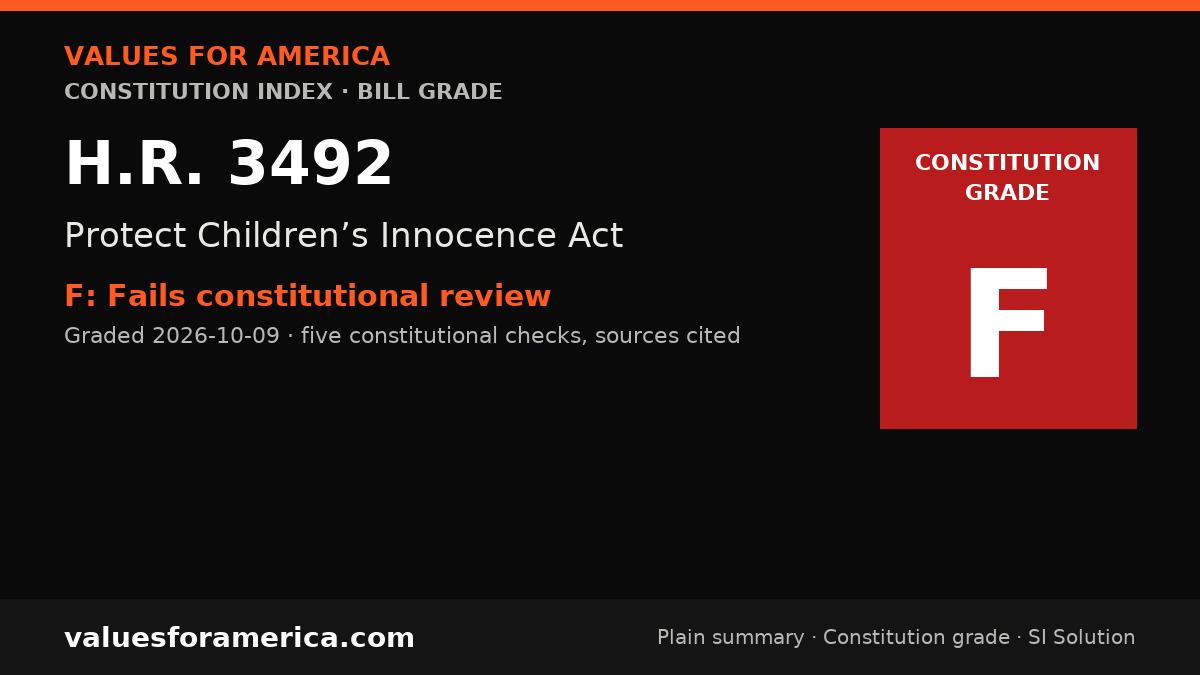
Protect Children’s Innocence Act
Cosponsors: 44 (0 D, 44 R) · per Congress.gov, 2026-10-09
Introduced: 2025-05-19
Latest action (2025-12-18): Received in the Senate and Read twice and referred to the Committee on the Judiciary.
What H.R. 3492 does, in plain terms
Protect Children’s Innocence Act of 2025 This bill establishes federal criminal offenses for providing gender-affirming care to minors. The bill also changes the existing federal criminal offense that prohibits female genital mutilation (FGM) and related conduct. Specifically, the bill makes it a federal crime to knowingly perform or attempt to perform procedures or provide medications (e.g., hormonal treatments) to a minor for the purpose of changing their body to correspond to a sex that differs from their biological sex. The bill provides exceptions for specified types of surgeries or procedures, including those for treating (1) individuals who have both ovarian and testicular tissue or abnormal sex chromosome structure or hormones, or (2) infections or other harms that result from a previous gender-transition procedure. A violation is punishable by a fine, a prison term of up to 10 years, or both. The bill prohibits the arrest or prosecution of an individual who undergoes gender-affirming procedures or medications. Additionally, the bill makes changes to the existing federal criminal prohibition on performing FGM on a minor and related conduct. Among the changes, the bill broadens the scope of prohibited conduct to include the facilitation or consent to FGM by any person (currently, prohibited facilitation or consent applies only to a parent, guardian, or caretaker of the minor). The bill also prohibits the arrest or prosecution of an individual who undergoes FGM. The bill does not change the applicable criminal penalty of a fine, a prison term of up to 10 years, or both.
Official summary by the Congressional Research Service, via Congress.gov.
Constitution Index
“VFA Constitution grade”
Fails constitutional review
Graded 2026-10-09
SI-generated grade · five published checks · not individually reviewed by a person · methodology
HR 3492 exceeds Congress's enumerated powers by criminalizing purely local medical care without any interstate-commerce jurisdictional element, violates the Tenth Amendment, and intrudes on fundamental parental and individual liberty interests protected by the Due Process Clause. The bill's federalization of gender-affirming-care decisions cannot be justified by a federal interest, and the lack of a jurisdictional hook makes the offense unconstitutional on its face.
-
✗ Concern · Enumerated powers
Article I, Section 8 does not grant Congress a general police power. The bill creates a federal crime for providing gender-affirming care to minors, but the Congress.gov summary contains no jurisdictional element connecting the offense to interstate commerce, federal enclaves, or federal instrumentalities. Under United States v. Lopez (1995) and United States v. Morrison (2000), Congress may regul… -
✗ Concern · Bill of Rights
The Fifth Amendment's Due Process Clause protects fundamental liberty interests, including parents' rights to direct the upbringing and medical care of their children (Meyer v. Nebraska, 1923; Pierce v. Society of Sisters, 1925; Troxel v. Granville, 2000). HR 3492 criminalizes doctors for providing medically recognized care to minors with parental consent, overriding those family decisions without… -
✗ Concern · Individual sovereignty
This bill restricts what families and physicians may do with their own bodies, labor, and judgment. It prevents a patient from obtaining care and a doctor from providing it, solely because the treatment relates to gender transition. The government bears the burden to justify such a restriction with a compelling constitutional justification. While states may regulate medical practice within their p… -
✗ Concern · Decentralization
The bill fails all four questions. Families and doctors can decide medical matters through informed consent; local communities and states are fully capable of regulating or prohibiting medical procedures within their borders; and no federal interest is shown that would require a national criminal statute. The effect is to consolidate decision-making at the federal level and to directly violate the… -
✗ Concern · Due process and takings
The bill provides fair notice of the prohibited conduct and does not shift the presumption of innocence, but it fails substantive due process review. It substantially deprives families and patients of liberty interests without the compelling justification that strict scrutiny requires. Because the statute rests on no enumerated federal power and operates as an arbitrary federal police-power enactm…
Sources: Congress.gov: HR 3492 summary
Report an error in this grade
What should pass
“VFA SI Solution”
No solution yet
A sourced SI draft appears here once it passes automated checks (Constitution citation, source verification, independent SI critic). How publication works.
Related on VFA

For journalists and bloggers
“Embed this grade”
Free to use with the link back. The badge and card update when the grade changes. Embed terms →
