H.R. 3490 explained · 119th Congress · Became law
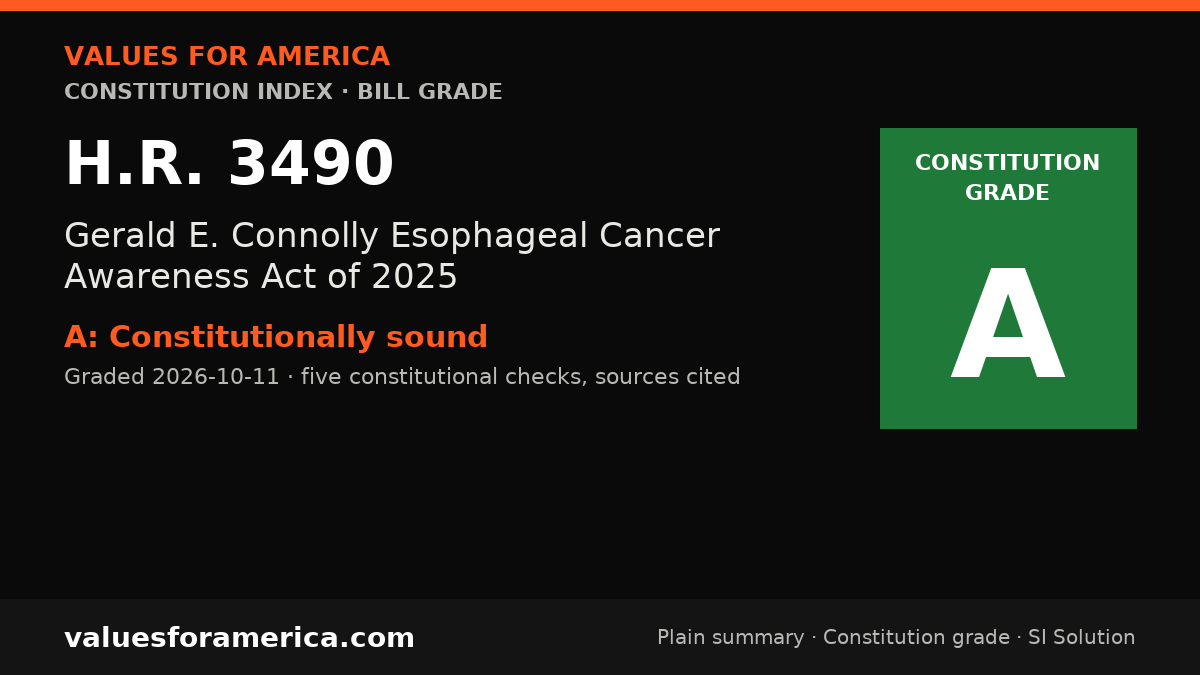
Gerald E. Connolly Esophageal Cancer Awareness Act of 2025
Cosponsors: 1 (0 D, 1 R) · per Congress.gov, 2026-10-10
Introduced: 2025-05-19
Latest action (2026-06-09): Became Public Law No: 119-96.
What H.R. 3490 does, in plain terms
Esophageal Cancer Awareness Act This bill requires the Government Accountability Office to report to Congress on (1) the impact of esophageal cancer-related health care spending under the Federal Employees Health Benefits Program (FEHBP) for federal employees and retirees diagnosed with esophageal cancer, and (2) how often FEHBP participants with a high risk of esophageal cancer undergo screenings according to established guidelines.
Official summary by the Congressional Research Service, via Congress.gov.
Constitution Index
“VFA Constitution grade”
Constitutionally sound
Graded 2026-10-11
SI-generated grade · five published checks · not individually reviewed by a person · methodology
This bill is a routine congressional oversight measure directing the Government Accountability Office to study and report on federal employee health benefits spending and screening practices. It does not expand federal regulatory power, restrict individual rights, or take property. It is fully within Congress's enumerated powers and respects federalism by merely gathering information for legislative purposes.
-
✓ Passes · Enumerated powers
Congress has broad authority under Article I, Section 8 to provide for the general welfare and to manage federal employee compensation and benefits. The Federal Employees Health Benefits Program is a federal program, and Congress's power to oversee and legislate on its operation is inherent in its spending and appropriations powers. Requiring a report from the Government Accountability Office is a… -
✓ Passes · Bill of Rights
The bill imposes no restrictions on speech, religion, assembly, press, petition, arms, quartering, search and seizure, self-incrimination, due process, trial rights, or cruel and unusual punishment. It merely mandates a study and report, which does not implicate any provision of the Bill of Rights. -
✓ Passes · Individual sovereignty
The bill does not restrict any individual's use of their person, property, speech, labor, or belief. It imposes no mandates on private citizens or federal employees; it only directs a government agency to collect and report data. There is no burden on individual freedom. -
✓ Passes · Decentralization
This is a federal action concerning a federal program (FEHBP). The questions are answered as follows: (1) Individuals cannot handle this because it involves aggregate federal program data and oversight; (2) local communities cannot handle this because it is a federal program; (3) states cannot handle this because FEHBP is a federal program; (4) the action does not consolidate decision-making upwar… -
✓ Passes · Due process and takings
The bill does not deprive any person of life, liberty, or property, nor does it take private property for public use. It requires no hearing, but none is needed because it imposes no penalty or deprivation. It is a purely informational mandate with no due process or takings implications.
Sources: Congress.gov: HR 3490 summary
Report an error in this grade
What should pass
“VFA SI Solution”
No solution yet
A sourced SI draft appears here once it passes automated checks (Constitution citation, source verification, independent SI critic). How publication works.
Related on VFA

For journalists and bloggers
“Embed this grade”
Free to use with the link back. The badge and card update when the grade changes. Embed terms →
