H.R. 3486 explained · 119th Congress · Pending in Congress
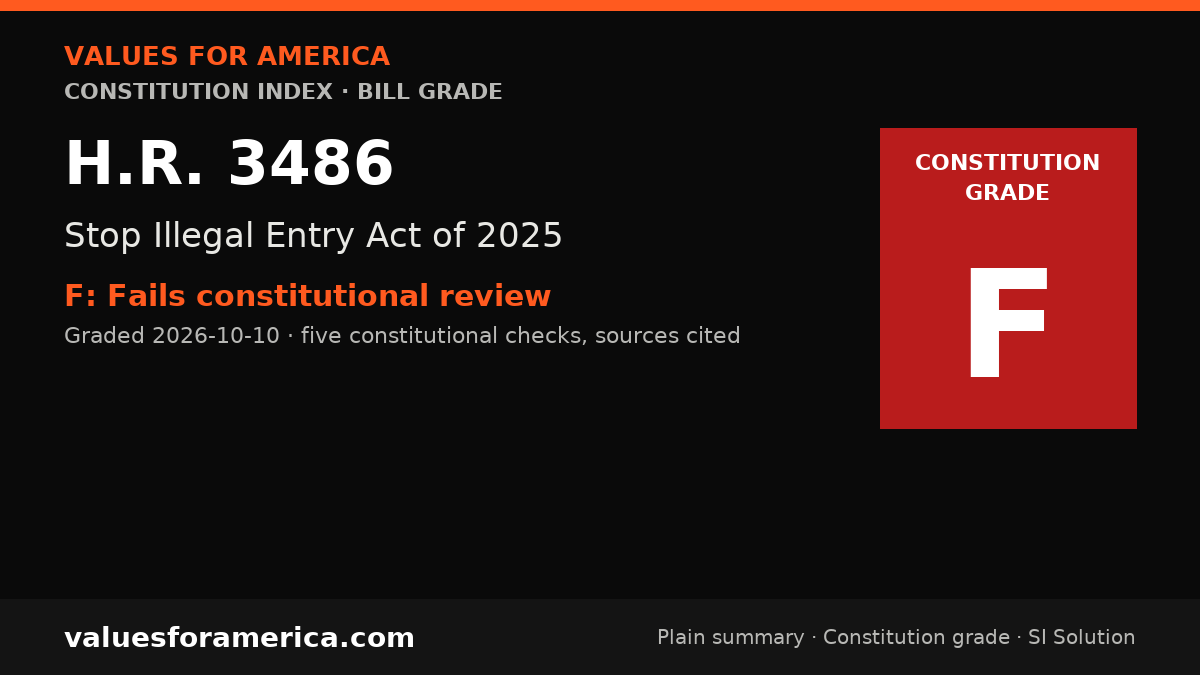
Stop Illegal Entry Act of 2025
Cosponsors: 5 (0 D, 5 R) · per Congress.gov, 2026-10-10
Introduced: 2025-05-19
Latest action (2025-09-15): Received in the Senate.
What H.R. 3486 does, in plain terms
Stop Illegal Reentry Act This bill establishes or increases criminal penalties for certain non-U.S. nationals (aliens under federal law) who illegally enter the United States and then commit a felony or illegally reenter the United States. The bill establishes a mandatory minimum prison term of 5 years and allows a life sentence for an individual who (1) improperly enters, or attempts to improperly enter, the United States; and (2) is subsequently convicted of a felony. The bill increases the maximum term of imprisonment from 2 years to 5 years for repeated improper entry. The bill also increases from 2 years to 10 years the maximum term of imprisonment for an individual who had been denied entry into or removed from the United States and who later enters or attempts to enter without prior approval. The bill increases the maximum term of imprisonment from 10 to 15 years if such an individual was convicted of three or more specified types of misdemeanors before removal. An individual who had been denied entry or removed three or more times and who later enters or attempts to enter the United States shall be fined, imprisoned for up to 10 years, or both. The bill establishes a mandatory minimum term of imprisonment of 10 years and allows a life sentence for an individual who was convicted of a felony before removal, or convicted of illegal reentry at least two times before removal, and who subsequently enters or tries to enter the United States.
Official summary by the Congressional Research Service, via Congress.gov.
Constitution Index
“VFA Constitution grade”
Fails constitutional review
Graded 2026-10-10
SI-generated grade · five published checks · not individually reviewed by a person · methodology
This bill violates multiple constitutional protections, including the Eighth Amendment's prohibition on cruel and unusual punishment, the Fifth Amendment's due process guarantees, and the Tenth Amendment's reservation of powers to the states. It imposes mandatory life sentences for immigration violations, which are civil or administrative matters, not crimes that warrant such extreme penalties. The bill also overrides state authority over local law enforcement and criminal justice, consolidating power at the federal level without constitutional justification.
-
✗ Concern · Enumerated powers
The federal government has authority over naturalization and immigration under Article I, Section 8, Clause 4, but this bill goes beyond regulating entry and removal by imposing criminal penalties that are punitive rather than regulatory. The power to define and punish felonies is not an enumerated federal power; it is reserved to the states under the Tenth Amendment. The bill's mandatory life sen… -
✗ Concern · Bill of Rights
The bill violates the Eighth Amendment by mandating life imprisonment for nonviolent immigration offenses, which is grossly disproportionate to the offense. The Supreme Court has held that the Eighth Amendment prohibits extreme sentences that are disproportionate to the crime (Solem v. Helm, 463 U.S. 277 (1983)). Additionally, the bill's mandatory minimum sentences for reentry after a prior felony… -
✗ Concern · Individual sovereignty
The bill severely restricts individual liberty by imposing life sentences for entering the country without authorization, even when no violent crime is committed. This infringes on the fundamental right to freedom from excessive government punishment. The government has not provided a compelling justification for such extreme penalties, as immigration violations are not inherently violent or threa… -
✗ Concern · Decentralization
The bill fails all four decentralization questions. (1) Individuals cannot handle federal immigration enforcement on their own. (2) Local communities cannot handle federal immigration law. (3) States have traditionally handled criminal law, including felony definitions and sentencing, but this bill federalizes those areas. (4) The bill consolidates decision-making at the federal level by imposing … -
✗ Concern · Due process and takings
The bill violates procedural due process under the Fifth Amendment by imposing mandatory minimum sentences without individualized consideration of the circumstances of the offense or the offender. The Supreme Court has held that mandatory life sentences without parole for juveniles violate the Eighth Amendment (Miller v. Alabama, 567 U.S. 460 (2012)), and similar reasoning applies to nonviolent ad…
Sources: Congress.gov: HR 3486 summary
Report an error in this grade
What should pass
“VFA SI Solution”
No solution yet
A sourced SI draft appears here once it passes automated checks (Constitution citation, source verification, independent SI critic). How publication works.
Related on VFA

For journalists and bloggers
“Embed this grade”
Free to use with the link back. The badge and card update when the grade changes. Embed terms →
