H.R. 3400 explained · 119th Congress · Pending in Congress
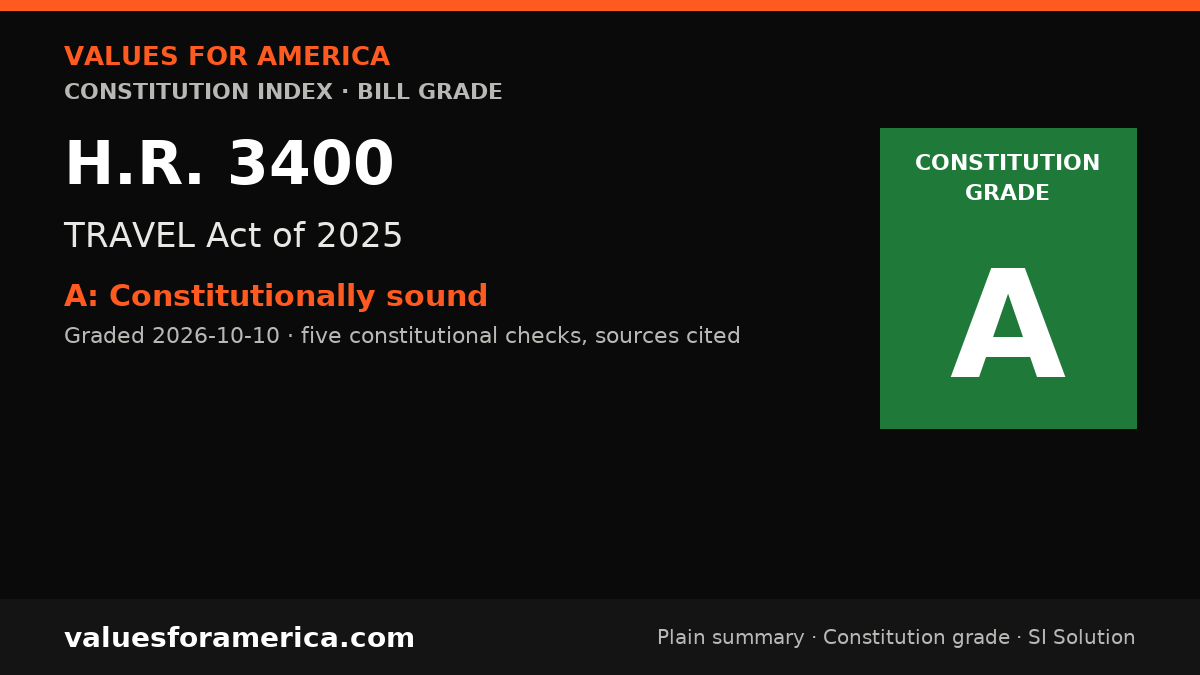
TRAVEL Act of 2025
Cosponsors: 12 (9 D, 3 R) · per Congress.gov, 2026-10-10
Introduced: 2025-05-14
Latest action (2025-09-16): Received in the Senate and Read twice and referred to the Committee on Veterans' Affairs.
What H.R. 3400 does, in plain terms
The Territorial Response and Access to Veterans' Essential Lifecare Act or the TRAVEL Act of 2025 This bill authorizes the Department of Veterans Affairs (VA) to assign a physician who has been appointed in the Veterans Health Administration to serve as a traveling physician for a period of not more than one year. Such physician must provide health care to veterans at VA facilities located in American Samoa, Guam, the Northern Mariana Islands, Puerto Rico, the U.S. Virgin Islands, and any other territory or possession of the United States. Traveling physicians must coordinate with non-VA providers when necessary to ensure high quality and coordinated care for veterans receiving hospital care and medical services. The VA must provide a relocation or retention bonus to traveling physicians.
Official summary by the Congressional Research Service, via Congress.gov.
Constitution Index
“VFA Constitution grade”
Constitutionally sound
Graded 2026-10-10
SI-generated grade · five published checks · not individually reviewed by a person · methodology
The TRAVEL Act of 2025 is a straightforward exercise of Congress's enumerated power to provide for the common defense and to raise and support armies, as well as its authority over federal property and territories. It does not infringe on any constitutional right, does not restrict individual sovereignty, and does not centralize authority beyond the federal level—indeed, it addresses a federal responsibility (veterans' health care) that cannot be handled by individuals, localities, or states alone. The bill also respects due process and property rights, as it only authorizes voluntary assignments and bonuses for VA physicians.
-
✓ Passes · Enumerated powers
Congress has explicit authority under Article I, Section 8, Clause 12 to 'raise and support Armies' and under Clause 14 to 'make Rules for the Government and Regulation of the land and naval Forces.' Providing health care to veterans is a direct incident of this power, as veterans are former members of the armed forces. Additionally, Congress has plenary authority over U.S. territories under Artic… -
✓ Passes · Bill of Rights
The bill does not implicate any of the first ten amendments. It does not restrict speech, religion, assembly, press, petition, arms, quartering, search and seizure, self-incrimination, due process, takings, trial rights, or cruel and unusual punishment. It is a purely administrative measure regarding the assignment of federal employees to provide health care. -
✓ Passes · Individual sovereignty
The bill imposes no restrictions on individual liberty. It authorizes the VA to assign physicians, but these are voluntary federal employees who have already consented to serve in the VA. The bill does not compel any private citizen to act or refrain from acting. It only facilitates the provision of health care to veterans, which is a benefit, not a burden. -
✓ Passes · Decentralization
The four-question test: (1) Individuals or families cannot handle the provision of comprehensive veterans' health care on their own—this is a complex federal program. (2) Local communities cannot handle the health care needs of veterans across multiple territories—this requires a nationwide system. (3) States cannot handle this without federal involvement because the territories are not states and… -
✓ Passes · Due process and takings
The bill does not deprive any person of life, liberty, or property without due process. It does not take private property for public use without just compensation. It only authorizes the assignment of federal employees and the payment of bonuses, which are voluntary and contractual in nature. There is no arbitrary government action; the bill is a clear, statutory authorization.
Sources: Congress.gov: HR 3400 summary
Report an error in this grade
What should pass
“VFA SI Solution”
No solution yet
A sourced SI draft appears here once it passes automated checks (Constitution citation, source verification, independent SI critic). How publication works.
Related on VFA

For journalists and bloggers
“Embed this grade”
Free to use with the link back. The badge and card update when the grade changes. Embed terms →
