H.R. 3383 explained · 119th Congress · Pending in Congress
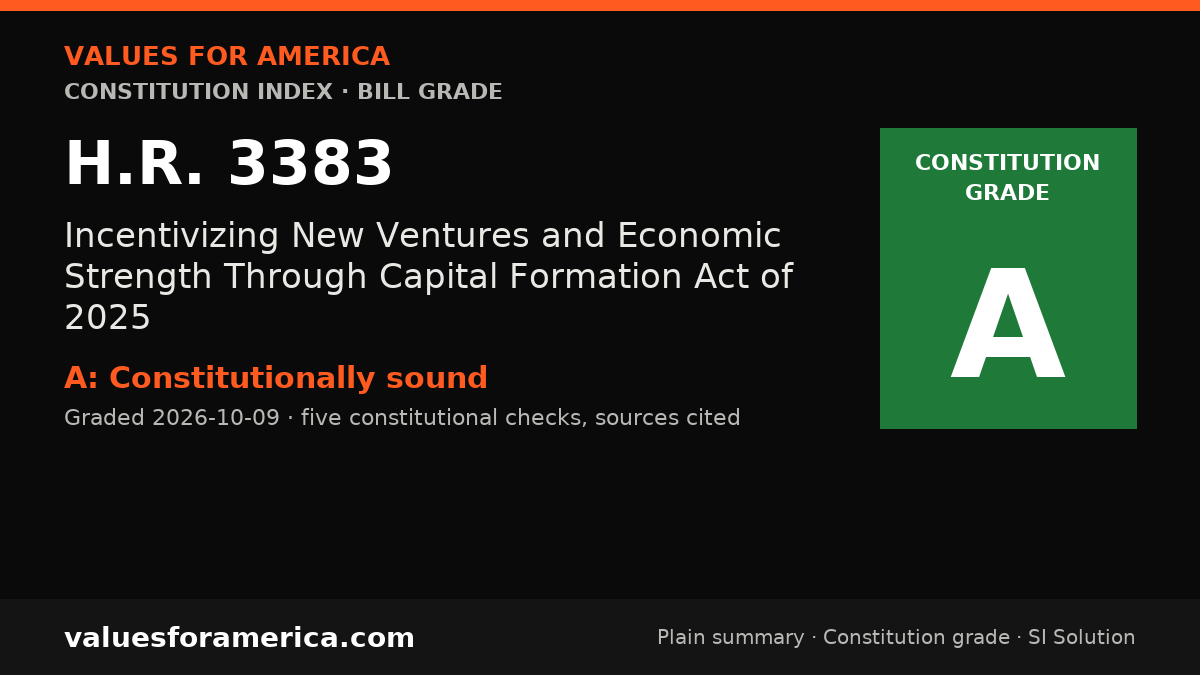
Incentivizing New Ventures and Economic Strength Through Capital Formation Act of 2025
Cosponsors: 4 (3 D, 1 R) · per Congress.gov, 2026-10-09
Introduced: 2025-05-14
Latest action (2025-12-15): Received in the Senate and Read twice and referred to the Committee on Banking, Housing, and Urban Affairs.
What H.R. 3383 does, in plain terms
Increasing Investor Opportunities Act This bill allows a closed-end fund—a portfolio of pooled assets with a limited number of shares traded on an exchange—to increase its investment in private investment funds. Specifically, the Securities and Exchange Commission is prohibited from limiting the sale or listing of securities of a closed-end fund that invests in private investment funds. This bill also apples to a closed-end company treated as a business development company.
Official summary by the Congressional Research Service, via Congress.gov.
Constitution Index
“VFA Constitution grade”
Constitutionally sound
Graded 2026-10-09
SI-generated grade · five published checks · not individually reviewed by a person · methodology
The bill is constitutional. Congress has authority over interstate securities markets under the Commerce Clause, and this bill simply limits the SEC's discretion rather than expanding federal power. It does not restrict constitutional rights, centralize authority, or raise due process or takings concerns.
-
✓ Passes · Enumerated powers
Congress has express authority to regulate interstate commerce under Article I, Section 8, Clause 3. The sale and listing of securities on national exchanges and the operation of investment funds are interstate commercial activities. This bill is a valid exercise of that power. -
✓ Passes · Bill of Rights
The bill does not infringe any provision of the Bill of Rights. It does not regulate speech, religion, assembly, press, petition, arms, quartering, searches, seizures, criminal procedure, or punishment. It creates no new government intrusion into individual liberty. -
✓ Passes · Individual sovereignty
The bill removes a federal restriction on investment choices, allowing closed-end funds and investors more freedom to direct their capital. It does not restrict what a person may do with their person, property, or labor; it expands economic liberty. -
✓ Passes · Decentralization
This bill does not consolidate decision-making at a higher level of government. It reduces federal regulatory control by prohibiting the SEC from imposing certain limits. It does not preempt state securities law or commandeer state officials, and it leaves more room for private investment decisions. -
✓ Passes · Due process and takings
The bill does not deprive anyone of life, liberty, or property without due process. It imposes no fines, forfeitures, or new liabilities, and it does not take private property for public use. No Fifth Amendment concern is present.
Sources: Congress.gov: HR 3383 summary
Report an error in this grade
What should pass
“VFA SI Solution”
No solution yet
A sourced SI draft appears here once it passes automated checks (Constitution citation, source verification, independent SI critic). How publication works.
Related on VFA

For journalists and bloggers
“Embed this grade”
Free to use with the link back. The badge and card update when the grade changes. Embed terms →
