H.R. 331 explained · 119th Congress · Pending in Congress
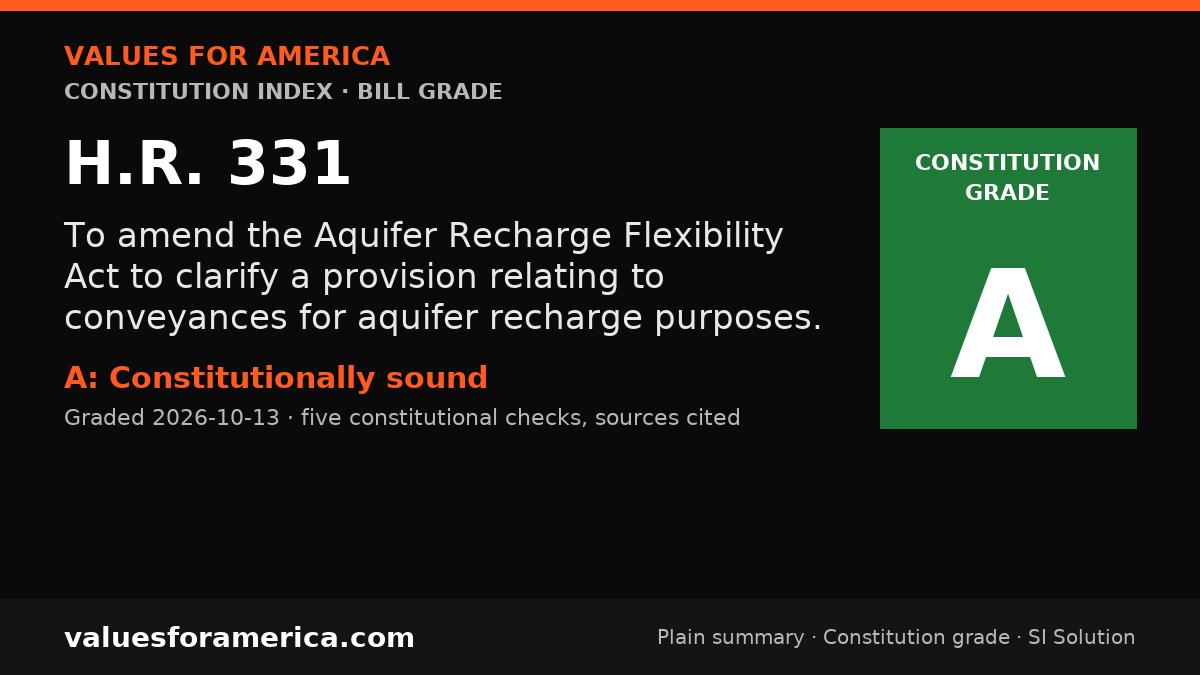
To amend the Aquifer Recharge Flexibility Act to clarify a provision relating to conveyances for aquifer recharge purposes.
Cosponsors: 1 (0 D, 1 R) · per Congress.gov, 2026-10-14
Introduced: 2025-01-13
Latest action (2026-09-30): Committee on Energy and Natural Resources. Ordered to be reported without amendment favorably.
What H.R. 331 does, in plain terms
This bill modifies the Aquifer Recharge Flexibility Act to expand provisions concerning authorizations (e.g., rights-of-way) to transport water across public land administered by the Bureau of Land Management (BLM) for aquifer recharge purposes. Under the Aquifer Recharge Flexibility Act, the holder of existing rights-of-way, easements, permits, or other authorizations to transport water across BLM land may transport the water for aquifer recharge purposes without additional authorization from the Department of the Interior so long as the use does not expand or modify the operation of such authorizations across public land. The bill allows the holders of such authorizations to act not only on behalf of themselves, but also on behalf of states, Indian Tribes, or public entities, to use the existing authorizations for aquifer recharge without additional authorization from the Department of the Interior. Further, the bill states that this use may not be considered an expansion, modification, major federal action, or substantial deviation. Additionally, the bill exempts holders from paying additional rents to the BLM for any use of such authorizations; however, the exemption does not apply to for-profit uses of aquifer recharge or for-profit entities. Finally, holders of rights-of-way or other authorizations must provide notice to the BLM of the intended use of authorization as specified by the bill.
Official summary by the Congressional Research Service, via Congress.gov.
Constitution Index
“VFA Constitution grade”
Constitutionally sound
Graded 2026-10-13
SI-generated grade · five published checks · not individually reviewed by a person · methodology
This bill is fully constitutional. It operates within Congress's enumerated property powers, does not infringe any Bill of Rights protections, respects individual sovereignty by facilitating voluntary water management, passes all four decentralization questions, and does not violate due process or takings protections.
-
✓ Passes · Enumerated powers
Congress has explicit authority under Article I, Section 8, Clause 17 to exercise exclusive legislation over federal property, and under the Property Clause (Article IV, Section 3, Clause 2) to make rules governing public lands. This bill merely clarifies existing rights-of-way and authorizations on BLM land, which falls squarely within Congress's enumerated power to manage federal property. It do… -
✓ Passes · Bill of Rights
The bill does not restrict speech, religion, assembly, press, petition, arms, quartering, search and seizure, self-incrimination, due process, trial rights, jury rights, cruel and unusual punishment, or any other enumerated right. It is a property management statute that imposes no burdens on personal liberties. No amendment is implicated. -
✓ Passes · Individual sovereignty
The bill expands voluntary options for water rights holders, states, tribes, and public entities to use existing authorizations for aquifer recharge. It does not compel any action, restrict personal conduct, or take property. The exemption from additional rents for non-profit uses respects private property rights and encourages cooperative conservation without coercion. -
✓ Passes · Decentralization
The bill passes all four decentralization questions. Individuals and families are not involved in aquifer recharge on BLM land, so question 1 is not applicable. Local communities and states can handle aquifer recharge through existing authorizations without federal micromanagement. The bill actually reduces federal involvement by eliminating the need for additional DOI authorization. It does not c… -
✓ Passes · Due process and takings
The bill does not take property without just compensation; it merely clarifies that existing rights-of-way may be used for aquifer recharge without additional authorization. The notice requirement provides procedural fairness. There is no deprivation of life, liberty, or property, and no arbitrary government action. The exemption from additional rents for non-profit uses does not constitute a taki…
Sources: Congress.gov: HR 331 summary
Report an error in this grade
What should pass
“VFA SI Solution”
No solution yet
A sourced SI draft appears here once it passes automated checks (Constitution citation, source verification, independent SI critic). How publication works.
Related on VFA

For journalists and bloggers
“Embed this grade”
Free to use with the link back. The badge and card update when the grade changes. Embed terms →
