H.R. 33 explained · 119th Congress · Pending in Congress
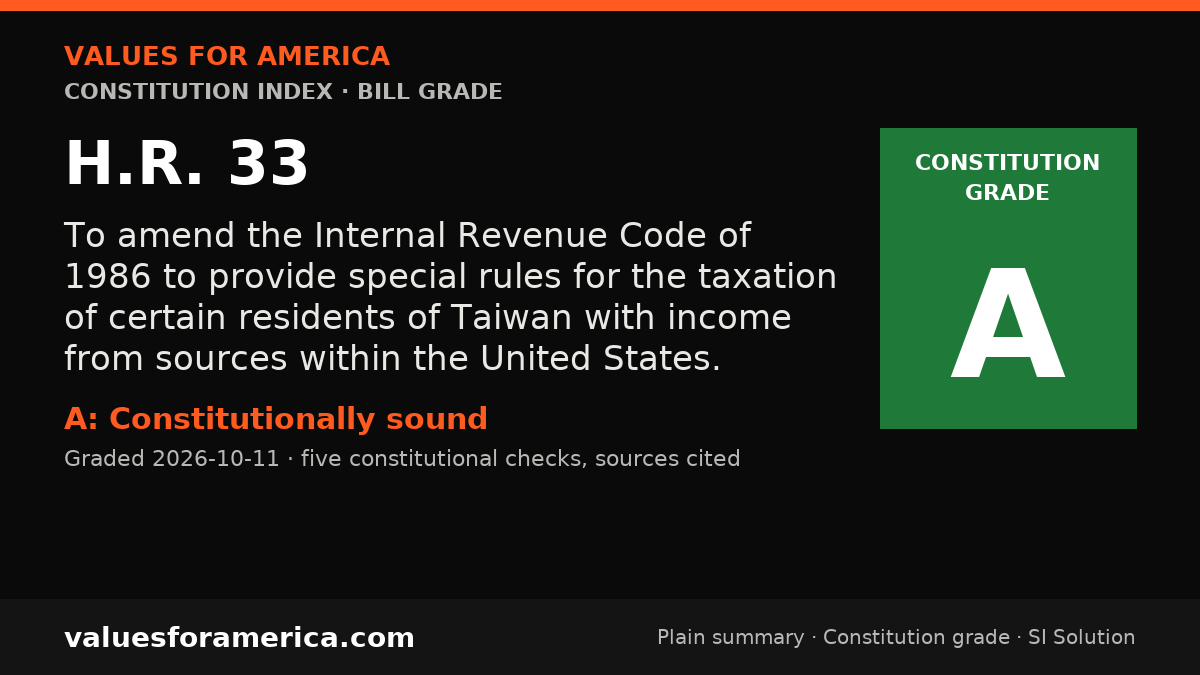
To amend the Internal Revenue Code of 1986 to provide special rules for the taxation of certain residents of Taiwan with income from sources within the United States.
Cosponsors: 46 (16 D, 30 R) · per Congress.gov, 2026-10-12
Introduced: 2025-01-03
Latest action (2025-01-16): Received in the Senate and Read twice and referred to the Committee on Finance.
What H.R. 33 does, in plain terms
The Congressional Research Service has not published a summary of H.R. 33 yet. Its official title: “To amend the Internal Revenue Code of 1986 to provide special rules for the taxation of certain residents of Taiwan with income from sources within the United States.”.
Constitution Index
“VFA Constitution grade”
Constitutionally sound
Graded 2026-10-11
SI-generated grade · five published checks · not individually reviewed by a person · methodology
This bill is a routine exercise of Congress's constitutional power to lay and collect taxes. It adjusts tax rates and withholding rules for certain Taiwan residents with U.S.-source income, which falls squarely within the enumerated powers of Article I, Section 8, Clause 1. The bill does not infringe on any constitutional rights, does not restrict individual sovereignty, and does not raise due process or takings concerns. It also appropriately operates at the federal level, as taxation of foreign residents' U.S.-source income is inherently a federal matter.
-
✓ Passes · Enumerated powers
The Constitution grants Congress the power to 'lay and collect Taxes, Duties, Imposts and Excises' (Article I, Section 8, Clause 1). This bill amends the Internal Revenue Code to set special tax rates and withholding rules for certain Taiwan residents with U.S.-source income. This is a direct exercise of the taxing power and is clearly within Congress's enumerated authority. -
✓ Passes · Bill of Rights
The bill does not implicate any of the first ten amendments. It does not restrict speech, religion, assembly, press, petition, arms, quartering, search and seizure, self-incrimination, due process, takings, trial rights, jury rights, cruel and unusual punishment, unenumerated rights, or reserved powers. It merely adjusts tax rates and withholding rules for a specific class of taxpayers. -
✓ Passes · Individual sovereignty
The bill does not restrict what individuals can do with their person, property, speech, labor, or belief. It only affects the tax treatment of certain income earned by Taiwan residents in the United States. Taxing income is a legitimate exercise of sovereign power, and the bill does not impose any new restrictions on personal freedom. -
✓ Passes · Decentralization
The bill concerns the taxation of foreign residents' U.S.-source income, which is inherently a federal matter. An individual, local community, or state cannot handle international tax treaties or the taxation of nonresidents. The federal government is the appropriate level to address this issue, and the bill does not consolidate decision-making beyond the necessary minimum. -
✓ Passes · Due process and takings
The bill does not bypass due process or take property without just compensation. It provides clear rules for tax rates and withholding, and taxpayers retain the right to challenge any assessment through normal administrative and judicial procedures. There is no arbitrary government action or deprivation of property without due process.
Report an error in this grade
What should pass
“VFA SI Solution”
No solution yet
A sourced SI draft appears here once it passes automated checks (Constitution citation, source verification, independent SI critic). How publication works.
Related on VFA

For journalists and bloggers
“Embed this grade”
Free to use with the link back. The badge and card update when the grade changes. Embed terms →
