H.R. 3276 explained · 119th Congress · Pending in Congress
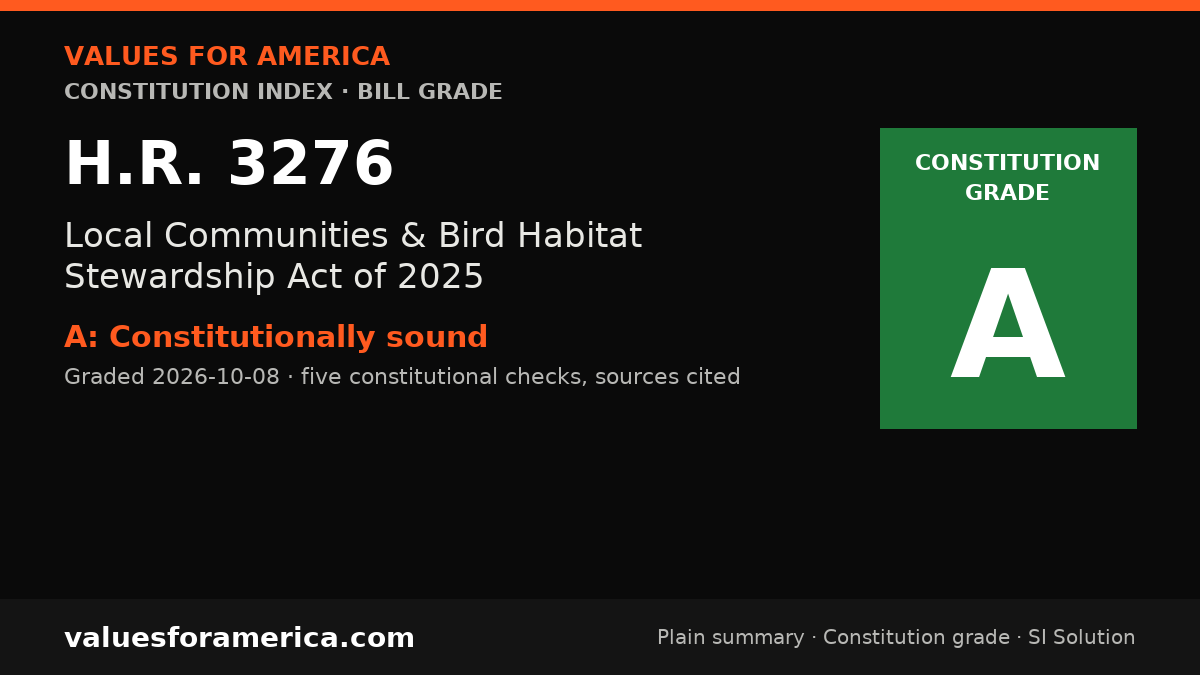
Local Communities & Bird Habitat Stewardship Act of 2025
Cosponsors: 21 (18 D, 3 R) · per Congress.gov, 2026-10-08
Introduced: 2025-05-08
Latest action (2026-06-10): Ordered to be Reported in the Nature of a Substitute (Amended) by Unanimous Consent.
What H.R. 3276 does, in plain terms
Local Communities & Bird Habitat Stewardship Act of 2026 This bill provides statutory authority for the Urban Bird Treaty Program, which is administered by the U.S. Fish and Wildlife Service. This program works with communities to support conserving and managing birds that live in and migrate through urban areas. This support includes grants administered by the National Fish and Wildlife Foundation and provided to entities including government agencies, community groups, and academic institutions for conducting activities related to the program.
Official summary by the Congressional Research Service, via Congress.gov.
Constitution Index
“VFA Constitution grade”
Constitutionally sound
Graded 2026-10-08
SI-generated grade · five published checks · not individually reviewed by a person · methodology
Voluntary federal grant support for local urban bird stewardship under the Spending Clause with no rights restriction, no compulsion, and no taking. Minor decentralization note that local work is central, but the federal role for migratory habitat is constitutionally grounded.
-
✓ Passes · Enumerated powers
Federal authority rests on Article I, Section 8, Clause 1, the Spending Clause for the general Welfare, to fund voluntary conservation grants, and is supported for migratory wildlife by Article I, Section 8, Clause 3, the Commerce Clause among the several States, and Article II, Section 2 treaty authority implemented under the Migratory Bird Treaty Act framework. The bill regulates no intrastate c… -
✓ Passes · Bill of Rights
The bill creates voluntary grants for bird conservation through the U.S. Fish and Wildlife Service and National Fish and Wildlife Foundation to agencies, community groups, and schools. It compels no speech, religion, assembly, press activity, arms restriction, search, self-incrimination, or trial deprivation. No First through Eighth Amendment right is infringed. Under the Ninth and Tenth Amendment… -
✓ Passes · Individual sovereignty
The bill restricts no personal conduct, property use, speech, labor, or belief. Grants are voluntary and competitive. No person must participate, cede land, or alter conduct. The burden test is satisfied because government imposes no restriction requiring compelling justification. -
✓ Passes · Decentralization
(1) Individuals alone cannot manage migratory urban bird habitat across flyways, so individual_can_handle is false. (2) Local communities can and do handle much of the work, and the bill supports rather than preempts them, so local_can_handle is true. (3) States alone cannot fully handle interstate migratory species, so state_can_handle is false. (4) The program does not consolidate upward: it fun… -
✓ Passes · Due process and takings
No deprivation of life, liberty, or property under the Fifth Amendment Due Process Clause and no taking under the Fifth Amendment Takings Clause. The bill authorizes grants, not fines, seizures, forfeitures, or land condemnation. No hearing or compensation is triggered because no property is taken for public use.
Sources: Congress.gov: HR 3276 summary
Report an error in this grade
What should pass
“VFA SI Solution”
No solution yet
A sourced SI draft appears here once it passes automated checks (Constitution citation, source verification, independent SI critic). How publication works.
Related on VFA

For journalists and bloggers
“Embed this grade”
Free to use with the link back. The badge and card update when the grade changes. Embed terms →
