H.R. 3203 explained · 119th Congress · Pending in Congress
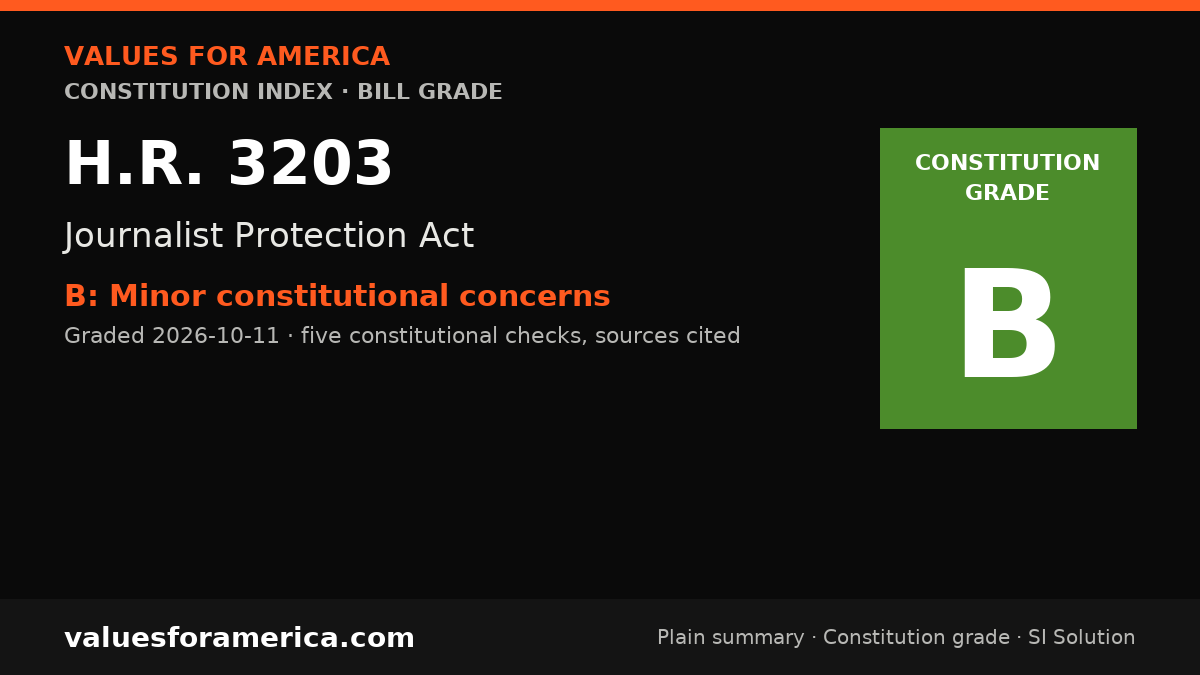
Journalist Protection Act
Cosponsors: 1 (1 D, 0 R) · per Congress.gov, 2026-10-11
Introduced: 2025-05-05
Latest action (2025-05-05): Referred to the House Committee on the Judiciary.
What H.R. 3203 does, in plain terms
Journalist Protection Act This bill establishes new criminal offenses for intentional acts (or attempts to commit acts) that cause bodily injury to a journalist.
Official summary by the Congressional Research Service, via Congress.gov.
Constitution Index
“VFA Constitution grade”
Minor constitutional concerns
Graded 2026-10-11
SI-generated grade · five published checks · not individually reviewed by a person · methodology
The Journalist Protection Act is mostly sound but has minor constitutional tensions. It falls within Congress's enumerated powers under the Commerce Clause and the Necessary and Proper Clause, and it does not directly infringe any Bill of Rights protections. However, the creation of a special protected class for journalists raises mild concerns under the First Amendment's equal protection principles and individual sovereignty, as it could be seen as granting preferential treatment to one category of speakers. The bill does not violate decentralization or due process standards.
-
✓ Passes · Enumerated powers
Congress has authority under Article I, Section 8, Clause 3 (Commerce Clause) to criminalize conduct that substantially affects interstate commerce, and under the Necessary and Proper Clause (Article I, Section 8, Clause 18) to enact laws that are appropriate to carry out its enumerated powers. Creating federal criminal offenses for acts causing bodily injury to journalists can be justified as a m… -
✓ Passes · Bill of Rights
The bill does not restrict speech, press, assembly, or any other First Amendment right; it only criminalizes intentional acts causing bodily injury. This does not infringe the Second, Fourth, Fifth, Sixth, Seventh, Eighth, Ninth, or Tenth Amendments. The special protection for journalists does not violate the First Amendment because it does not suppress any viewpoint or content—it merely adds pena… -
✗ Concern · Individual sovereignty
While the bill does not restrict individual liberty in the traditional sense, it creates a special protected class (journalists) that receives heightened legal protection compared to ordinary citizens. This raises a mild concern under the Ninth Amendment's reservation of unenumerated rights and the principle of equal protection implicit in the Fifth Amendment's Due Process Clause. The government h… -
✓ Passes · Decentralization
The bill passes all four questions: (1) An individual or family cannot handle the problem of violent attacks on journalists without government involvement, as this requires criminal law enforcement. (2) A local community could handle this, but the interstate nature of news reporting justifies federal involvement. (3) States could handle this, but the bill does not preempt state law—it adds a feder… -
✓ Passes · Due process and takings
The bill establishes clear criminal offenses with specific intent requirements ('intentional acts'), providing fair notice of prohibited conduct. It does not bypass procedural due process, presumption of innocence, or take property without just compensation. The mens rea element ensures that only those who knowingly cause injury are subject to penalties, satisfying substantive due process requirem…
Sources: Congress.gov: HR 3203 summary
Report an error in this grade
What should pass
“VFA SI Solution”
No solution yet
A sourced SI draft appears here once it passes automated checks (Constitution citation, source verification, independent SI critic). How publication works.
Related on VFA

For journalists and bloggers
“Embed this grade”
Free to use with the link back. The badge and card update when the grade changes. Embed terms →
