H.R. 3123 explained · 119th Congress · Pending in Congress
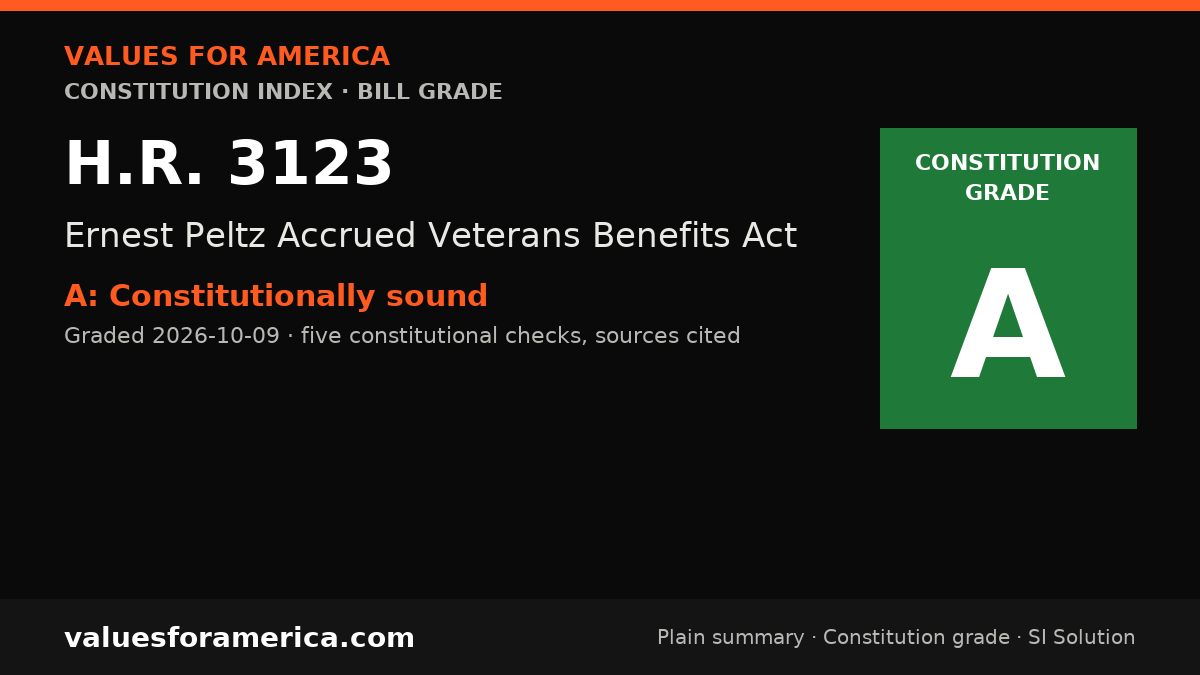
Ernest Peltz Accrued Veterans Benefits Act
Cosponsors: 2 (2 D, 0 R) · per Congress.gov, 2026-10-09
Introduced: 2025-04-30
Latest action (2026-02-03): Received in the Senate and Read twice and referred to the Committee on Veterans' Affairs.
What H.R. 3123 does, in plain terms
Ernest Peltz Accrued Veterans Benefits Act This bill establishes procedures for the Department of Veterans Affairs (VA) to issue a pension that was due but unpaid at the time of a veteran’s death. Specifically, if the VA issues a decision awarding entitlement to a pension to a veteran prior to the veteran’s death but issues the payment after the veteran dies, the pension must be paid to the first available recipient on the following list: (1) the veteran’s living spouse; (2) the veteran’s living children; (3) the veteran’s living dependent parents; or (4) the estate of the veteran, unless the estate will escheat (i.e., transfer to the state). To be eligible for such pension payments, a claimant of accrued benefits must file an application within one year after the veteran's death. If no application for accrued benefits is filed within one year following the death of the veteran, the pension must be paid to the veteran’s estate unless the estate will escheat.
Official summary by the Congressional Research Service, via Congress.gov.
Constitution Index
“VFA Constitution grade”
Constitutionally sound
Graded 2026-10-09
SI-generated grade · five published checks · not individually reviewed by a person · methodology
HR 3123 is constitutional. It is a straightforward veterans-benefits payment procedure that stays within Congress's enumerated powers over military affairs and spending, expands rather than restricts individual benefit rights, does not consolidate power upward, and creates no due process or takings problem.
-
✓ Passes · Enumerated powers
Congress has explicit constitutional authority to provide for veterans' pensions under Article I, Section 8, Clause 12, which authorizes Congress to raise and support Armies, and under Article I, Section 8, Clause 1, which authorizes spending for the common defense and general welfare. Administering and distributing accrued VA pensions is a traditional federal function within this authority. -
✓ Passes · Bill of Rights
The bill does not implicate any provision of the Bill of Rights. It does not restrict speech, religion, press, assembly, petition, the right to keep and bear arms, quartering of soldiers, search and seizure, self-incrimination, trial rights, jury rights, excessive punishment, or unenumerated rights under the Ninth and Tenth Amendments. -
✓ Passes · Individual sovereignty
This bill expands the ability of veterans' spouses, children, dependent parents, and estates to receive benefits that were earned but unpaid at death. It imposes no restriction on personal liberty, property, labor, speech, or belief. The one-year application window is a reasonable and non-oppressive procedural condition for claiming a statutory benefit. -
✓ Passes · Decentralization
The pension at issue is a federal benefit created and paid through the Department of Veterans Affairs. Neither an individual, a local community, nor a state can independently administer a federal pension obligation established under Congress's military and spending powers. This bill does not consolidate new decision-making at a higher level; it simply prescribes the order of payment for an existin… -
✓ Passes · Due process and takings
The bill provides a clear statutory priority list and a one-year filing period, giving claimants fair notice of how to receive accrued pension benefits. It does not deprive anyone of vested property without due process because the payment is a statutory benefit subject to reasonable conditions. The escheat limitation merely prevents payments to a state when no proper claimant comes forward; it doe…
Sources: Congress.gov: HR 3123 summary
Report an error in this grade
What should pass
“VFA SI Solution”
No solution yet
A sourced SI draft appears here once it passes automated checks (Constitution citation, source verification, independent SI critic). How publication works.
Related on VFA

For journalists and bloggers
“Embed this grade”
Free to use with the link back. The badge and card update when the grade changes. Embed terms →
