H.R. 3109 explained · 119th Congress · Pending in Congress
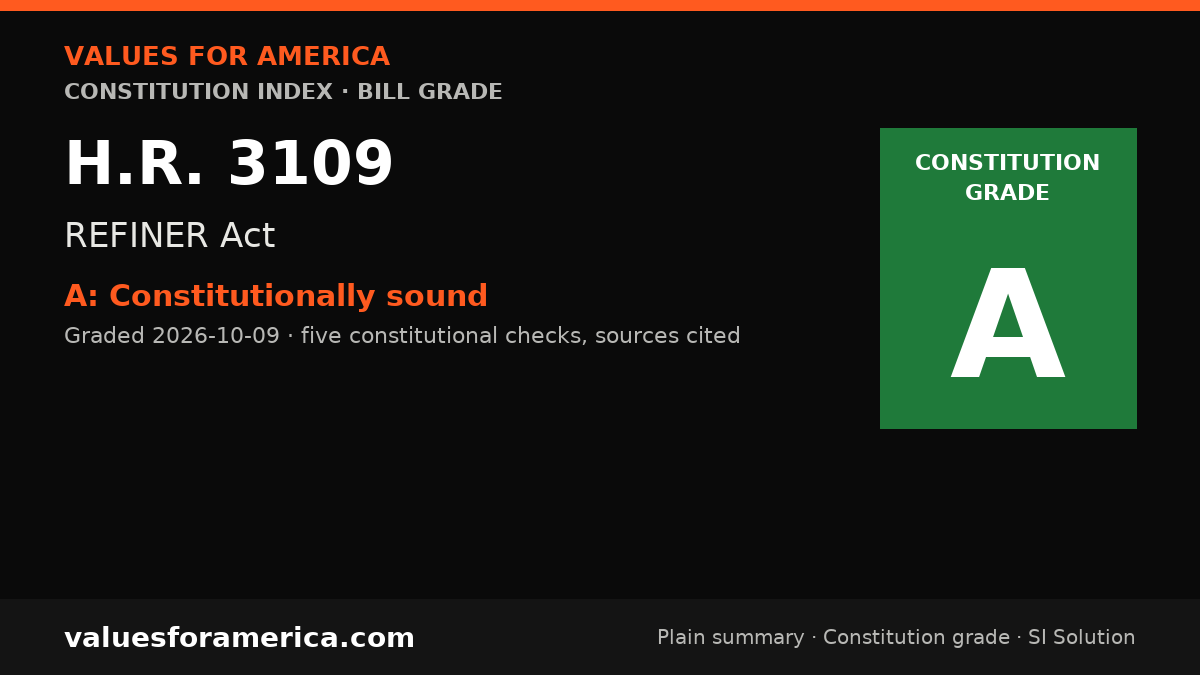
REFINER Act
Cosponsors: 1 (0 D, 1 R) · per Congress.gov, 2026-10-10
Introduced: 2025-04-30
Latest action (2025-12-01): Received in the Senate and Read twice and referred to the Committee on Energy and Natural Resources.
What H.R. 3109 does, in plain terms
Researching Efficient Federal Improvements for Necessary Energy Refining Act or the REFINER Act This bill requires the Department of Energy to direct the National Petroleum Council to publish a report on petrochemical refineries located in the United States. The report must include information concerning (1) the contributions of such refineries to U.S. energy security, (2) analyses and projections with respect to opportunities for expanding the capacities of the refineries and the risks to such refineries, (3) any federal or state executive actions that have contributed to a decline in their capacities, and (4) any recommendations to increase such capacities.
Official summary by the Congressional Research Service, via Congress.gov.
Constitution Index
“VFA Constitution grade”
Constitutionally sound
Graded 2026-10-09
SI-generated grade · five published checks · not individually reviewed by a person · methodology
The REFINER Act is a straightforward reporting requirement that directs the Department of Energy to commission a study from the National Petroleum Council on petrochemical refineries. It does not regulate conduct, restrict rights, or preempt state authority. The report is informational and falls within Congress's enumerated powers under the Commerce Clause and the Necessary and Proper Clause. No constitutional rights are implicated, individual sovereignty is untouched, the action is appropriately federal given the interstate and national security dimensions, and there is no deprivation of due process or property. The bill is fully constitutional.
-
✓ Passes · Enumerated powers
Congress has authority under Article I, Section 8, Clause 3 (Commerce Clause) to gather information on industries that substantially affect interstate commerce, such as petrochemical refining. The Necessary and Proper Clause (Article I, Section 8, Clause 18) permits Congress to commission studies that inform its legislative functions. The report's focus on energy security also touches on the natio… -
✓ Passes · Bill of Rights
The bill imposes no restrictions on speech, religion, press, assembly, petition, arms, quartering, search and seizure, self-incrimination, due process, takings, trial rights, or cruel and unusual punishment. It does not infringe any provision of the first ten amendments. The requirement to publish a report does not compel speech or violate any enumerated right. -
✓ Passes · Individual sovereignty
The REFINER Act does not restrict what any individual may do with their person, property, speech, labor, or belief. It imposes no mandates, prohibitions, or burdens on private citizens. The government bears no burden to justify a restriction because none exists. Individual sovereignty remains fully intact. -
✓ Passes · Decentralization
The four-question test confirms the federal role is appropriate. (1) An individual or family cannot produce a nationwide study on petrochemical refineries and energy security—government involvement is necessary. (2) A local community or county lacks the scope and resources to assess national energy security and interstate refinery networks. (3) A single state cannot comprehensively evaluate federa… -
✓ Passes · Due process and takings
The bill does not deprive any person of life, liberty, or property without due process. It imposes no penalties, fines, or seizures. There is no taking of private property for public use. The report requirement is purely informational and does not trigger procedural or substantive due process concerns, nor the Takings Clause of the Fifth Amendment.
Sources: Congress.gov: HR 3109 summary
Report an error in this grade
What should pass
“VFA SI Solution”
No solution yet
A sourced SI draft appears here once it passes automated checks (Constitution citation, source verification, independent SI critic). How publication works.
Related on VFA

For journalists and bloggers
“Embed this grade”
Free to use with the link back. The badge and card update when the grade changes. Embed terms →
