H.R. 3062 explained · 119th Congress · Pending in Congress
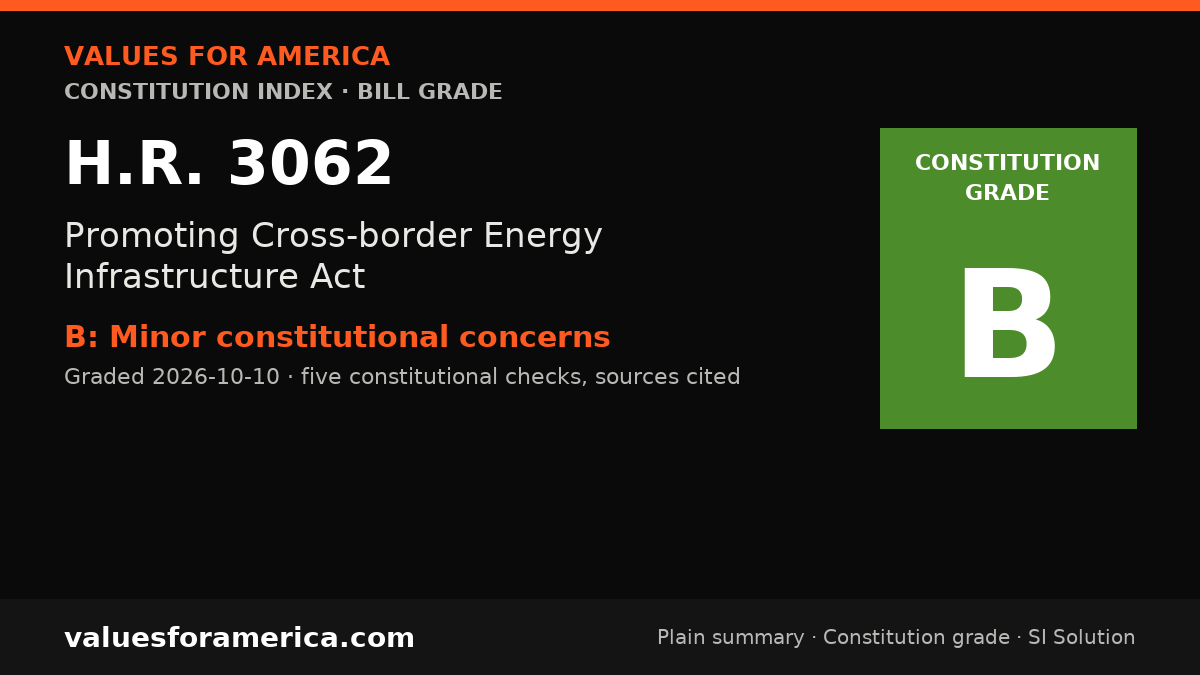
Promoting Cross-border Energy Infrastructure Act
Cosponsors: 2 (0 D, 2 R) · per Congress.gov, 2026-10-10
Introduced: 2025-04-29
Latest action (2025-09-19): Received in the Senate and Read twice and referred to the Committee on Energy and Natural Resources.
What H.R. 3062 does, in plain terms
Promoting Cross-border Energy Infrastructure Act This bill establishes a new process for approving or revoking permits for the construction and operation of energy infrastructure across an international border of the United States. Thus, it replaces the existing process established under specified executive orders. The bill requires a person to obtain a certificate of crossing before constructing, connecting, operating, or maintaining a border-crossing facility for the import or export of oil or natural gas, or the transmission of electricity, across a U.S. border with Canada or Mexico. A certificate must be obtained from the Federal Energy Regulatory Commission (FERC) for a facility consisting of oil or natural gas pipelines or the Department of Energy (DOE) for an electric transmission facility. As a condition of issuing a certificate, DOE must require that an electric transmission facility be constructed, connected, operated, or maintained consistent with specified policies and standards. FERC and DOE must meet a deadline for issuing a certificate as set forth by this bill. The bill also requires FERC to meet a deadline for approving applications to import or export natural gas to or from Canada or Mexico. The bill also requires the President to obtain the approval of Congress before revoking a permit issued under executive orders for constructing, connecting, operating, or maintaining an oil or natural gas pipeline, an electric transmission facility, or a related border-crossing facility.
Official summary by the Congressional Research Service, via Congress.gov.
Constitution Index
“VFA Constitution grade”
Minor constitutional concerns
Graded 2026-10-10
SI-generated grade · five published checks · not individually reviewed by a person · methodology
The bill is largely constitutional, as it operates within Congress's enumerated powers over foreign commerce and interstate commerce, and it does not infringe upon individual rights. The main concern is the requirement for congressional approval before the President can revoke permits, which may raise separation of powers issues, but this is a minor tension that can be addressed.
-
✓ Passes · Enumerated powers
Congress has the power to regulate commerce with foreign nations and among the several states under Article I, Section 8, Clause 3. The bill regulates cross-border energy infrastructure, which directly involves foreign commerce and interstate commerce. Additionally, Congress has the power to dispose of and make all needful rules respecting the territory or other property belonging to the United St… -
✓ Passes · Bill of Rights
The bill does not infringe upon any of the first ten amendments. It does not restrict speech, religion, assembly, press, petition, arms, quartering, search and seizure, self-incrimination, due process, takings, fair trial, jury, cruel and unusual punishment, or unenumerated rights. The permitting process is a regulatory measure that does not implicate these rights. -
✓ Passes · Individual sovereignty
The bill imposes a permitting requirement on persons seeking to construct or operate cross-border energy infrastructure. This is a reasonable regulation of commercial activity that has significant interstate and international implications. The government has a compelling interest in ensuring the safety, reliability, and environmental compliance of such infrastructure. The burden on individuals is … -
✗ Concern · Decentralization
The bill centralizes permitting authority at the federal level, which is appropriate given the interstate and international nature of the infrastructure. However, it fails the decentralization test because it consolidates decision-making at the federal level, whereas states could potentially handle some aspects of permitting. Nevertheless, the federal role is necessary for cross-border facilities,… -
✓ Passes · Due process and takings
The bill establishes a clear process for obtaining certificates and sets deadlines for agency action, which provides procedural due process. It does not take property without just compensation; rather, it regulates the construction and operation of new facilities. The requirement for congressional approval before revoking permits provides an additional layer of due process for permit holders.
Sources: Congress.gov: HR 3062 summary
Report an error in this grade
What should pass
“VFA SI Solution”
No solution yet
A sourced SI draft appears here once it passes automated checks (Constitution citation, source verification, independent SI critic). How publication works.
Related on VFA

For journalists and bloggers
“Embed this grade”
Free to use with the link back. The badge and card update when the grade changes. Embed terms →
