H.R. 3015 explained · 119th Congress · Pending in Congress
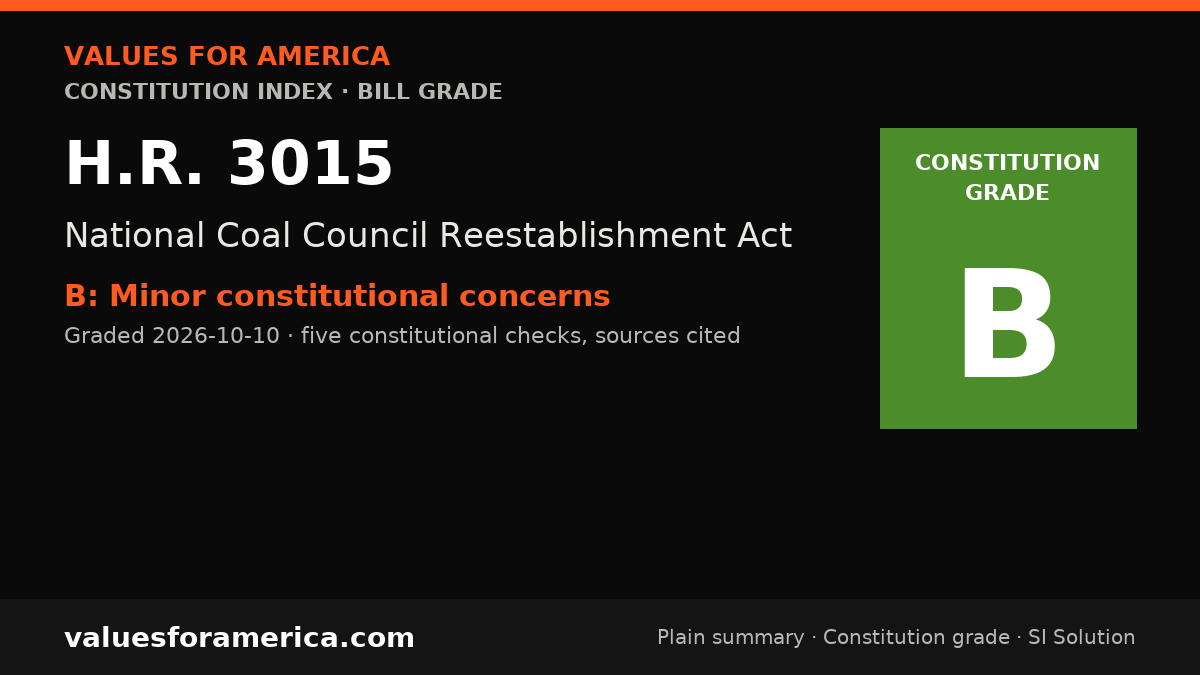
National Coal Council Reestablishment Act
Cosponsors: 5 (0 D, 5 R) · per Congress.gov, 2026-10-10
Introduced: 2025-04-24
Latest action (2025-09-19): Received in the Senate and Read twice and referred to the Committee on Energy and Natural Resources.
What H.R. 3015 does, in plain terms
National Coal Council Reestablishment Act This bill provides statutory authority for the National Coal Council and directs the Department of Energy to reestablish the council in accordance with the charter that was in effect on November 19, 2021. Established in 1984, the council made recommendations to DOE on matters relating to coal and the coal industry. In addition, the bill removes the requirement under the Federal Advisory Committee Act for the council to be re-chartered every two years.
Official summary by the Congressional Research Service, via Congress.gov.
Constitution Index
“VFA Constitution grade”
Minor constitutional concerns
Graded 2026-10-10
SI-generated grade · five published checks · not individually reviewed by a person · methodology
The bill is largely constitutional as it operates within federal authority over energy policy and interstate commerce, and does not infringe on individual rights. However, it raises minor concerns by exempting the council from periodic re-chartering under the Federal Advisory Committee Act, which could reduce transparency and accountability, though it does not rise to a constitutional violation.
-
✓ Passes · Enumerated powers
The federal government has authority over energy policy under the Commerce Clause (Article I, Section 8, Clause 3) and the Necessary and Proper Clause (Article I, Section 8, Clause 18). Establishing an advisory council to the Department of Energy on coal matters is a reasonable means of executing federal energy policy, which affects interstate commerce and national energy security. -
✓ Passes · Bill of Rights
The bill does not infringe on any rights protected by the Bill of Rights. It does not restrict speech, religion, assembly, press, petition, arms, quartering, search and seizure, self-incrimination, due process, takings, trial rights, or cruel and unusual punishment. The council's advisory role is purely recommendatory and does not coerce or penalize individuals. -
✓ Passes · Individual sovereignty
The bill does not restrict individual liberty, property, speech, labor, or belief. It merely establishes a federal advisory council to make recommendations to the Department of Energy. No individual is compelled to participate or comply with any council recommendations, so individual sovereignty is not infringed. -
✗ Concern · Decentralization
The bill consolidates advisory authority at the federal level, but this is appropriate for a national energy policy matter. However, the removal of the two-year re-chartering requirement reduces periodic oversight and could be seen as consolidating decision-making at the federal level without adequate checks. The questions reveal that while individuals and states could handle some aspects of coal … -
✓ Passes · Due process and takings
The bill does not affect due process or takings. It does not deprive any person of life, liberty, or property without due process, nor does it take private property for public use without just compensation. The council's recommendations are advisory and do not have direct legal effect on individuals.
Sources: Congress.gov: HR 3015 summary
Report an error in this grade
What should pass
“VFA SI Solution”
No solution yet
A sourced SI draft appears here once it passes automated checks (Constitution citation, source verification, independent SI critic). How publication works.
Related on VFA

For journalists and bloggers
“Embed this grade”
Free to use with the link back. The badge and card update when the grade changes. Embed terms →
