H.R. 30 explained · 119th Congress · Pending in Congress
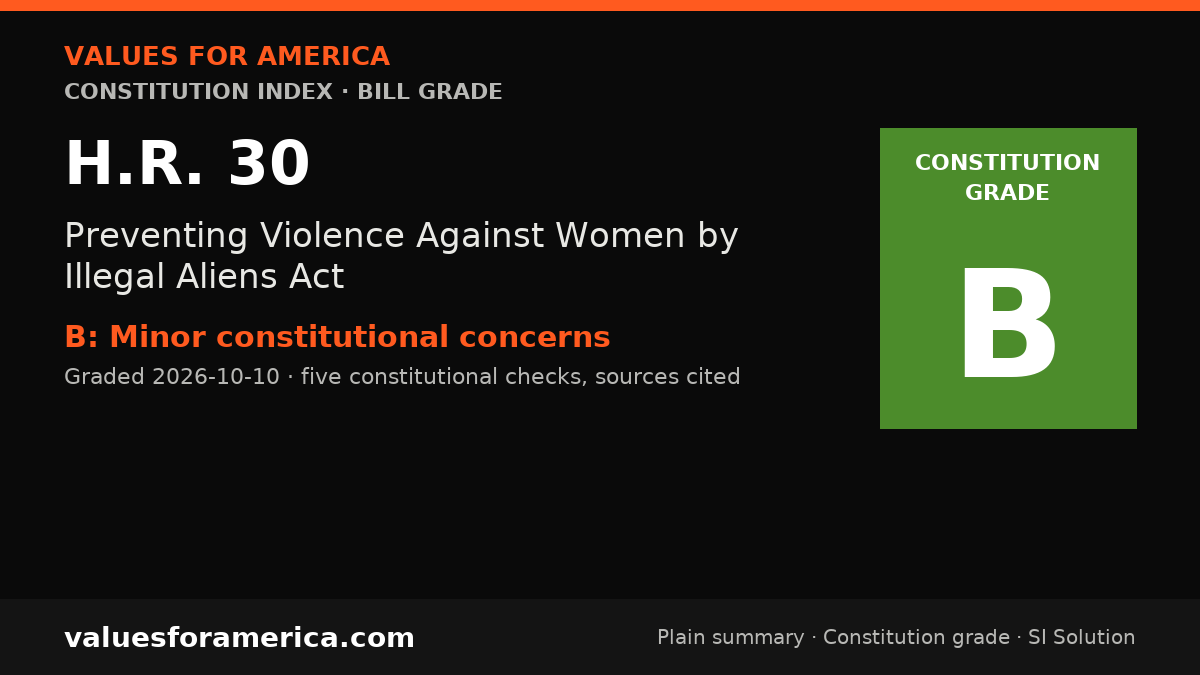
Preventing Violence Against Women by Illegal Aliens Act
Cosponsors: 60 (0 D, 60 R) · per Congress.gov, 2026-10-12
Introduced: 2025-01-03
Latest action (2025-01-17): Received in the Senate and Read twice and referred to the Committee on the Judiciary.
What H.R. 30 does, in plain terms
Preventing Violence Against Women by Illegal Aliens Act This bill establishes certain criminal grounds for making non-U.S. nationals (aliens under federal law) inadmissible and expands the crimes for which a non-U.S. national is deportable. First, the bill establishes that a non-U.S. national is inadmissible if the individual has admitted to or is convicted of acts constituting the essential elements of stalking, child abuse, child neglect, child abandonment, a sex offense, conspiracy to commit a sex offense, a violation of certain protection orders, or domestic violence (including physical or sexual abuse or a pattern of coercive behavior when it occurs within certain close relationships). Next, the bill establishes additional grounds for deportation. Under current law, a non-U.S. national is deportable for certain criminal convictions, including domestic violence, stalking, and child abuse. The bill makes any sex offense (including crimes against minors) or conspiracy to commit a sex offense a basis for deportation. The bill also expands the domestic violence crimes that make a non-U.S. national deportable to include physical or sexual abuse or a pattern of coercive behavior when it occurs within certain close relationships.
Official summary by the Congressional Research Service, via Congress.gov.
Constitution Index
“VFA Constitution grade”
Minor constitutional concerns
Graded 2026-10-10
SI-generated grade · five published checks · not individually reviewed by a person · methodology
The bill is mostly sound but has minor tensions with due process and individual sovereignty. It operates within Congress's enumerated immigration powers, does not directly infringe the Bill of Rights, and largely respects decentralization. However, the use of vague terms like 'pattern of coercive behavior' and the inclusion of admissions without conviction raise procedural due process concerns.
-
✓ Passes · Enumerated powers
Congress has plenary power over immigration and naturalization under Article I, Section 8, Clause 4. The bill establishes grounds for inadmissibility and deportation, which are core exercises of this enumerated power. The Supreme Court has consistently upheld Congress's authority to define categories of aliens who may be removed or excluded. -
✓ Passes · Bill of Rights
The bill does not directly infringe any of the first ten amendments. It applies to non-U.S. nationals seeking admission or already present in the United States, who do not have full constitutional rights in immigration proceedings. The Fifth Amendment's Due Process Clause applies to all persons, but the bill's provisions for deportation based on criminal conduct do not violate it on its face, as l… -
✗ Concern · Individual sovereignty
The bill restricts the liberty of non-U.S. nationals by making them deportable for conduct that may not have resulted in a criminal conviction, such as admitting to acts constituting the essential elements of certain crimes. This shifts the burden to the individual to prove they did not commit the acts, which is a significant restriction on personal freedom. However, the government has a compellin… -
✓ Passes · Decentralization
Immigration is inherently a federal matter under the Constitution, as states cannot set their own immigration policies. The bill does not consolidate decision-making upward beyond what is necessary, as it operates within the existing federal framework. Individuals and families cannot handle immigration enforcement on their own, and states lack constitutional authority to deport non-citizens. -
✗ Concern · Due process and takings
The bill expands deportability based on 'admissions' of acts constituting the essential elements of a crime, without requiring a conviction. This raises procedural due process concerns under the Fifth Amendment, as it may allow removal based on unproven allegations. Additionally, the term 'pattern of coercive behavior' is vague and could be applied arbitrarily, potentially violating substantive du…
Sources: Congress.gov: HR 30 summary
Report an error in this grade
What should pass
“VFA SI Solution”
No solution yet
A sourced SI draft appears here once it passes automated checks (Constitution citation, source verification, independent SI critic). How publication works.
Related on VFA

For journalists and bloggers
“Embed this grade”
Free to use with the link back. The badge and card update when the grade changes. Embed terms →
