H.R. 2966 explained · 119th Congress · Pending in Congress
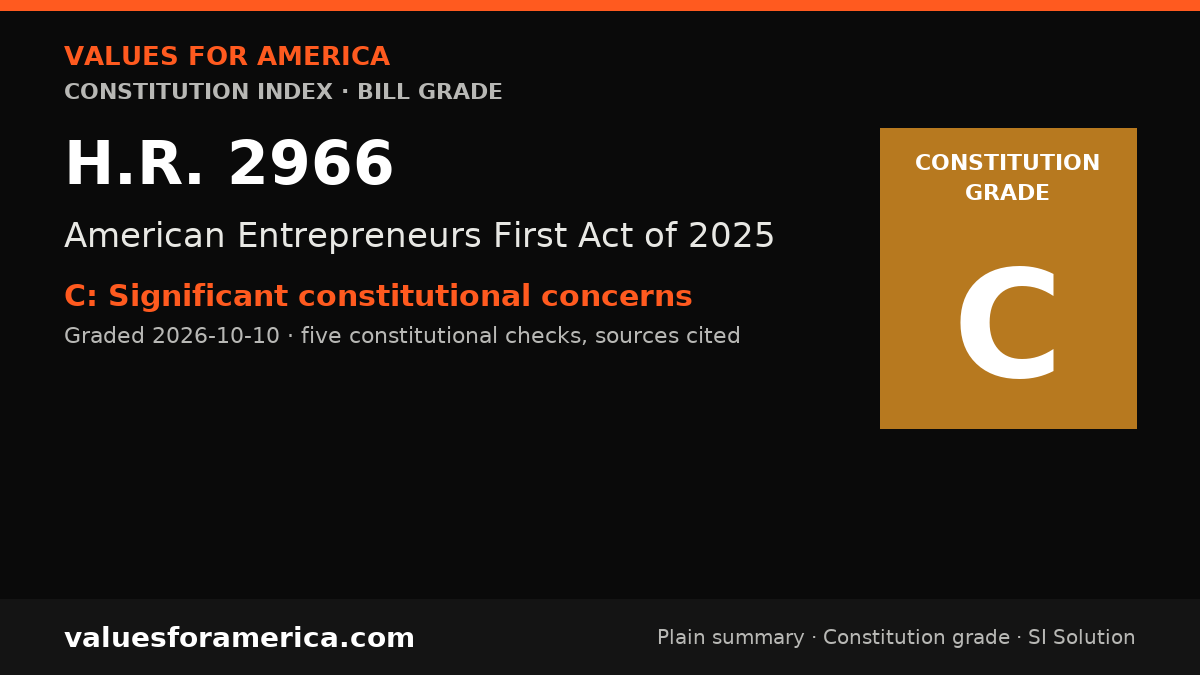
American Entrepreneurs First Act of 2025
Cosponsors: 1 (0 D, 1 R) · per Congress.gov, 2026-10-11
Introduced: 2025-04-17
Latest action (2025-06-09): Received in the Senate and Read twice and referred to the Committee on Small Business and Entrepreneurship.
What H.R. 2966 does, in plain terms
American Entrepreneurs First Act This bill revises the application requirements for the Small Business Administration's 7(a) loan and 504 loan programs. Specifically, the bill requires applications for such loans to include (1) the applicant's date of birth; and (2) a certification that the applicant or all beneficial owners are citizens, nationals, or lawful permanent residents of the United States. The bill specifies that certain individuals are ineligible for such loans, including (1) asylees, (2) refugees, (3) individuals issued a visa to remain in the United States, (4) individuals legally classified as nonimmigrants, (5) individuals to whom deferred action has been granted pursuant to the Deferred Action for Childhood Arrivals, and (6) individuals without lawful status under the immigration laws of the United States.
Official summary by the Congressional Research Service, via Congress.gov.
Constitution Index
“VFA Constitution grade”
Significant constitutional concerns
Graded 2026-10-10
SI-generated grade · five published checks · not individually reviewed by a person · methodology
The bill is a federal action in the area of small business lending, which falls within Congress's enumerated power to regulate interstate commerce and to provide for the general welfare through spending programs. However, the bill's eligibility restrictions raise significant equal protection and due process concerns by categorically excluding certain lawful immigrants and DACA recipients from participation in a federal benefit program, without a clear constitutional justification. The bill also consolidates decision-making at the federal level, but this is inherent in a federal loan program. The bill does not violate the Bill of Rights directly, but the exclusion of certain classes of individuals may implicate the Fifth Amendment's Due Process Clause and the equal protection component of the Fifth Amendment. The bill is not a direct violation of individual sovereignty, but it does restrict access to a government benefit based on immigration status, which may be an arbitrary classification. The decentralization test is partially failed because the program is inherently federal, but the eligibility criteria could be more narrowly tailored. Overall, the bill has significant constitutional issues that require a structural rewrite to ensure equal protection and due process.
-
✓ Passes · Enumerated powers
Congress has the power to regulate interstate commerce under Article I, Section 8, Clause 3, and to spend for the general welfare under Article I, Section 8, Clause 1. The Small Business Administration's loan programs are a federal spending program that affects interstate commerce, and Congress has the authority to set conditions on the receipt of federal funds. The bill's requirements and eligibi… -
✗ Concern · Bill of Rights
The bill does not directly infringe on the First, Second, Third, Fourth, Sixth, Seventh, Eighth, or Ninth Amendments. However, the exclusion of certain classes of individuals from a federal benefit program may implicate the Fifth Amendment's Due Process Clause, which includes an equal protection component. The Supreme Court has held that the Fifth Amendment's Due Process Clause prohibits the feder… -
✗ Concern · Individual sovereignty
The bill restricts the ability of certain individuals to participate in a federal loan program, which is a government benefit, not a fundamental right. However, the restriction is based on immigration status, and the government must have a compelling justification for such a classification. The bill's exclusion of asylees and refugees, who are lawfully present and authorized to work, may not be ra… -
✗ Concern · Decentralization
The bill fails the decentralization test because it consolidates decision-making at the federal level, which is inherent in a federal loan program. However, the question is whether the eligibility criteria could be handled at a lower level. The federal government has a legitimate interest in ensuring that federal funds are used for their intended purpose, and the eligibility criteria are a conditi… -
✗ Concern · Due process and takings
The bill does not take property without just compensation, but it may violate procedural due process by denying certain individuals a fair opportunity to participate in a federal benefit program. The bill's eligibility criteria are clear, but the exclusion of certain classes of individuals may be arbitrary and capricious, lacking a rational basis. The bill does not provide a hearing or an opportun…
Sources: Congress.gov: HR 2966 summary
Report an error in this grade
What should pass
“VFA SI Solution”
No solution yet
A sourced SI draft appears here once it passes automated checks (Constitution citation, source verification, independent SI critic). How publication works.
Related on VFA

For journalists and bloggers
“Embed this grade”
Free to use with the link back. The badge and card update when the grade changes. Embed terms →
