H.R. 2965 explained · 119th Congress · Pending in Congress
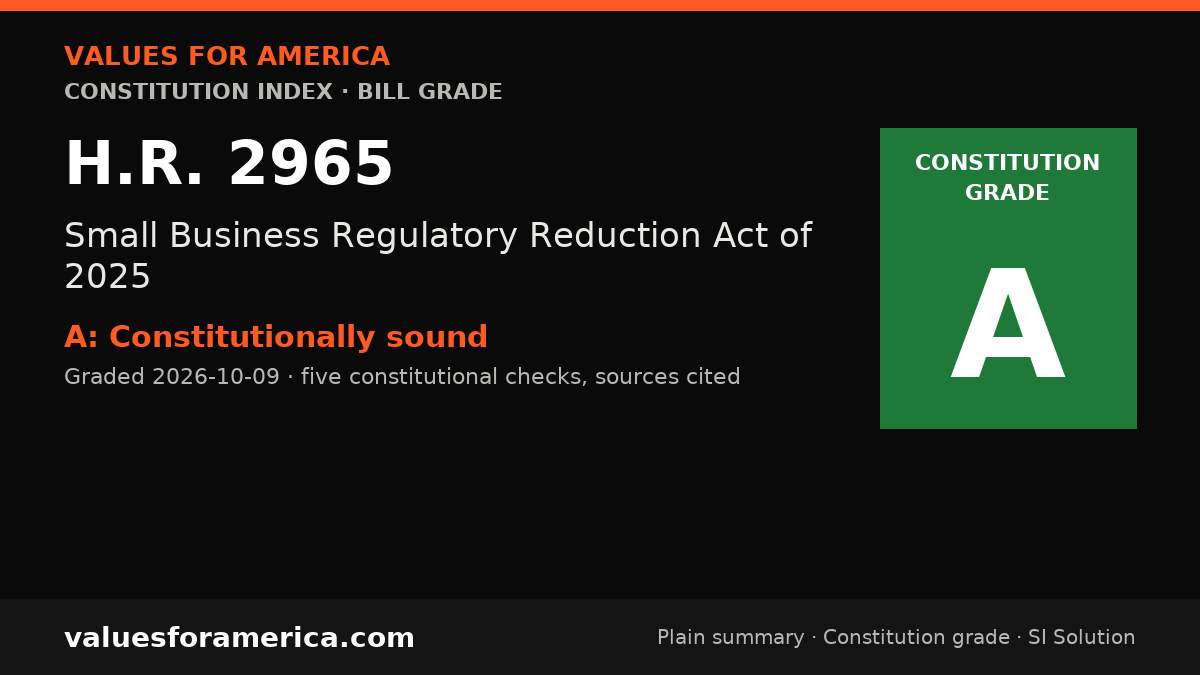
Small Business Regulatory Reduction Act of 2025
Cosponsors: 5 (0 D, 5 R) · per Congress.gov, 2026-10-10
Introduced: 2025-04-17
Latest action (2025-12-04): Received in the Senate and Read twice and referred to the Committee on Small Business and Entrepreneurship.
What H.R. 2965 does, in plain terms
Small Business Regulatory Reduction Act of 2025 This bill requires the Small Business Administration (SBA) to ensure the annual small business regulatory budget for the SBA in each fiscal year is no greater than zero. The small business regulatory budget is the cost to a small business of a federal rulemaking, including the cost resulting from the issuance of any new rule and the cost resulting from the modification or repeal of an existing rule.
Official summary by the Congressional Research Service, via Congress.gov.
Constitution Index
“VFA Constitution grade”
Constitutionally sound
Graded 2026-10-09
SI-generated grade · five published checks · not individually reviewed by a person · methodology
The Small Business Regulatory Reduction Act of 2025 is fully constitutional. It operates within Congress's enumerated power to structure and fund the Small Business Administration, imposes no restriction on individual rights, and actually reduces the federal regulatory burden on small businesses, thereby enhancing individual sovereignty and decentralization.
-
✓ Passes · Enumerated powers
Congress has broad authority under Article I, Section 8, Clause 18 (the Necessary and Proper Clause) to organize and set the budget for federal agencies, including the Small Business Administration. This bill merely directs the SBA to set its regulatory budget at zero, which is a permissible exercise of Congress's power over the internal operations of the executive branch. It does not regulate com… -
✓ Passes · Bill of Rights
The bill does not infringe any provision of the Bill of Rights. It does not restrict speech, religion, press, assembly, petition, arms, quartering, search and seizure, self-incrimination, due process, trial rights, jury rights, cruel and unusual punishment, or unenumerated rights. It imposes no criminal penalties or civil liabilities on individuals. -
✓ Passes · Individual sovereignty
This bill enhances individual sovereignty by reducing the regulatory costs imposed on small businesses. Small business owners retain greater control over their property, labor, and economic decisions when the government imposes fewer compliance costs. The government has no compelling interest in imposing regulatory costs on small businesses beyond what is necessary, and this bill reduces that burd… -
✓ Passes · Decentralization
The bill passes all four decentralization questions. (1) An individual or family could handle their own business affairs without federal regulatory costs. (2) Local communities and counties can regulate small businesses without federal involvement. (3) States can regulate small businesses without federal involvement. (4) This action does not consolidate decision-making upward; it actually reduces … -
✓ Passes · Due process and takings
The bill does not bypass due process or take property without just compensation. It does not impose any penalties, fines, or seizures. It merely sets an internal budget constraint on the SBA's rulemaking costs. No person's property is taken, and no procedural rights are affected.
Sources: Congress.gov: HR 2965 summary
Report an error in this grade
What should pass
“VFA SI Solution”
No solution yet
A sourced SI draft appears here once it passes automated checks (Constitution citation, source verification, independent SI critic). How publication works.
Related on VFA

For journalists and bloggers
“Embed this grade”
Free to use with the link back. The badge and card update when the grade changes. Embed terms →
