H.R. 29 explained · 119th Congress · Pending in Congress
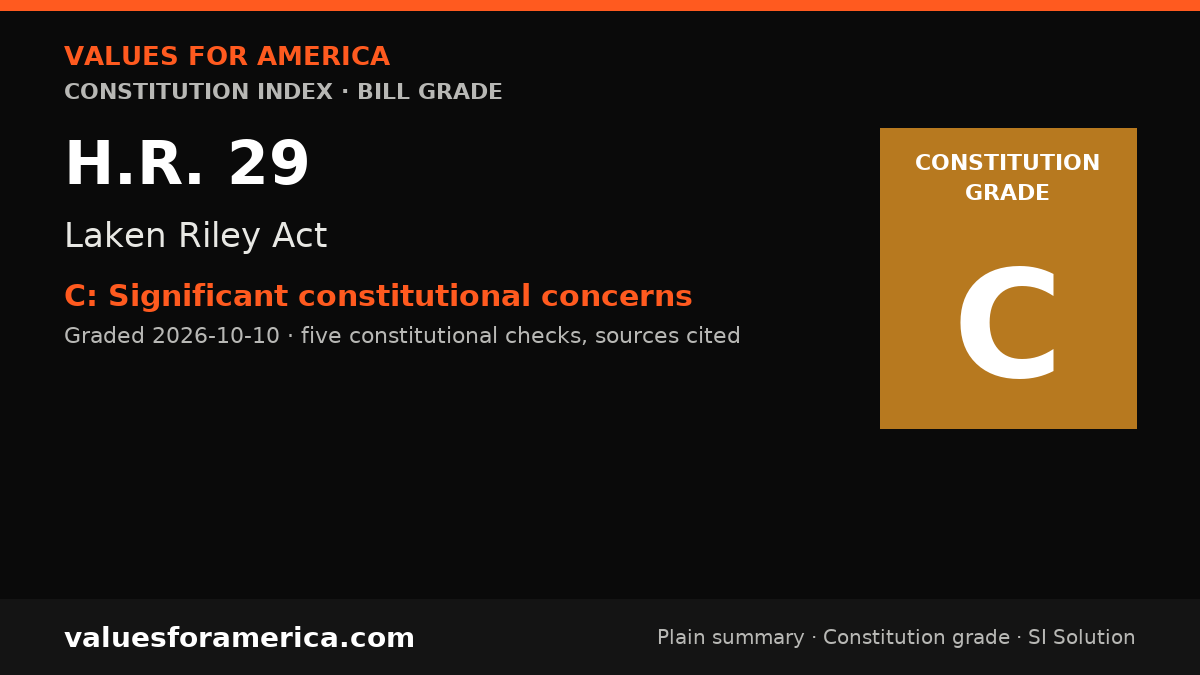
Laken Riley Act
Cosponsors: 54 (1 D, 53 R) · per Congress.gov, 2026-10-12
Introduced: 2025-01-03
Latest action (2025-02-10): Read the second time. Placed on Senate Legislative Calendar under General Orders. Calendar No. 10.
What H.R. 29 does, in plain terms
Laken Riley Act This bill requires the Department of Homeland Security (DHS) to detain certain non-U.S. nationals (aliens under federal law) who have been arrested for burglary, theft, larceny, or shoplifting. The bill also authorizes states to sue the federal government for decisions or alleged failures related to immigration enforcement. Under this bill, DHS must detain an individual who (1) is unlawfully present in the United States or did not possess the necessary documents when applying for admission; and (2) has been charged with, arrested for, convicted of, or admits to having committed acts that constitute the essential elements of burglary, theft, larceny, or shoplifting. The bill also authorizes state governments to sue for injunctive relief over certain immigration-related decisions or alleged failures by the federal government if the decision or failure caused the state or its residents harm, including financial harm of more than $100. Specifically, the state government may sue the federal government over a decision to release a non-U.S. national from custody; failure to fulfill requirements relating to inspecting individuals seeking admission into the United States, including requirements related to asylum interviews; failure to fulfill a requirement to stop issuing visas to nationals of a country that unreasonably denies or delays acceptance of nationals of that country; violation of limitations on immigration parole, such as the requirement that parole be granted only on a case-by-case basis; or failure to detain an individual who has been ordered removed from the United States.
Official summary by the Congressional Research Service, via Congress.gov.
Constitution Index
“VFA Constitution grade”
Significant constitutional concerns
Graded 2026-10-10
SI-generated grade · five published checks · not individually reviewed by a person · methodology
The Laken Riley Act raises significant constitutional concerns. It mandates detention based on arrests or charges, potentially violating due process and the presumption of innocence. It also authorizes state lawsuits against the federal government, which may infringe on exclusive federal power over immigration and disrupt the separation of powers. While immigration enforcement is a federal power, the bill's provisions overreach by allowing states to interfere with federal enforcement discretion and by mandating detention without conviction.
-
✗ Concern · Enumerated powers
The federal government has broad authority over immigration under Article I, Section 8, Clause 3 (the Naturalization Clause) and the plenary power doctrine. However, the bill's provision authorizing states to sue the federal government over immigration enforcement decisions is problematic. States do not have enumerated powers over immigration, and this provision effectively allows states to interf… -
✗ Concern · Bill of Rights
The bill mandates detention of individuals who have been 'charged with' or 'arrested for' certain crimes, without requiring conviction. This implicates the Fifth Amendment's Due Process Clause, which protects against deprivation of liberty without adequate procedural safeguards. Detaining someone based on an arrest or charge, without a finding of guilt, presumes guilt and undermines the presumptio… -
✗ Concern · Individual sovereignty
The bill restricts the liberty of non-citizens by mandating detention based on arrests or charges, not convictions. This restricts an individual's freedom from physical restraint without a compelling justification. The government's interest in immigration enforcement is compelling, but the means—mandatory detention based on mere allegations—is not narrowly tailored. It imposes a significant depriv… -
✗ Concern · Decentralization
Immigration enforcement is inherently a federal responsibility, and the Constitution grants the federal government plenary power over immigration. The bill's provision allowing states to sue the federal government over enforcement decisions consolidates decision-making at the state level, but in a way that interferes with federal authority. This fails the decentralization test because it does not … -
✗ Concern · Due process and takings
The bill's mandatory detention provision bypasses procedural due process by requiring detention based on an arrest or charge, without a hearing or a finding of guilt. This violates the Fifth Amendment's Due Process Clause, which requires fair notice and a fair hearing before deprivation of liberty. The bill also allows states to sue for financial harm exceeding $100, which could be seen as a takin…
Sources: Congress.gov: HR 29 summary
Report an error in this grade
What should pass
“VFA SI Solution”
No solution yet
A sourced SI draft appears here once it passes automated checks (Constitution citation, source verification, independent SI critic). How publication works.
Related on VFA

For journalists and bloggers
“Embed this grade”
Free to use with the link back. The badge and card update when the grade changes. Embed terms →
