H.R. 2853 explained · 119th Congress · Pending in Congress
Combating Organized Retail Crime Act of 2025
Cosponsors: 206 (84 D, 122 R) · per Congress.gov, 2026-10-08
Introduced: 2025-04-10
Latest action (2026-05-13): Received in the Senate and Read twice and referred to the Committee on the Judiciary.
What H.R. 2853 does, in plain terms
Combating Organized Retail Crime Act of 2025 This bill expands federal enforcement of criminal offenses related to organized retail and supply chain crime. The term organized retail and supply chain crime includes criminal offenses involving the interstate transportation of stolen property, the sale or receipt of stolen goods, or theft from an interstate or foreign shipment that is committed by, in coordination with, or at the instruction of an organization. First, with respect to criminal offenses involving the interstate transportation of stolen property or the sale or receipt of stolen goods, the bill broadens the scope of conduct that qualifies as offenses by allowing prosecutions to be based on the aggregate value of stolen items over a 12-month period. Additionally, the bill makes the offenses predicate offenses (i.e., underlying offenses) for prosecutions under the federal money laundering statute and authorizes the criminal forfeiture of any property obtained from the proceeds of an offense. Second, with respect to criminal offenses involving theft from an interstate or foreign shipment, the bill also makes an offense an underlying offense for prosecution under the federal money laundering statute and authorizes the criminal forfeiture of any associated property. Third, the bill expands the federal money laundering statute to include offenses involving general-use prepaid cards, gift certificates, or store gift cards. Finally, the bill temporarily establishes a center within the Department of Homeland Security to coordinate federal law enforcement activities related to organized retail and supply chain crime.
Official summary by the Congressional Research Service, via Congress.gov.
Constitution Index
“VFA Constitution grade”
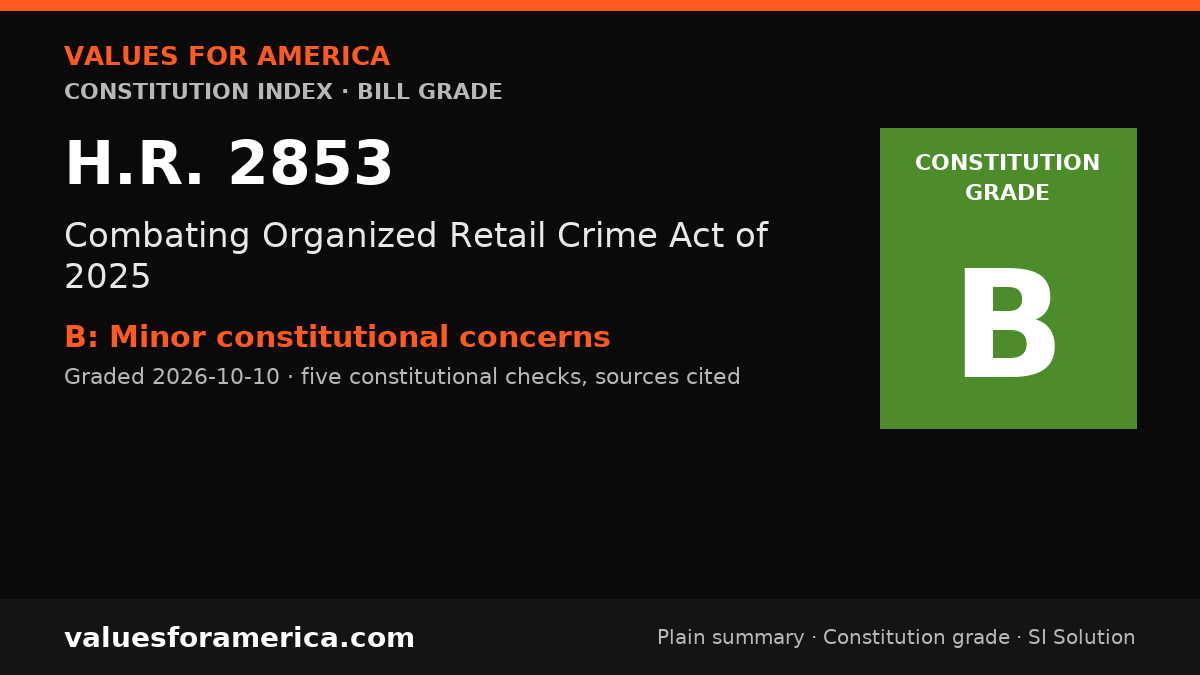
Minor constitutional concerns
Graded 2026-10-10
SI-generated grade · five published checks · not individually reviewed by a person · methodology
The bill is mostly sound but has minor tensions with federalism and decentralization. It expands federal criminal jurisdiction into areas traditionally handled by states, but does so within Congress's enumerated power over interstate commerce. It does not infringe individual rights or due process, but the creation of a federal coordination center consolidates law enforcement upward beyond what is strictly necessary.
-
✓ Passes · Enumerated powers
Congress has authority under Article I, Section 8, Clause 3 (Commerce Clause) to regulate interstate transportation of stolen property and theft from interstate shipments. The bill's provisions on money laundering and forfeiture are ancillary to this power. The creation of a DHS center for coordination is within Congress's power to establish federal agencies under the Necessary and Proper Clause (… -
✓ Passes · Bill of Rights
The bill does not restrict speech, religion, assembly, press, petition, or arms. It does not authorize warrantless searches or seizures (Fourth Amendment) — it only expands existing criminal liability and forfeiture for already-illegal conduct. No cruel or unusual punishment is mandated (Eighth Amendment). The bill does not infringe any enumerated right in the first ten amendments. -
✓ Passes · Individual sovereignty
The bill targets organized criminal enterprises engaged in theft and fraud. It does not restrict lawful individual conduct, property use, speech, labor, or belief. The aggregate-value provision could theoretically sweep in small-scale offenders if they commit multiple minor thefts over a year, but the requirement that the conduct be 'committed by, in coordination with, or at the instruction of an … -
✗ Concern · Decentralization
The bill fails two of the four decentralization questions. (1) Individuals and families cannot handle organized retail crime without government — passed. (2) Local communities and counties can handle most retail theft, but organized crime often crosses state lines — borderline, but passed given interstate nature. (3) States can handle organized retail crime through their own criminal codes and int… -
✓ Passes · Due process and takings
The bill does not bypass procedural due process — it expands existing criminal statutes with clear notice of prohibited conduct. The aggregate-value provision provides fair notice by defining the 12-month period and requiring organized involvement. Forfeiture is authorized only for property obtained from proceeds of an offense, consistent with the Fifth Amendment's Takings Clause (which does not p…
Sources: Congress.gov: HR 2853 summary
Report an error in this grade
What should pass
“VFA SI Solution”
No solution yet
A sourced SI draft appears here once it passes automated checks (Constitution citation, source verification, independent SI critic). How publication works.
Related on VFA

For journalists and bloggers
“Embed this grade”
Free to use with the link back. The badge and card update when the grade changes. Embed terms →
