H.R. 2827 explained · 119th Congress · Pending in Congress
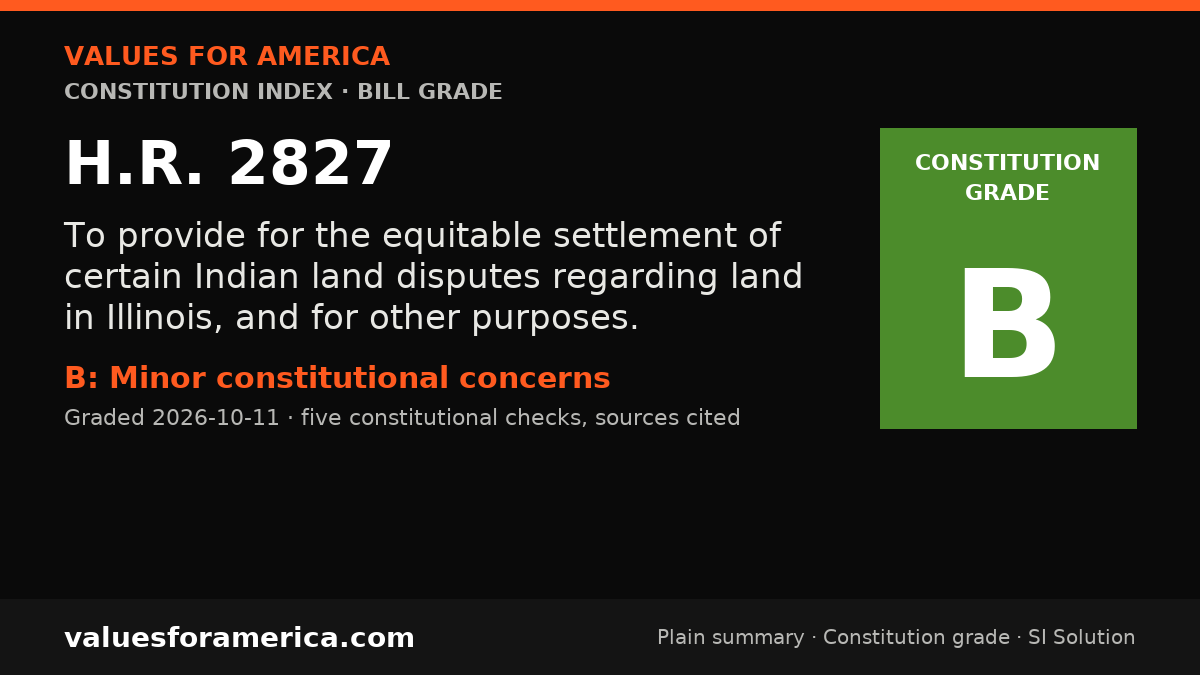
To provide for the equitable settlement of certain Indian land disputes regarding land in Illinois, and for other purposes.
Cosponsors: 2 (1 D, 1 R) · per Congress.gov, 2026-10-14
Introduced: 2025-04-10
Latest action (2026-08-20): Placed on the Union Calendar, Calendar No. 663.
What H.R. 2827 does, in plain terms
This bill confers jurisdiction to the U.S. Court of Federal Claims for the Miami Tribe of Oklahoma's land claim arising under the Treaty of Grouseland. The court must render judgement without regard to the statute of limitations or any delay-based defense. This jurisdiction expires unless such a claim is filed within one year. All other claims, including any future claims, of the tribe to land in Illinois are extinguished.
Official summary by the Congressional Research Service, via Congress.gov.
Constitution Index
“VFA Constitution grade”
Minor constitutional concerns
Graded 2026-10-11
SI-generated grade · five published checks · not individually reviewed by a person · methodology
This bill is mostly sound but has minor tension with the separation of powers and due process. It confers jurisdiction to the U.S. Court of Federal Claims for a specific tribal land claim, waives statute of limitations and delay-based defenses, and extinguishes all other claims. The core purpose—settling Indian land disputes under treaty obligations—falls within Congress's plenary authority over Indian affairs, but the directed waiver of defenses and extinguishment of future claims raise minor due process and sovereignty concerns.
-
✓ Passes · Enumerated powers
Congress has broad constitutional authority over Indian affairs under the Indian Commerce Clause (Article I, Section 8, Clause 3) and the Treaty Clause (Article II, Section 2, Clause 2), as well as inherent plenary power recognized by the Supreme Court (e.g., United States v. Lara, 541 U.S. 193 (2004)). Conferring jurisdiction on the U.S. Court of Federal Claims for a treaty-based land claim is a … -
✓ Passes · Bill of Rights
The bill does not infringe any of the first ten amendments. It does not restrict speech, religion, press, assembly, petition, arms, quartering, search and seizure, self-incrimination, due process (see separate check), fair trial, jury, cruel and unusual punishment, or unenumerated rights. The extinguishment of future claims does not violate the Bill of Rights as it applies to a sovereign tribe's c… -
✓ Passes · Individual sovereignty
The bill addresses a collective tribal land claim, not individual rights. The Miami Tribe of Oklahoma is a sovereign entity, and the bill's provisions—conferring jurisdiction, waiving defenses, and extinguishing claims—operate on the tribe as a government, not on individual persons. No individual's person, property, speech, labor, or belief is restricted. The burden on the government is met by the… -
✗ Concern · Decentralization
The bill fails the decentralization test because it consolidates decision-making at the federal level for a matter that could be handled by the tribe and state. The claim arises from a treaty between the tribe and the federal government, so federal involvement is appropriate, but the extinguishment of all future claims without state or tribal input consolidates power upward. -
✗ Concern · Due process and takings
The bill waives the statute of limitations and any delay-based defense, which is a directed waiver of procedural defenses that would normally be available to the government. This raises a minor due process concern because it denies the government a fair hearing on timeliness. However, the waiver is limited to one claim filed within one year, and the extinguishment of future claims is a legislative…
Sources: Congress.gov: HR 2827 summary
Report an error in this grade
The Framers
“Founders’ Verdict”
Confidence 1.00
Archived SI output (machine-generated)No editorial review recorded. This historical SI verdict was machine-generated by software and predates the review desk; check it against the official bill text.
Synthesis
The bill is constitutional only if it provides just compensation for any property rights extinguished, particularly under the Fifth Amendment's Takings Clause, and does not violate treaty obligations or due process. All four Founders agree that Congress has the power to confer jurisdiction on the U.S. Court of Federal Claims and waive statutes of limitations, but the extinguishment of all future claims without compensation raises constitutional concerns.
The bill proposes to confer jurisdiction on the U.S. Court of Federal Claims for a specific tribal land claim, waiving the statute of limitations and delay-based defenses, and extinguishing all other claims. Under Article III, Section 2, Clause 1, the judicial power extends to controversies to which the United States is a party, and Congress may define the jurisdiction of inferior federal courts, including the Court of Federal Claims, as per Article I, Section 8, Clause 9 (power to constitute tribunals inferior to the Supreme Court). However, the extinguishment of future claims without compens…
While Congress possesses the authority under the Indian Commerce Clause (Article I, Section 8, Clause 3) to regulate affairs with Indian tribes, this bill's extinguishment of all land claims of the Miami Tribe of Oklahoma, including future claims, without provision for just compensation raises grave concerns under the Fifth Amendment's protection of private property: 'nor shall private property be taken for public use, without just compensation.' The retroactive waiver of statutes of limitations and delay-based defenses further intrudes upon settled legal principles of due process, also secure…
This bill raises two distinct constitutional questions. First, it confers jurisdiction on the U.S. Court of Federal Claims for a specific tribal claim, waiving statutes of limitations and delay-based defenses. Congress has the power to define the jurisdiction of inferior federal courts under Article III, Section 1, and to regulate commerce with Indian tribes under Article I, Section 8, Clause 3. However, the extinguishment of all other claims, including future ones, must be examined under the Treaty Clause (Article II, Section 2, Clause 2) and the principle that treaties are the supreme law of…
This bill proposes to confer jurisdiction upon the U.S. Court of Federal Claims for a specific tribal land claim, waiving the statute of limitations and delay-based defenses, while extinguishing all other claims. Under Article III, Section 2, the judicial power extends to controversies to which the United States is a party, and Congress may define the jurisdiction of inferior federal courts, as affirmed in Marbury v. Madison (1803) which established that Congress cannot expand the original jurisdiction of the Supreme Court beyond what the Constitution prescribes, but may regulate the jurisdict…
Report an error in this Founders' Verdict
What should pass
“VFA SI Solution”
No solution yet
A sourced SI draft appears here once it passes automated checks (Constitution citation, source verification, independent SI critic). How publication works.
Related on VFA

For journalists and bloggers
“Embed this grade”
Free to use with the link back. The badge and card update when the grade changes. Embed terms →
