H.R. 2821 explained · 119th Congress · Pending in Congress
FDA Modernization Act 3.0
Cosponsors: 41 (21 D, 20 R) · per Congress.gov, 2026-10-15
Introduced: 2025-04-10
Latest action (2026-07-21): Received in the Senate.
What H.R. 2821 does, in plain terms
FDA Modernization Act 3.0 This bill requires the Food and Drug Administration (FDA) to publish an interim final rule implementing a provision of the Consolidated Appropriations Act of 2023 that authorized the use of certain alternatives to animal testing to support investigational use of a new drug. The rule must replace references to animal tests, data, studies, models, and research with references to nonclinical tests, data, studies, models, and research throughout the FDA’s regulations governing investigational new drug applications. The rule must be published within one year of the bill’s enactment, and must take immediate effect as an interim final rule.
Official summary by the Congressional Research Service, via Congress.gov.
Constitution Index
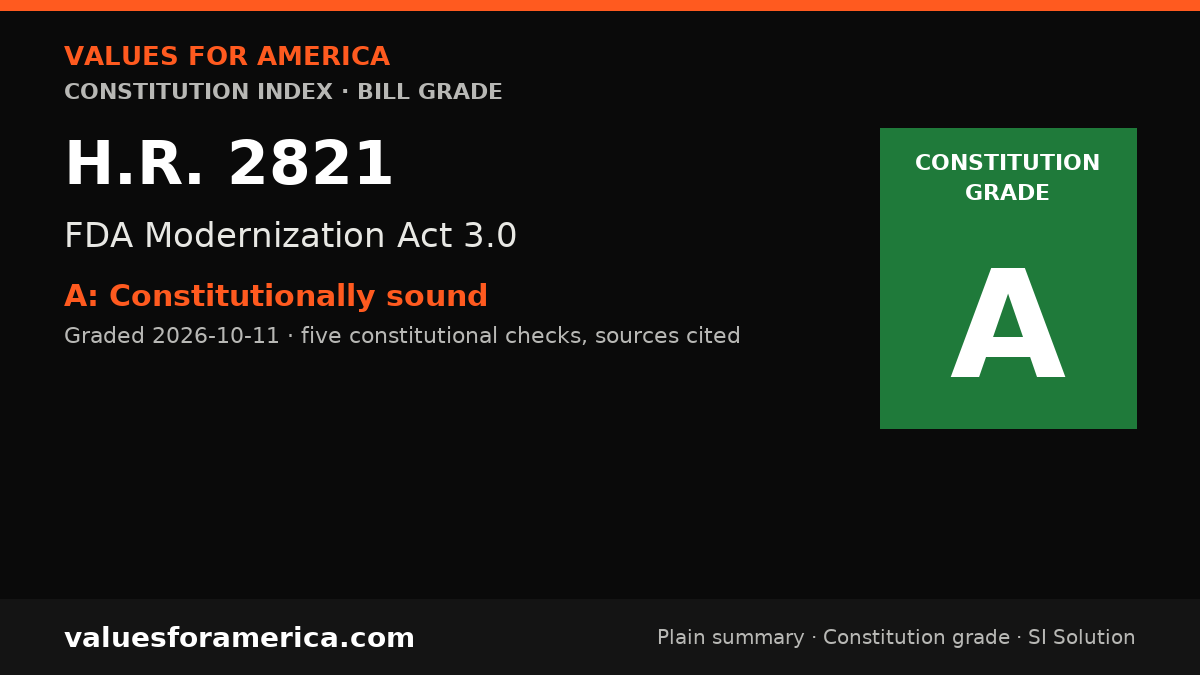
“VFA Constitution grade”
Constitutionally sound
Graded 2026-10-11
SI-generated grade · five published checks · not individually reviewed by a person · methodology
The FDA Modernization Act 3.0 is a procedural and administrative measure that directs the FDA to update its regulations to reflect existing statutory authority. It does not expand federal power beyond the enumerated authority to regulate interstate commerce in drugs, nor does it infringe on any constitutional rights. The bill is consistent with the Tenth Amendment as it does not commandeer state governments, and it does not implicate due process or takings concerns.
-
✓ Passes · Enumerated powers
The bill directs the FDA, an agency within the executive branch, to implement a provision of the Consolidated Appropriations Act of 2023. This falls within Congress's enumerated power under Article I, Section 8, Clause 3 (the Commerce Clause) to regulate interstate and foreign commerce in drugs. The FDA's authority over new drug applications is a well-established exercise of this power. The bill d… -
✓ Passes · Bill of Rights
The bill does not implicate any of the first ten amendments. It does not restrict speech, religion, assembly, press, petition, the right to bear arms, quartering of soldiers, search and seizure, self-incrimination, due process, takings, fair trial, jury trial, or cruel and unusual punishment. It is a purely administrative rulemaking requirement. -
✓ Passes · Individual sovereignty
The bill does not restrict individual liberty or property rights. It does not impose new obligations on individuals; rather, it directs the FDA to update its internal regulations. The change from animal testing to nonclinical alternatives does not restrict individual freedom but may actually reduce regulatory burdens on drug developers. There is no compelling constitutional issue here. -
✓ Passes · Decentralization
The bill concerns the regulation of new drugs, which is inherently a national matter due to the interstate nature of drug development and marketing. An individual, family, or local community cannot effectively regulate the safety and efficacy of drugs that cross state lines. A state could theoretically regulate drugs, but a patchwork of state regulations would burden interstate commerce and create… -
✓ Passes · Due process and takings
The bill does not bypass due process or take property without just compensation. It requires the FDA to publish an interim final rule, which is a standard administrative procedure that includes notice and comment (even if post-promulgation). The rule does not deprive any person of life, liberty, or property without due process. It does not involve any taking of private property for public use.
Sources: Congress.gov: HR 2821 summary
Report an error in this grade
The Framers
“Founders’ Verdict”
Confidence 1.00
Archived SI output (machine-generated)No editorial review recorded. This historical SI verdict was machine-generated by software and predates the review desk; check it against the official bill text.
Synthesis
The bill is a constitutional exercise of Congress's commerce and necessary and proper powers, and does not violate separation of powers or federalism.
This bill is a legitimate exercise of Congress's power under the Commerce Clause and the Necessary and Proper Clause to regulate the approval of new drugs and to direct the FDA in implementing statutory provisions. Requiring an interim final rule that takes immediate effect is a permissible legislative instruction; Congress may prescribe the form of agency action without violating separation of powers. The delegation to the FDA is limited and specific, providing an intelligible principle for rulemaking, and the one-year deadline is a reasonable time frame. The bill does not encroach upon the P…
The FDA Modernization Act 3.0 operates within the enumerated powers of Congress under the Commerce Clause to regulate the introduction of new drugs in interstate commerce, and the Necessary and Proper Clause empowers Congress to direct the FDA to issue rules to effectuate that regulation. While I hold a strict construction of federal power, the oversight of drug safety and efficacy has been consistently understood as a federal matter, and this bill merely updates the methods for assessing such safety and efficacy. I do not find that it violates the Tenth Amendment, as it does not commandeer st…
This bill is a valid exercise of Congress's power under the Commerce Clause to regulate interstate commerce in drugs. The directive to the Food and Drug Administration to replace references to animal testing with nonclinical tests in its regulations is a specific legislative instruction that falls within the agency's delegated authority and does not violate the separation of powers; Congress may prescribe the manner in which executive agencies execute the laws. The requirement for an interim final rule to take immediate effect is a procedural choice that Congress may dictate, and it does not i…
This bill is a constitutional exercise of Congress's power to regulate interstate commerce and to make all laws necessary and proper for executing that power. The regulation of new drugs and the procedures for their approval directly affect interstate commerce, as drugs are articles of commerce moving among the states. Congress may direct an executive agency, such as the Food and Drug Administration, to issue rules implementing statutory directives, and the requirement to replace references to animal tests with nonclinical tests is a specific, permissible instruction that does not exceed the l…
Report an error in this Founders' Verdict
What should pass
“VFA SI Solution”
No solution yet
A sourced SI draft appears here once it passes automated checks (Constitution citation, source verification, independent SI critic). How publication works.
Related on VFA

For journalists and bloggers
“Embed this grade”
Free to use with the link back. The badge and card update when the grade changes. Embed terms →
