H.R. 28 explained · 119th Congress · Pending in Congress
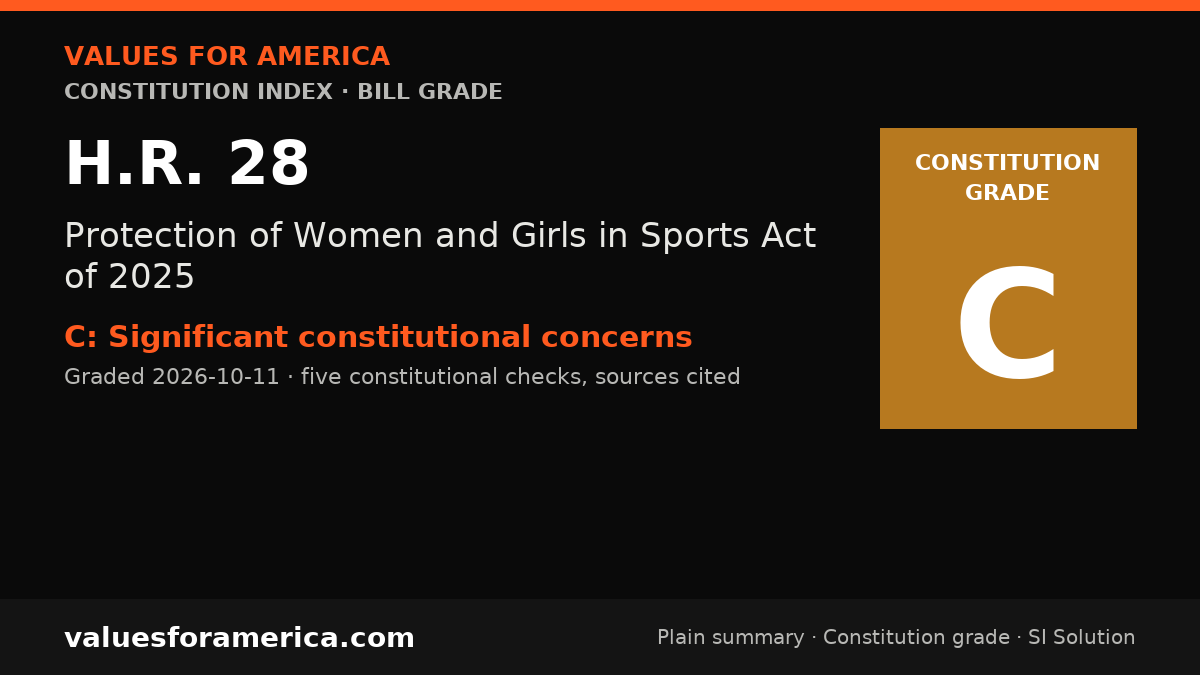
Protection of Women and Girls in Sports Act of 2025
Cosponsors: 83 (0 D, 83 R) · per Congress.gov, 2026-10-12
Introduced: 2025-01-03
Latest action (2025-01-15): Received in the Senate.
What H.R. 28 does, in plain terms
Protection of Women and Girls in Sports Act of 2025 This bill generally prohibits school athletic programs from allowing individuals whose biological sex at birth was male to participate in programs that are for women or girls. Specifically, the bill provides that it is a violation of Title IX of the Education Amendments of 1972 for federally funded education programs or activities to operate, sponsor, or facilitate athletic programs or activities that allow individuals of the male sex to participate in programs or activities that are designated for women or girls. (Title IX prohibits discrimination on the basis of sex in federally funded education programs or activities, including in public elementary and secondary schools and in colleges and universities.) Under the bill, sex is based on an individual's reproductive biology and genetics at birth. The bill does not prohibit male individuals from training or practicing with programs or activities for women or girls as long as such training or practice does not deprive any female of corresponding opportunities or benefits. The Government Accountability Office must report on the benefits for women or girls in single-sex sports that would be lost as a result of male participation. In particular, the report must document the negative psychological, developmental, participatory, and sociological effects of male participation on girls.
Official summary by the Congressional Research Service, via Congress.gov.
Constitution Index
“VFA Constitution grade”
Significant constitutional concerns
Graded 2026-10-11
SI-generated grade · five published checks · not individually reviewed by a person · methodology
The bill raises significant constitutional concerns regarding federal overreach into state and local control of education and athletics, and it imposes a categorical rule that may infringe on the rights of transgender individuals. While it aims to protect women's sports, the means chosen are overly broad and may not withstand constitutional scrutiny.
-
✗ Concern · Enumerated powers
The bill conditions federal funding on compliance with its provisions, invoking Congress's spending power under Article I, Section 8, Clause 1. However, the conditions are not clearly related to the purpose of the funding (education) and may be seen as coercive, potentially exceeding the limits of the spending power as articulated in cases like South Dakota v. Dole. The bill also mandates a GAO re… -
✗ Concern · Bill of Rights
The bill's categorical exclusion of transgender individuals from women's sports may implicate the Equal Protection Clause of the Fourteenth Amendment (though not part of the Bill of Rights, it is a key constitutional provision). It also raises concerns under the Ninth Amendment, which protects unenumerated rights, including the right to privacy and bodily autonomy. The bill's definition of sex bas… -
✗ Concern · Individual sovereignty
The bill restricts the ability of transgender individuals to participate in sports consistent with their gender identity, which is a significant restriction on personal autonomy and self-determination. The government must demonstrate a compelling interest for such a restriction, and while protecting women's sports is a legitimate interest, the categorical ban may be overbroad and not narrowly tail… -
✗ Concern · Decentralization
The bill centralizes decision-making at the federal level, overriding the traditional role of states and local communities in determining athletic policies. While there is a federal interest in enforcing Title IX, the bill's prescriptive mandate leaves little room for local variation and could be seen as consolidating authority upward. The questions: (1) Individuals and families could handle this … -
✗ Concern · Due process and takings
The bill may deprive transgender individuals of opportunities without adequate procedural protections, as it imposes a blanket rule without individualized assessment. This could be seen as arbitrary and capricious, violating substantive due process. Additionally, if the bill results in the loss of athletic opportunities or scholarships, it could implicate the Takings Clause, though that is less li…
Sources: Congress.gov: HR 28 summary
Report an error in this grade
What should pass
“VFA SI Solution”
No solution yet
A sourced SI draft appears here once it passes automated checks (Constitution citation, source verification, independent SI critic). How publication works.
Related on VFA

For journalists and bloggers
“Embed this grade”
Free to use with the link back. The badge and card update when the grade changes. Embed terms →
