H.R. 2795 explained · 119th Congress · Pending in Congress
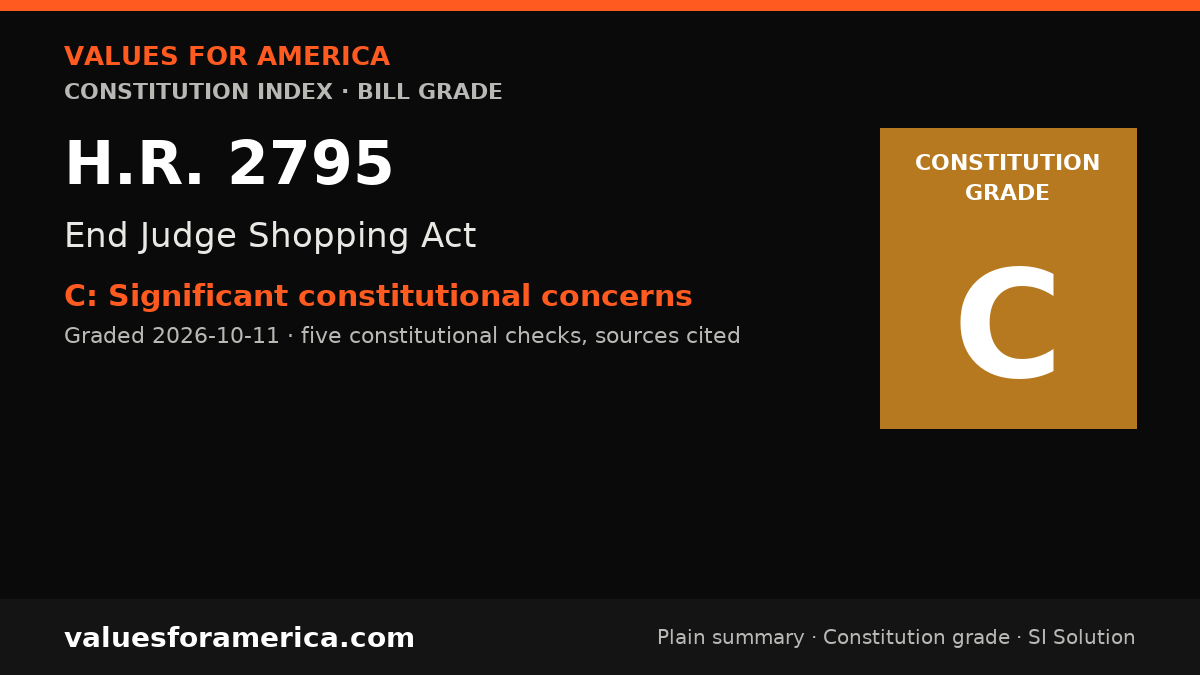
End Judge Shopping Act
Cosponsors: none · per Congress.gov, 2026-10-11
Introduced: 2025-04-09
Latest action (2025-04-09): Referred to the House Committee on the Judiciary.
What H.R. 2795 does, in plain terms
End Judge Shopping Act This bill requires a civil action that seeks a widely enforceable order to be brought in a division of a judicial district with two or more active judges.
Official summary by the Congressional Research Service, via Congress.gov.
Constitution Index
“VFA Constitution grade”
Significant constitutional concerns
Graded 2026-10-11
SI-generated grade · five published checks · not individually reviewed by a person · methodology
The bill raises significant constitutional concerns by restricting the venue for civil actions seeking widely enforceable orders, potentially infringing on the right to petition the courts and the structural principle of judicial independence. While Congress has authority over federal court jurisdiction, the bill's approach to venue regulation may unduly burden access to justice and consolidate judicial decision-making in a way that undermines the constitutional design of district courts.
-
✓ Passes · Enumerated powers
Congress has explicit authority under Article III, Section 1 to establish and regulate inferior federal courts, including rules of venue and procedure. The bill's requirement that certain civil actions be brought in divisions with two or more active judges falls within Congress's power to structure the federal judiciary. However, this power is not unlimited and must be exercised consistent with ot… -
✗ Concern · Bill of Rights
The bill implicates the First Amendment right to petition the government for redress of grievances, which includes access to the courts. By restricting venue for actions seeking widely enforceable orders, the bill may make it more difficult for plaintiffs to obtain timely and convenient judicial relief, potentially chilling the exercise of this right. While venue rules are generally permissible, t… -
✗ Concern · Individual sovereignty
The bill restricts an individual's ability to choose the forum for their lawsuit, which is a significant aspect of their right to seek legal redress. While the government has a legitimate interest in preventing 'judge shopping,' the restriction must be narrowly tailored to achieve that interest. The bill's blanket requirement for all actions seeking widely enforceable orders may be overbroad, limi… -
✗ Concern · Decentralization
The bill consolidates decision-making at the federal level by imposing a uniform venue rule on all district courts, which may reduce the ability of individual districts to manage their own dockets and procedures. While the federal judiciary is inherently centralized, the bill's approach could be seen as an unnecessary consolidation of power, as it overrides local court rules and practices. The que… -
✗ Concern · Due process and takings
The bill may raise due process concerns by potentially denying plaintiffs a fair opportunity to present their case in a convenient forum. While venue rules are procedural and generally do not violate due process, the bill's specific restriction could be seen as arbitrary if it does not provide a reasonable alternative for plaintiffs who are far from the designated divisions. Additionally, the bill…
Sources: Congress.gov: HR 2795 summary
Report an error in this grade
What should pass
“VFA SI Solution”
No solution yet
A sourced SI draft appears here once it passes automated checks (Constitution citation, source verification, independent SI critic). How publication works.
Related on VFA

For journalists and bloggers
“Embed this grade”
Free to use with the link back. The badge and card update when the grade changes. Embed terms →
