H.R. 275 explained · 119th Congress · Pending in Congress
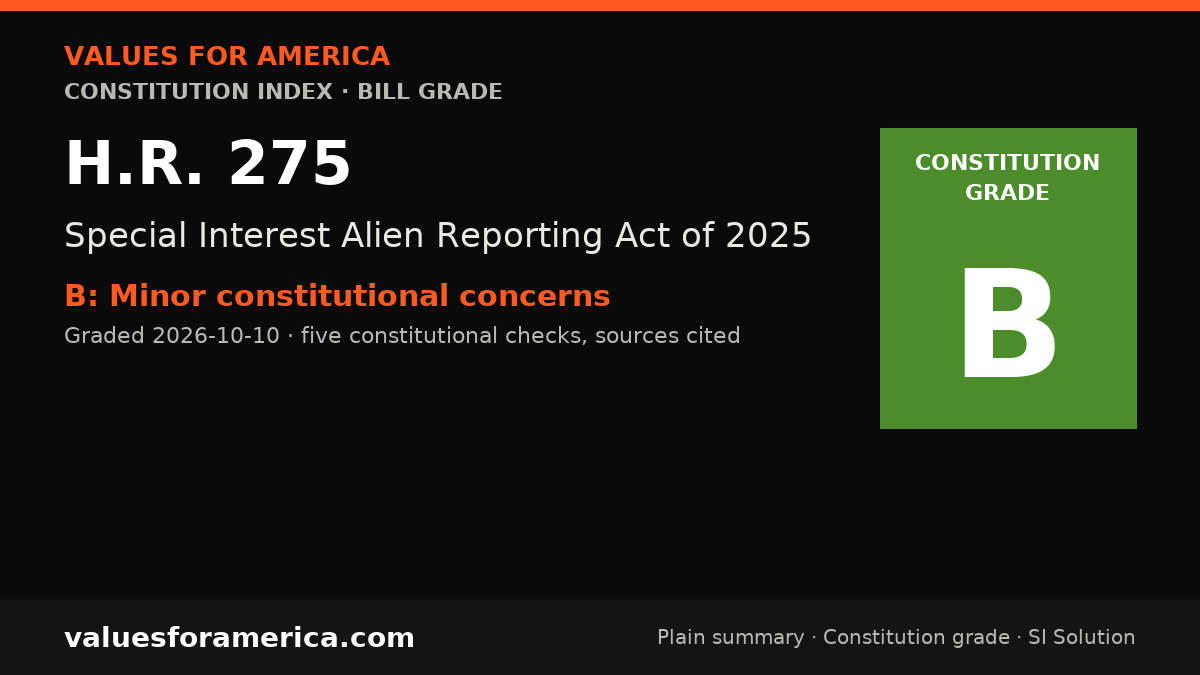
Special Interest Alien Reporting Act of 2025
Cosponsors: 6 (0 D, 6 R) · per Congress.gov, 2026-10-11
Introduced: 2025-01-09
Latest action (2025-06-27): Received in the Senate and Read twice and referred to the Committee on Homeland Security and Governmental Affairs.
What H.R. 275 does, in plain terms
Special Interest Alien Reporting Act of 2024 [sic] This bill requires the Department of Homeland Security (DHS) to report every month on non-U.S. nationals (aliens under federal law) who attempt to unlawfully enter the United States and who potentially pose a national security risk. DHS must report on (1) the number of individuals, (2) the nationalities or countries of last residence of these individuals, and (3) the location of the encounters.
Official summary by the Congressional Research Service, via Congress.gov.
Constitution Index
“VFA Constitution grade”
Minor constitutional concerns
Graded 2026-10-10
SI-generated grade · five published checks · not individually reviewed by a person · methodology
The bill is a reporting requirement that falls within Congress's broad authority over immigration and national security. It does not directly infringe on individual rights, as it only mandates the collection and reporting of aggregate data on encounters with individuals attempting unlawful entry who may pose a national security risk. However, there are minor concerns about potential privacy implications and the lack of explicit safeguards against the misuse of the reported data, which could be addressed through amendments.
-
✓ Passes · Enumerated powers
Congress has explicit authority over naturalization and immigration under Article I, Section 8, Clause 4, and the power to regulate foreign commerce under Article I, Section 8, Clause 3. Additionally, the federal government has inherent authority over national security and border control. Requiring DHS to report on individuals attempting unlawful entry is a reasonable exercise of these powers. -
✓ Passes · Bill of Rights
The bill does not directly infringe on any of the first ten amendments. It does not restrict speech, religion, assembly, press, or petition. It does not involve searches or seizures, as it only mandates reporting on encounters that have already occurred. It does not implicate the Second, Third, Fifth, Sixth, Seventh, Eighth, Ninth, or Tenth Amendments. The reporting is administrative and does not … -
✓ Passes · Individual sovereignty
The bill does not restrict what individuals can do with their own person, property, speech, labor, or belief. It only requires the government to compile and report aggregate data on individuals who have attempted unlawful entry and may pose a national security risk. While there is a potential privacy concern, the reporting is limited to numbers, nationalities, and encounter locations, and does not… -
✓ Passes · Decentralization
Immigration and border control are inherently federal responsibilities, as they involve foreign relations and national security. An individual or family cannot handle border enforcement, a local community cannot manage international borders, and a state cannot unilaterally regulate immigration without conflicting with federal law. This action does not consolidate decision-making at a higher level … -
✓ Passes · Due process and takings
The bill does not bypass due process or take property. It is a reporting requirement that does not affect the legal status or rights of any individual. It does not impose penalties or deprive anyone of life, liberty, or property. The reporting is for informational purposes and does not constitute an adjudicative action.
Sources: Congress.gov: HR 275 summary
Report an error in this grade
What should pass
“VFA SI Solution”
No solution yet
A sourced SI draft appears here once it passes automated checks (Constitution citation, source verification, independent SI critic). How publication works.
Related on VFA

For journalists and bloggers
“Embed this grade”
Free to use with the link back. The badge and card update when the grade changes. Embed terms →
