H.R. 274 explained · 119th Congress · Pending in Congress
Sunset Chevron Act
Cosponsors: 16 (0 D, 16 R) · per Congress.gov, 2026-10-12
Introduced: 2025-01-09
Latest action (2025-01-09): Referred to the Committee on the Judiciary, and in addition to the Committees on Oversight and Government Reform, and Rules, for a period to be subsequently determined by the Speaker, in each case for consideration of such provisions as fall within the jurisdiction of the committee concerned.
What H.R. 274 does, in plain terms
Sunset Chevron Act This bill requires the Government Accountability Office (GAO) to compile a list of federal agency rules that were upheld under the administrative law doctrine of Chevron deference. It also establishes sunset dates for the rules and requires the GAO list to include the dates. (In Loper Bright Enterprises v. Raimondo, the Supreme Court overturned Chevron v. Natural Resources Defense Council and held that courts must exercise their independent judgment in deciding whether an agency has acted within its statutory authority. Under Loper, the courts may not defer to an agency interpretation of the law simply because a statute is ambiguous, as the Chevron doctrine required.) The GAO list must include each federal court decision that (1) upheld a rule based on Chevron deference, (2) was not subsequently overturned, and (3) pertains to a rule that is in effect on the date of enactment of this bill. The list must also include a sunset date for each identified rule. The sunset date for each agency's most recent rule on the list must be 30 days after the list is published. The sunset date for each prior rule of the agency must be 30 days after the sunset date of the rule preceding it on the list. Further, rules identified on the list are subject to a joint resolution of disapproval under the Congressional Review Act without regard to the 60-legislative-day limit on the period for filing such a resolution after a rule has been received by Congress.
Official summary by the Congressional Research Service, via Congress.gov.
Constitution Index
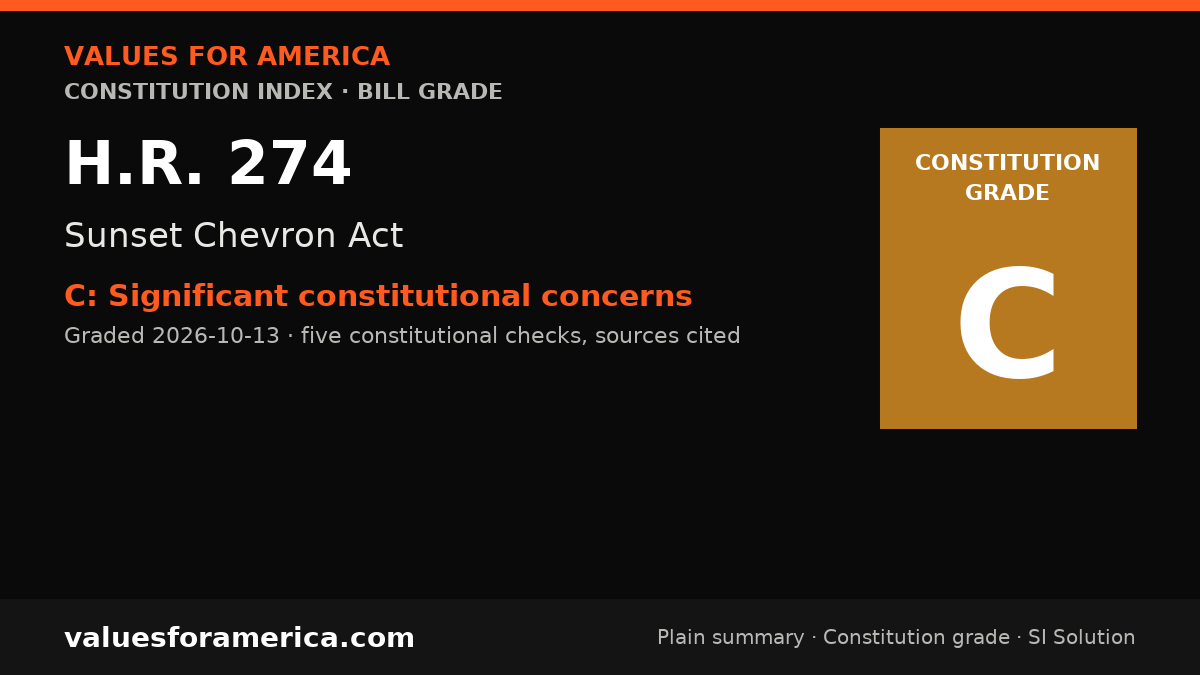
“VFA Constitution grade”
Significant constitutional concerns
Graded 2026-10-13
SI-generated grade · five published checks · not individually reviewed by a person · methodology
The Sunset Chevron Act raises significant constitutional concerns by retroactively sunsetting agency rules based on judicial decisions that applied a now-overturned doctrine. While Congress has broad authority over federal agencies and can repeal or amend statutes, the bill's mechanism of automatically sunsetting rules without a new legislative act may violate the separation of powers by effectively delegating legislative authority to the executive branch (GAO) and by bypassing the bicameralism and presentment requirements for changing the law. Additionally, the bill's retroactive application and lack of individualized due process for affected parties raise due process concerns. The bill also consolidates decision-making at the federal level, but this is inherent in federal agency rulemaking. Overall, the bill is not a direct violation of the Bill of Rights but has significant structural and procedural issues that require a rewrite to align with constitutional principles.
-
✓ Passes · Enumerated powers
Congress has the power to legislate on matters within its enumerated powers, and the regulation of federal agencies falls under its authority to make laws necessary and proper for executing its enumerated powers (Article I, Section 8, Clause 18). The bill seeks to sunset rules that were upheld under Chevron deference, which is a matter of administrative law and government operations. Congress has … -
✓ Passes · Bill of Rights
The bill does not directly infringe upon any of the first ten amendments. It does not restrict speech, religion, assembly, press, petition, arms, quartering, search and seizure, self-incrimination, due process (in the criminal context), fair trial, jury, cruel and unusual punishment, or unenumerated rights. The bill's impact on property rights is indirect and not a taking. Therefore, no Bill of Ri… -
✗ Concern · Individual sovereignty
The bill restricts the ability of individuals and businesses to rely on existing agency rules that have been in effect, potentially affecting their property, contracts, and expectations. By sunsetting rules without a new legislative act, the bill imposes a significant restriction on individual freedom to operate under established regulations. The government has not provided a compelling justificat… -
✗ Concern · Decentralization
The bill consolidates decision-making at the federal level by having GAO compile the list and set sunset dates, and by subjecting rules to a joint resolution of disapproval under the Congressional Review Act. This is a federal action, and the questions are: (1) Could an individual or family handle this? No, because individuals cannot sunset federal rules. (2) Could a local community or county hand… -
✗ Concern · Due process and takings
The bill raises due process concerns because it retroactively sunset rules without providing affected parties with notice and an opportunity to be heard. The sunsetting of rules can deprive individuals and businesses of vested rights and expectations, and the bill does not provide for any individualized review or hearing. Additionally, the bill may constitute a taking of property without just comp…
Sources: Congress.gov: HR 274 summary
Report an error in this grade
What should pass
“VFA SI Solution”
No solution yet
A sourced SI draft appears here once it passes automated checks (Constitution citation, source verification, independent SI critic). How publication works.
Related on VFA

For journalists and bloggers
“Embed this grade”
Free to use with the link back. The badge and card update when the grade changes. Embed terms →
