H.R. 2715 explained · 119th Congress · Pending in Congress
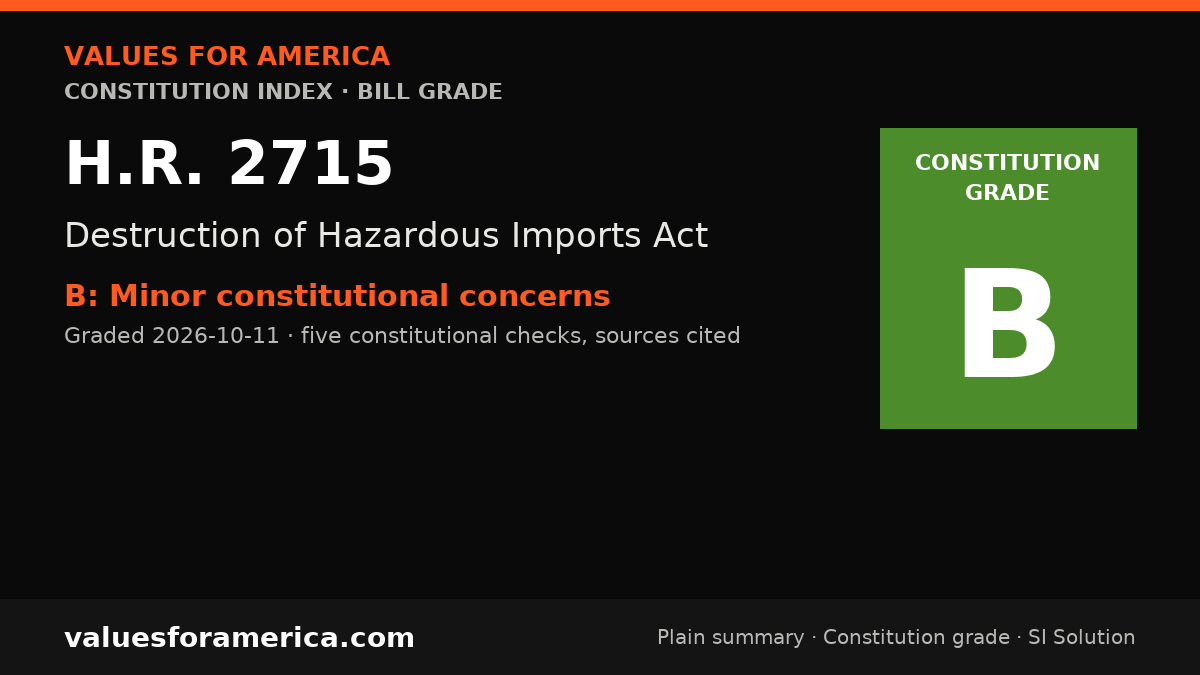
Destruction of Hazardous Imports Act
Cosponsors: 18 (4 D, 14 R) · per Congress.gov, 2026-10-15
Introduced: 2025-04-08
Latest action (2026-07-21): Received in the Senate and Read twice and referred to the Committee on Health, Education, Labor, and Pensions.
What H.R. 2715 does, in plain terms
Destruction of Hazardous Imports Act This bill expands the Food and Drug Administration’s (FDA’s) authority to require the destruction of certain items that are refused import into the United States and pose a risk to public health. Under current law, imported food, drugs, medical devices, tobacco products, and cosmetics are subject to FDA review. If an imported item is deficient in a specified manner (e.g., counterfeit, misbranded, or manufactured under insanitary conditions), the item is generally refused admission to the United States. An item refused admission may generally be exported, except that the FDA may destroy a drug, medical device, or tobacco product that is valued under $2,500 without the opportunity for export. Under the bill, the FDA may order the destruction, without the opportunity for export, of any food, drug, medical device, tobacco product, or cosmetic that is refused admission if the item presents a significant public health concern. If such an order is issued, the item’s owner or consignee must destroy it within 90 days at their own cost. The bill also prohibits the unauthorized movement (e.g., export) of an item subject to a destruction order. A violator is subject to a fine, a prison term of up to one year, or both. The FDA must promulgate regulations to carry out these provisions. These regulations must provide for due process for the owner or consignee of an item subject to a destruction order, including notice and an opportunity to appear before the item is destroyed.
Official summary by the Congressional Research Service, via Congress.gov.
Constitution Index
“VFA Constitution grade”
Minor constitutional concerns
Graded 2026-10-11
SI-generated grade · five published checks · not individually reviewed by a person · methodology
The bill is a federal exercise of the Commerce Clause power to regulate imports, which is well-established. It raises minor due process concerns because it allows destruction of property without a prior hearing, but it mandates regulations that must provide notice and an opportunity to appear, which mitigates the concern. The bill does not infringe on core Bill of Rights protections, and it appropriately addresses a public health risk at the federal level, given that imports are inherently interstate and international. The main issue is the potential for property deprivation without a full pre-deprivation hearing, but the statutory requirement for due process regulations and the 90-day window for destruction provide a reasonable balance.
-
✓ Passes · Enumerated powers
The federal government has explicit authority to regulate foreign commerce under Article I, Section 8, Clause 3 (the Commerce Clause). This bill regulates imported items that are refused admission, which is a direct exercise of that power. The FDA's authority over imports is a longstanding and accepted federal function. -
✓ Passes · Bill of Rights
The bill does not implicate the First, Second, Third, Sixth, Seventh, or Eighth Amendments. The Fourth Amendment is not directly implicated because the destruction order is an administrative action, not a search or seizure. The Fifth Amendment's Due Process Clause is relevant, but the bill explicitly requires regulations that provide for notice and an opportunity to appear, which addresses procedu… -
✓ Passes · Individual sovereignty
The bill restricts the owner's ability to export or move refused items, but this is a reasonable exercise of the government's authority to protect public health. The owner retains the right to challenge the destruction order through the required due process procedures. The restriction is not arbitrary and is tied to a compelling public health interest. -
✓ Passes · Decentralization
The bill concerns imported goods, which are inherently interstate and international. An individual or local community cannot effectively regulate imports, and states cannot unilaterally control the flow of goods across national borders. Federal action is the minimum necessary level of government to address this issue. The bill does not consolidate decision-making upward beyond what is necessary. -
✓ Passes · Due process and takings
The bill allows the FDA to order destruction of property without a prior hearing, which could be seen as a deprivation of property without due process. However, the bill explicitly requires the FDA to promulgate regulations that provide for notice and an opportunity to appear before destruction. This satisfies procedural due process requirements, as long as the regulations are implemented. The 90-…
Sources: Congress.gov: HR 2715 summary
Report an error in this grade
The Framers
“Founders’ Verdict”
Confidence 0.75
Archived SI output (machine-generated)No editorial review recorded. This historical SI verdict was machine-generated by software and predates the review desk; check it against the official bill text.
Synthesis
The Destruction of Hazardous Imports Act is a constitutional exercise of Congress's power to regulate foreign commerce under Article I, Section 8, Clause 3. The power to exclude and destroy hazardous imported goods is inherent in the commerce power, and the bill's provision for notice and an opportunity to be heard satisfies the Fifth Amendment's Due Process Clause. The destruction of refused items does not constitute a taking requiring compensation because the items are not lawfully admitted into the United States. The criminal penalties and prohibition on unauthorized movement are necessary and proper to effectuate the destruction orders, consistent with the Necessary and Proper Clause and the broad federal authority over foreign commerce recognized in Federalist Nos. 23 and 45 and Gibbons v. Ogden.
The Destruction of Hazardous Imports Act is a constitutional exercise of Congress's power to regulate foreign commerce under Article I, Section 8, Clause 3. The federal government possesses plenary authority over imports, including the power to exclude or destroy goods that pose a significant public health risk. As argued in Federalist No. 23, the national government must be vested with all powers necessary for the common defense and general welfare, which includes protecting the public from hazardous imported articles. The bill's provision for due process through notice and an opportunity to …
The Congress possesses authority under the Commerce Clause to regulate imported articles that threaten public health. However, the power to destroy private property without compensation and with only administrative due process raises grave concerns under the Fifth Amendment, which prohibits the taking of property for public use without just compensation and guarantees due process of law. The Tenth Amendment further reminds us that powers not delegated to the United States are reserved to the states or the people. As written, the bill authorizes the destruction of property without any provision…
The proposed bill is a valid exercise of Congress's power to regulate commerce with foreign nations, as it addresses the destruction of imported items that have been refused admission and pose a public health risk. This authority is grounded in the Commerce Clause, which empowers Congress to control the terms of importation, including the disposition of goods that fail to meet lawful standards. The bill's provision for due process, including notice and an opportunity to be heard, satisfies the Fifth Amendment's requirement that no person be deprived of property without due process of law. The …
The Destruction of Hazardous Imports Act is a constitutional exercise of the power of Congress to regulate commerce with foreign nations, as vested by Article I, Section 8, Clause 3. The act authorizes the destruction of imported items that are refused admission and pose a significant public health risk. This power is inherent in the authority to exclude and control the entry of goods, as the power to regulate commerce includes the power to prohibit the introduction of harmful articles. The provision for due process, including notice and an opportunity to appear before destruction, satisfies t…
Report an error in this Founders' Verdict
What should pass
“VFA SI Solution”
No solution yet
A sourced SI draft appears here once it passes automated checks (Constitution citation, source verification, independent SI critic). How publication works.
Related on VFA

For journalists and bloggers
“Embed this grade”
Free to use with the link back. The badge and card update when the grade changes. Embed terms →
