H.R. 2709 explained · 119th Congress · Pending in Congress
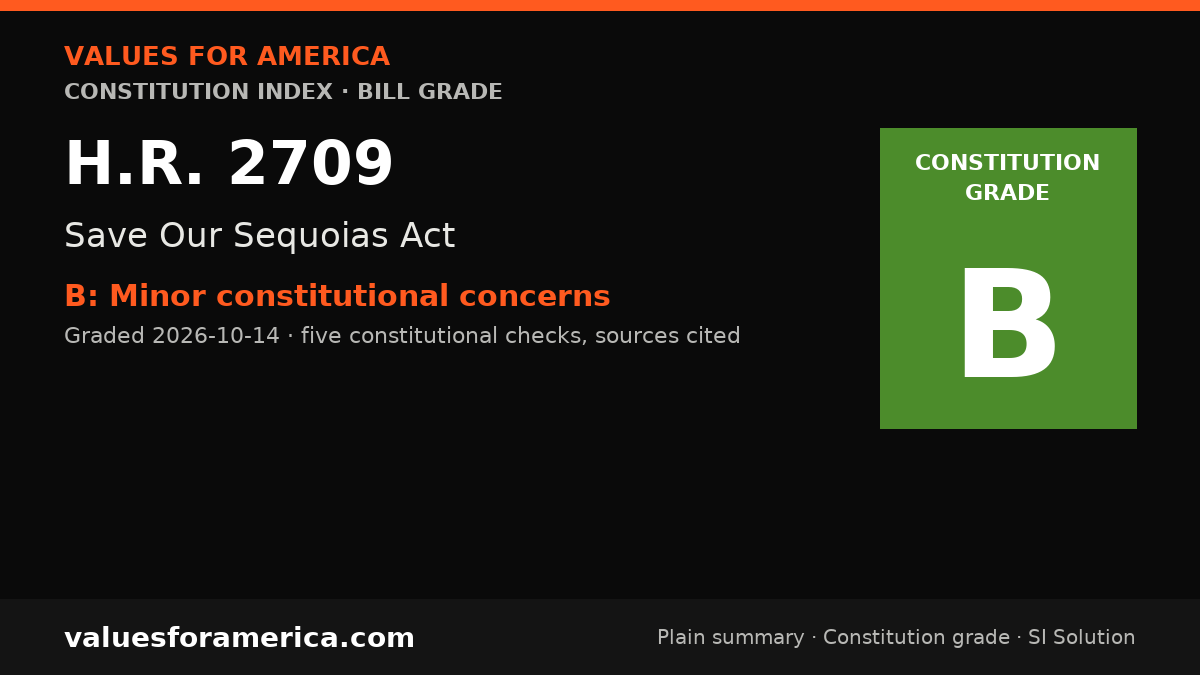
Save Our Sequoias Act
Cosponsors: 29 (13 D, 16 R) · per Congress.gov, 2026-10-14
Introduced: 2025-04-08
Latest action (2026-09-16): Committee on Energy and Natural Resources. Hearings held.
What H.R. 2709 does, in plain terms
Save Our Sequoias Act This bill provides for the conservation of giant sequoia trees (Sequoiadendron giganteum) in California. Specifically, it provides statutory authority for the Giant Sequoia Lands Coalition and outlines the coalition's duties. The coalition must submit a Giant Sequoia Health and Resiliency Assessment and annually update it. The information from the assessment must be made available so the information can be integrated into certain other plans. The coalition must also create and maintain a website that contains the assessment, educational materials, searchable information about individual giant sequoia groves, and a searchable database to track the status and costs of reforestation and rehabilitation activities. In addition, the bill declares an emergency on certain public lands and allows officials to carry out protection plans during the emergency to respond to the threat of wildfires, insects, and drought. The emergency expires after seven years. The Department of the Interior must develop and implement a Giant Sequoia Reforestation and Rehabilitation Strategy. Finally, the bill establishes a variety of programs and funds to support the conservation of giant sequoias.
Official summary by the Congressional Research Service, via Congress.gov.
Constitution Index
“VFA Constitution grade”
Minor constitutional concerns
Graded 2026-10-14
SI-generated grade · five published checks · not individually reviewed by a person · methodology
The Save Our Sequoias Act is a federal conservation measure that operates within the scope of federal authority over public lands and interstate commerce, but it raises minor concerns regarding the breadth of the emergency declaration and the potential for federal overreach into state and local land management decisions. The bill does not infringe on individual rights, and its decentralization profile is acceptable given the national significance of the resource, though it could be improved by incorporating more state and local input.
-
✓ Passes · Enumerated powers
The federal government has authority over public lands under the Property Clause (Article IV, Section 3, Clause 2), which grants Congress the power to dispose of and make all needful rules and regulations respecting the territory or other property belonging to the United States. Additionally, the regulation of activities affecting giant sequoias, which are a unique national resource, falls within … -
✓ Passes · Bill of Rights
The bill does not implicate any of the first ten amendments. It does not restrict speech, religion, assembly, press, petition, arms, quartering, search and seizure, self-incrimination, due process, takings, fair trial, jury, cruel and unusual punishment, or unenumerated rights. The provisions are administrative and regulatory in nature, focused on land management and conservation, and do not affec… -
✓ Passes · Individual sovereignty
The bill imposes no direct restrictions on individual conduct. It primarily directs federal agencies and the Giant Sequoia Lands Coalition to develop assessments, strategies, and programs. While it declares an emergency on certain public lands, this does not restrict individual property rights or personal freedoms; it authorizes federal action to protect trees. The burden of justification for any … -
✓ Passes · Decentralization
The four-question test: (1) Individuals and families cannot handle the conservation of giant sequoias on their own due to the scale and complexity of the ecosystem; (2) Local communities and counties lack the resources and jurisdiction to manage federal lands and address cross-boundary threats like wildfires and drought; (3) While California could handle some aspects, the federal government has a … -
✓ Passes · Due process and takings
The bill does not bypass due process or take private property without just compensation. It does not authorize the taking of private property; it focuses on public lands. The emergency declaration is limited to certain public lands and expires after seven years, providing a clear temporal limit. There is no indication of arbitrary government action; the bill requires assessments, strategies, and p…
Sources: Congress.gov: HR 2709 summary
Report an error in this grade
What should pass
“VFA SI Solution”
No solution yet
A sourced SI draft appears here once it passes automated checks (Constitution citation, source verification, independent SI critic). How publication works.
Related on VFA

For journalists and bloggers
“Embed this grade”
Free to use with the link back. The badge and card update when the grade changes. Embed terms →
