H.R. 27 explained · 119th Congress · Pending in Congress
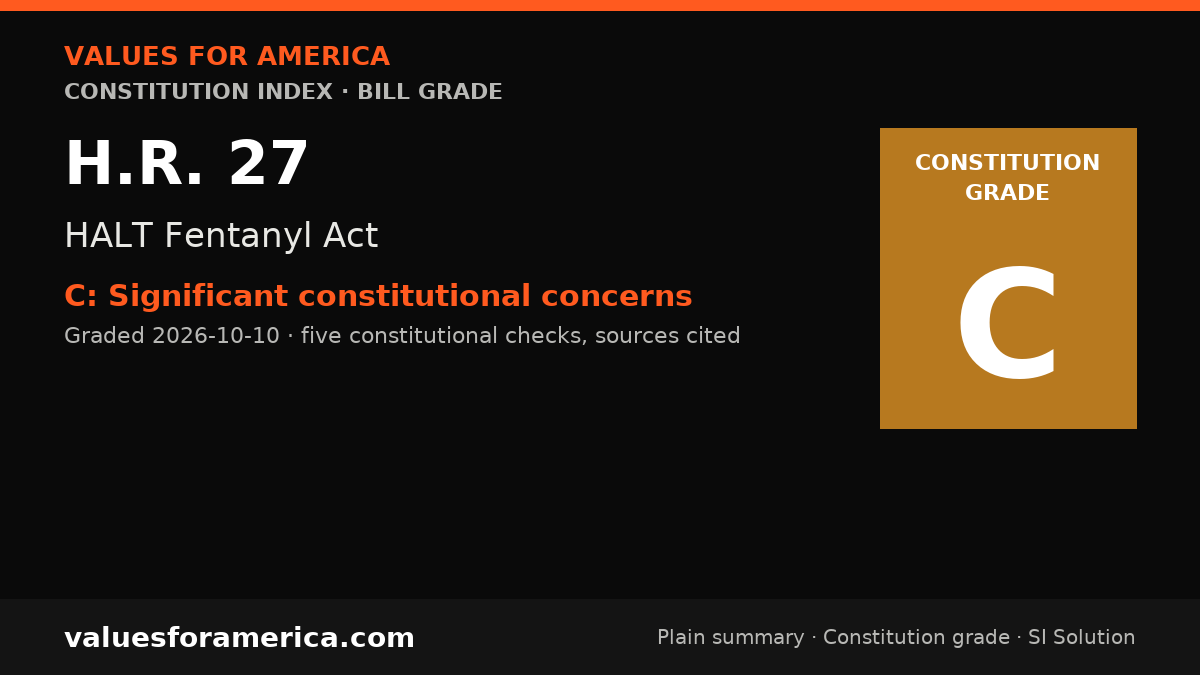
HALT Fentanyl Act
Cosponsors: 61 (2 D, 59 R) · per Congress.gov, 2026-10-12
Introduced: 2025-01-03
Latest action (2025-02-10): Received in the Senate and Read twice and referred to the Committee on the Judiciary.
What H.R. 27 does, in plain terms
Halt All Lethal Trafficking of Fentanyl Act or the HALT Fentanyl Act This bill permanently places fentanyl-related substances as a class into schedule I of the Controlled Substances Act. A schedule I controlled substance is a drug, substance, or chemical that has a high potential for abuse; has no currently accepted medical value; and is subject to regulatory controls and administrative, civil, and criminal penalties under the Controlled Substances Act. Under the bill, offenses involving fentanyl-related substances are triggered by the same quantity thresholds and subject to the same penalties as offenses involving fentanyl analogues (e.g., offenses involving 100 grams or more trigger a 10-year mandatory minimum prison term). Additionally, the bill establishes a new, alternative registration process for certain schedule I research. The bill also makes several other changes to registration requirements for conducting research with controlled substances, including permitting a single registration for related research sites in certain circumstances, waiving the requirement for a new inspection in certain situations, and allowing a registered researcher to perform certain manufacturing activities with small quantities of a substance without obtaining a manufacturing registration. Finally, the bill expresses the sense that Congress agrees with the interpretation of Controlled Substances Act in United States v. McCray, a 2018 case decided by the U.S. District Court for the Western District of New York. In that case, the court held that butyryl fentanyl, a controlled substance, can be considered an analogue of fentanyl even though, under the Controlled Substances Act, the term controlled substance analogue specifically excludes a controlled substance.
Official summary by the Congressional Research Service, via Congress.gov.
Constitution Index
“VFA Constitution grade”
Significant constitutional concerns
Graded 2026-10-10
SI-generated grade · five published checks · not individually reviewed by a person · methodology
The HALT Fentanyl Act raises significant constitutional concerns primarily under the decentralization principle and individual sovereignty. While Congress has enumerated power under the Commerce Clause to regulate controlled substances, permanently scheduling an entire class of substances without individualized assessment risks overreach, restricts individual liberty without compelling justification, and consolidates decision-making at the federal level beyond what is necessary.
-
✓ Passes · Enumerated powers
Congress has authority under Article I, Section 8, Clause 3 (Commerce Clause) to regulate interstate commerce in controlled substances, including fentanyl-related substances. The Supreme Court has long upheld federal drug scheduling under this power, as in Gonzales v. Raich (2005). However, the permanent scheduling of an entire class without periodic review strains the limits of this authority. -
✓ Passes · Bill of Rights
The bill does not directly infringe any enumerated right in the Bill of Rights. It does not restrict speech, religion, assembly, press, petition, arms, quartering, or trial rights. The research registration provisions may implicate the First Amendment's protection of scientific inquiry, but the alternative registration process mitigates this concern. No direct violation of the first ten amendments… -
✗ Concern · Individual sovereignty
The bill permanently places all fentanyl-related substances into Schedule I, which presumes they have no accepted medical value and high abuse potential. This restricts individual sovereignty over one's own body and medical choices without individualized scientific review. The government bears the burden of justifying such broad restrictions, and permanently banning an entire class of substances w… -
✗ Concern · Decentralization
The bill fails three of the four decentralization questions. (1) Individuals and families cannot handle fentanyl trafficking without government involvement. (2) Local communities cannot handle the interstate drug trade without state involvement. (3) States could handle fentanyl regulation through their own controlled substance laws, as many already do. (4) The bill consolidates decision-making at … -
✓ Passes · Due process and takings
The bill does not bypass procedural due process or take property without just compensation. The Controlled Substances Act provides notice and hearing procedures for scheduling. The alternative research registration process provides a pathway for legitimate research. No arbitrary government action or deprivation of property without compensation is present. The bill does not violate the Fifth Amendm…
Sources: Congress.gov: HR 27 summary
Report an error in this grade
What should pass
“VFA SI Solution”
No solution yet
A sourced SI draft appears here once it passes automated checks (Constitution citation, source verification, independent SI critic). How publication works.
Related on VFA

For journalists and bloggers
“Embed this grade”
Free to use with the link back. The badge and card update when the grade changes. Embed terms →
