H.R. 2683 explained · 119th Congress · Pending in Congress
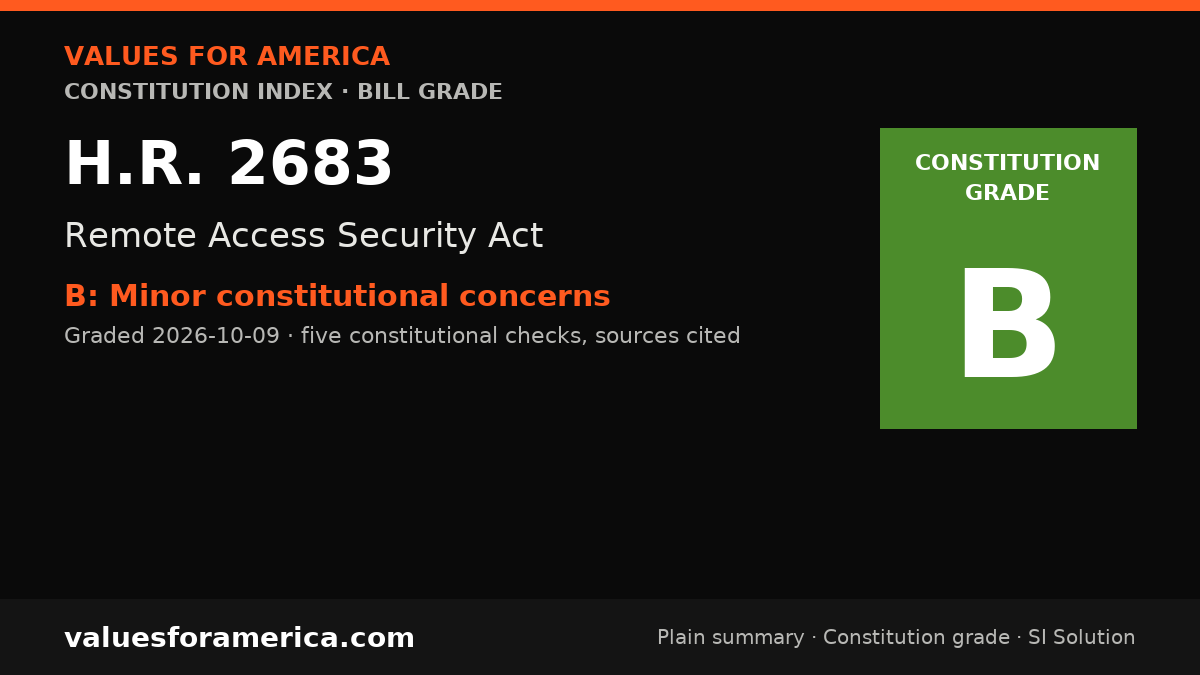
Remote Access Security Act
Cosponsors: 17 (9 D, 8 R) · per Congress.gov, 2026-10-09
Introduced: 2025-04-07
Latest action (2026-01-13): Received in the Senate and Read twice and referred to the Committee on Banking, Housing, and Urban Affairs.
What H.R. 2683 does, in plain terms
Remote Access Security Act This bill broadens the scope of the U.S. export control system to include remote access of items. Remote access means (1) access to an item subject to the jurisdiction of the United States by a foreign person through a network connection, including the internet or a cloud computing service, from a location other than where the item is physically located; or (2) any other form of access specified in regulations promulgated by the Department of Commerce. The Export Control Reform Act of 2018 (ECRA), which is implemented through the Export Administration Regulations, provides a permanent statutory basis for controlling the export of dual-use goods (e.g., items with both civilian and military uses) and certain military parts and components. This bill applies export controls under ECRA to remote access of items, thereby allowing Commerce's Bureau of Industry and Security to issue licenses and impose penalties related to remote access of controlled items.
Official summary by the Congressional Research Service, via Congress.gov.
Constitution Index
“VFA Constitution grade”
Minor constitutional concerns
Graded 2026-10-09
SI-generated grade · five published checks · not individually reviewed by a person · methodology
The Remote Access Security Act is mostly constitutional. It falls within Congress's enumerated powers over foreign commerce and foreign affairs. While it extends export controls to remote access, which could incidentally affect speech or property rights, the restrictions are justified by compelling national security interests and are consistent with longstanding precedent. The bill does not violate the Bill of Rights, though its breadth warrants careful application to avoid overreach. Decentralization is appropriate because export controls are inherently federal. Due process concerns are minor and can be addressed through existing administrative procedures.
-
✓ Passes · Enumerated powers
The federal government has explicit constitutional authority to regulate foreign commerce under Article I, Section 8, Clause 3 (Commerce Clause) and to conduct foreign affairs. Export controls on dual-use items and technical data are a traditional exercise of this power. Extending controls to remote access is a logical and necessary update to address modern technology, and remains within the scope… -
✓ Passes · Bill of Rights
The bill does not directly infringe any enumerated right. It regulates access to controlled items, not speech itself. While remote access could involve the transfer of technical data that may have expressive elements, the Supreme Court has upheld export controls as content-neutral and serving a compelling national security interest (e.g., United States v. Edler Industries, Inc., 579 F.2d 516 (9th … -
✓ Passes · Individual sovereignty
The bill restricts a person's ability to grant remote access to controlled items to foreign persons. This is a limitation on the use of property and information, but the government has a compelling constitutional justification: protecting national security and preventing the proliferation of sensitive technologies. The restriction is not arbitrary and is narrowly tailored to foreign access. The bu… -
✓ Passes · Decentralization
Export controls are inherently a matter of foreign commerce and national security, which cannot be handled by individuals, local communities, or states. The federal government is the appropriate level to regulate such matters. The bill does not consolidate power upward unnecessarily; it operates at the level already assigned by the Constitution. -
✓ Passes · Due process and takings
The bill authorizes the Department of Commerce to issue licenses and impose penalties for unauthorized remote access. This administrative scheme must comply with procedural due process (notice and hearing) under the Fifth Amendment. The underlying Export Control Reform Act provides such procedures. There is no direct taking of property; export controls are a permissible regulation of commerce and …
Sources: Congress.gov: HR 2683 summary
Report an error in this grade
What should pass
“VFA SI Solution”
No solution yet
A sourced SI draft appears here once it passes automated checks (Constitution citation, source verification, independent SI critic). How publication works.
Related on VFA

For journalists and bloggers
“Embed this grade”
Free to use with the link back. The badge and card update when the grade changes. Embed terms →
