H.R. 2659 explained · 119th Congress · Pending in Congress
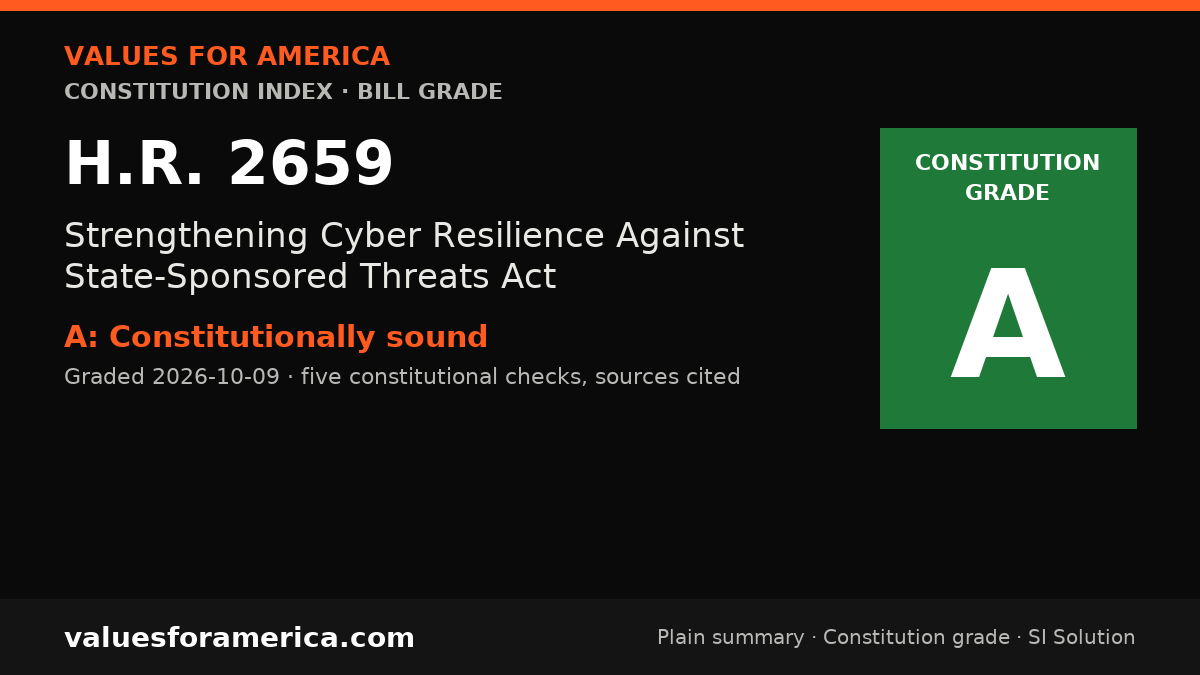
Strengthening Cyber Resilience Against State-Sponsored Threats Act
Cosponsors: 4 (0 D, 4 R) · per Congress.gov, 2026-10-10
Introduced: 2025-04-07
Latest action (2025-11-18): Received in the Senate and Read twice and referred to the Committee on Homeland Security and Governmental Affairs.
What H.R. 2659 does, in plain terms
Strengthening Cyber Resilience Against State-Sponsored Threats Act The bill creates a joint interagency task force to facilitate agency collaboration on efforts to respond to Chinese state-sponsored cyber actors, including Volt Typhoon. The task force must be established and led by the Cybersecurity and Infrastructure Security Agency (CISA), an agency within the Department of Homeland Security (DHS). The task force must facilitate collaboration and coordination among the Sector Risk Management Agencies (SRMAs) specified in the President's National Security Memorandum- 22 (e.g., the Department of Defense, the Department of Energy, and the Department of Agriculture) to detect, analyze, and respond to Chinese state-sponsored cyber actors by ensuring that such agencies’ actions are aligned and mutually reinforcing. The bill directs DHS, CISA, the Department of Justice, the Federal Bureau of Investigation, and specified SRMAs to provide the task force with analysis, inspections, audits, and other relevant information necessary for the task force to carry out its responsibilities. The production and use of information must comply with all applicable statutes, regulations, and executive orders, and task force members must have appropriate security clearances to access classified information. The task force must provide annual reports and briefings to Congress detailing its assessment of cyber threats and recommendations to improve the detection and mitigation of the cybersecurity threat posed by Chinese state-sponsored cyber actors. The first report must be provided no later than 540 days after the establishment of the task force, and additional reports must be provided annually thereafter for six years.
Official summary by the Congressional Research Service, via Congress.gov.
Constitution Index
“VFA Constitution grade”
Constitutionally sound
Graded 2026-10-09
SI-generated grade · five published checks · not individually reviewed by a person · methodology
The bill is constitutional. It creates an interagency federal coordination mechanism to address cyber threats from Chinese state-sponsored actors, an area within Congress's enumerated national-security and foreign-affairs powers. It does not restrict individual rights, commandeer state governments, or deny due process. Its information-sharing provisions are expressly subject to existing legal requirements, and it authorizes no new surveillance or search powers.
-
✓ Passes · Enumerated powers
Congress has authority under Article I, Section 8, Clause 3 to regulate foreign commerce, under its national-defense powers, and under Article I, Section 8, Clause 18 to make all laws necessary and proper for executing federal functions. Defending against state-sponsored cyber attacks is a federal national-security and foreign-affairs matter. Establishing a joint interagency task force to coordina… -
✓ Passes · Bill of Rights
The bill does not infringe the First, Second, Third, Fourth, Fifth, Sixth, Seventh, or Eighth Amendments. It does not regulate speech, religion, assembly, press, petition, arms, quartering, or criminal procedure. The bill's information-sharing provisions apply to federal agencies, do not authorize new searches or surveillance, and must comply with applicable statutes, regulations, and executive or… -
✓ Passes · Individual sovereignty
The bill imposes no direct restriction on what individuals can do with their own person, property, speech, labor, or belief. It targets coordination among federal agencies in response to foreign state-sponsored cyber actors. It does not criminalize private conduct or create penalties. The burden on government to justify any restriction is not triggered because no individual liberty is restricted. -
✓ Passes · Decentralization
The four-question test points toward federal action as the minimum necessary level. An individual or family cannot defend against Chinese state-sponsored cyber threats. A local community or county cannot handle such threats alone. A state cannot independently conduct foreign-state cyber defense because this involves foreign affairs and national security. The bill consolidates coordination at the f… -
✓ Passes · Due process and takings
The bill does not deprive any person of life, liberty, or property, impose fines, or take property without just compensation. It creates interagency reporting and coordination duties. Access to classified information is limited to persons with appropriate security clearances, and information production and use must comply with applicable law. No procedural or substantive due process violation aris…
Sources: Congress.gov: HR 2659 summary
Report an error in this grade
What should pass
“VFA SI Solution”
No solution yet
A sourced SI draft appears here once it passes automated checks (Constitution citation, source verification, independent SI critic). How publication works.
Related on VFA

For journalists and bloggers
“Embed this grade”
Free to use with the link back. The badge and card update when the grade changes. Embed terms →
