H.R. 2616 explained · 119th Congress · Pending in Congress
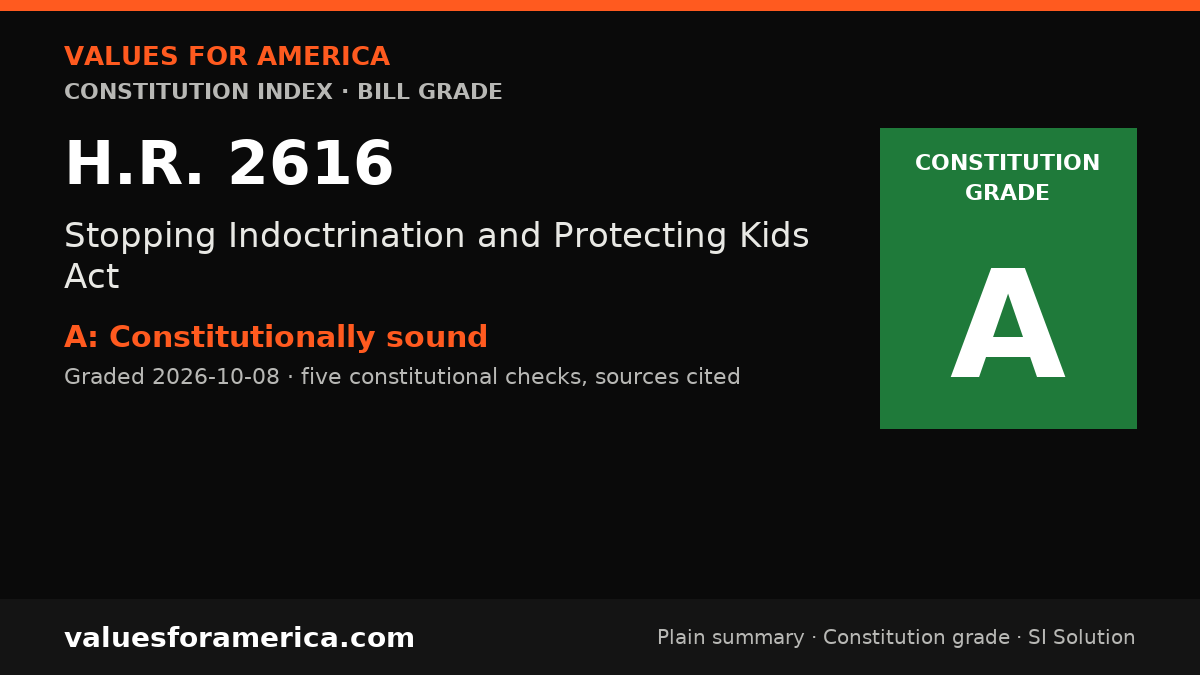
Stopping Indoctrination and Protecting Kids Act
Cosponsors: 4 (0 D, 4 R) · per Congress.gov, 2026-10-08
Introduced: 2025-04-03
Latest action (2026-05-21): Received in the Senate and Read twice and referred to the Committee on Health, Education, Labor, and Pensions.
What H.R. 2616 does, in plain terms
Parental Rights Over The Education and Care of Their Kids Act or the PROTECT Kids Act This bill requires public elementary and middle schools, as a condition of receiving certain federal funds for elementary and secondary education, to obtain parental consent before changing a student's gender on school forms or changing a student's sex-based accommodations. Specifically, an elementary school or a school consisting of only grades 5-8 must obtain parental consent before changing a minor student's (1) gender markers, pronouns, or preferred name on any school form; or (2) sex-based accommodations, including locker rooms or bathrooms.
Official summary by the Congressional Research Service, via Congress.gov.
Constitution Index
“VFA Constitution grade”
Constitutionally sound
Graded 2026-10-08
SI-generated grade · five published checks · not individually reviewed by a person · methodology
Constitutional conditional-spending measure that protects parental authority without mandating curriculum, compelling speech, or commandeering states. Grounded in Article I, Section 8, Clause 1 and consistent with the First, Tenth, and Fourteenth Amendments.
-
✓ Passes · Enumerated powers
Congress acts under Article I, Section 8, Clause 1, the Spending Clause, which permits Congress to spend for the general welfare and to attach conditions to federal funds received voluntarily by states and schools, within the limits of South Dakota v. Dole. The bill does not commandeer state legislatures in violation of the Tenth Amendment; it conditions certain federal elementary and secondary ed… -
✓ Passes · Bill of Rights
No provision of the Bill of Rights is infringed. The bill does not restrict speech, religion, press, assembly or petition under the First Amendment; it does not authorize searches under the Fourth Amendment; it does not compel self-incrimination. It instead reinforces parental direction of upbringing, a liberty interest recognized under the Fourteenth Amendment, Section 1 Due Process Clause, see P… -
✓ Passes · Individual sovereignty
The bill expands rather than restricts individual and family sovereignty. It prevents government employees in public elementary and middle schools from making decisions about a minor child's identity markers and intimate accommodations without the parents, restoring the burden to the government to obtain consent. No adult's speech, belief, labor, or property is restricted; no belief is compelled u… -
✓ Passes · Decentralization
Education is reserved to states and localities under the Tenth Amendment. This bill does not create a direct federal mandate, curriculum, or federal administration of schools. It uses conditional federal funds to require parental consent, which pushes decision-making downward to the family, the lowest level. A family can and should handle name and accommodation decisions for a minor child; local s… -
✓ Passes · Due process and takings
No deprivation of life, liberty, or property without due process under the Fifth Amendment and Fourteenth Amendment, Section 1. The bill adds a procedural protection, prior parental notice and consent, before a school alters official forms or accommodations. It creates no criminal penalty, no presumption of guilt, and no taking of private property for public use requiring just compensation under t…
Sources: Congress.gov: HR 2616 summary
Report an error in this grade
What should pass
“VFA SI Solution”
No solution yet
A sourced SI draft appears here once it passes automated checks (Constitution citation, source verification, independent SI critic). How publication works.
Related on VFA

For journalists and bloggers
“Embed this grade”
Free to use with the link back. The badge and card update when the grade changes. Embed terms →
