H.R. 2481 explained · 119th Congress · Sent to the President
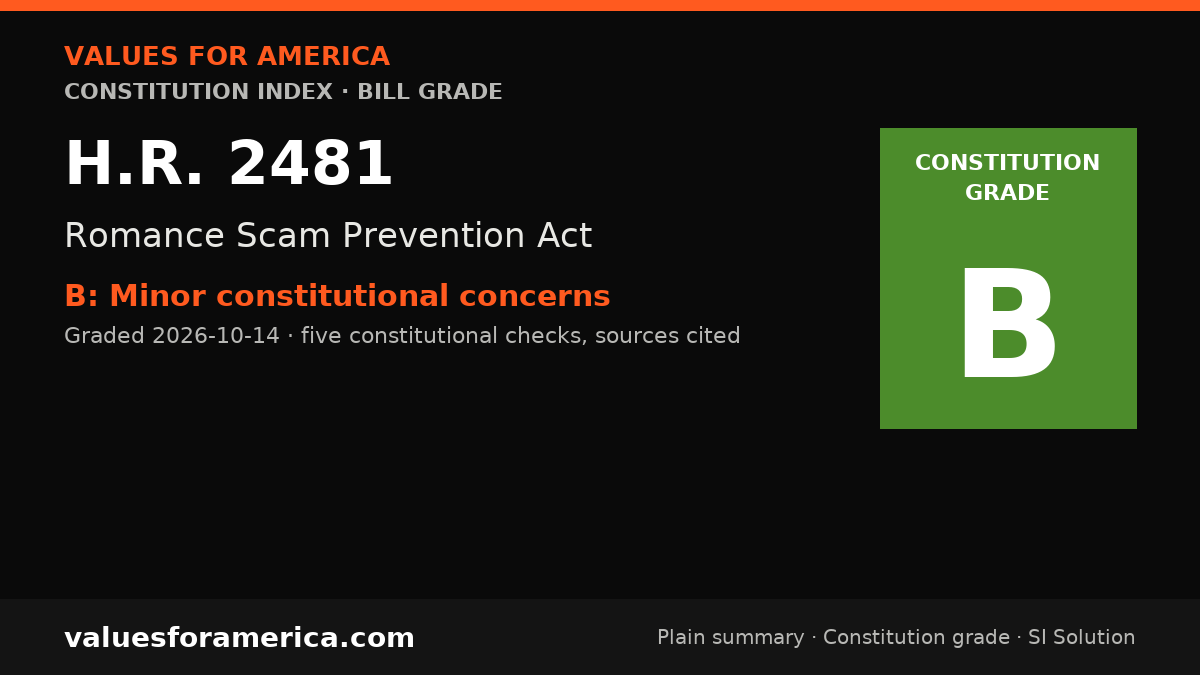
Romance Scam Prevention Act
Cosponsors: 9 (4 D, 5 R) · per Congress.gov, 2026-10-14
Introduced: 2025-03-31
Latest action (2026-10-14): Presented to President.
What H.R. 2481 does, in plain terms
Romance Scam Prevention Act This bill requires online dating service providers (i.e., mobile applications or websites) to provide users with a fraud ban notification if the user has established an account with the service and received a message through the service from a banned user of the service. The fraud ban notification must include (1) the username or other profile identifier of the banned user and the most recent time when the user who is receiving the notification sent or received a message through the service to or from the banned user, (2) a statement that the banned user may have been using a false identity or attempting to defraud other users, (3) a statement that the user should not send cash (or another form of currency) or personal financial information to another user, (4) information about avoiding online fraud (e.g., a link to another website or a disclosure) and (5) contact information for the provider's customer service department. The bill provides for enforcement of these requirements by the Federal Trade Commission and state attorneys general.
Official summary by the Congressional Research Service, via Congress.gov.
Constitution Index
“VFA Constitution grade”
Minor constitutional concerns
Graded 2026-10-14
SI-generated grade · five published checks · not individually reviewed by a person · methodology
The Romance Scam Prevention Act is a federal consumer protection measure that falls within Congress's enumerated power to regulate interstate commerce. It imposes a modest disclosure requirement on online dating services, which are inherently interstate in nature, and does not infringe on any specific constitutional right. The main constitutional tension is the delegation of enforcement to state attorneys general, which could lead to inconsistent application and a degree of federal-state entanglement, but this is not a direct violation of the Tenth Amendment. The bill is mostly sound but could be improved by clarifying the scope of state enforcement to avoid potential conflicts with federal supremacy.
-
✓ Passes · Enumerated powers
Congress has authority under Article I, Section 8, Clause 3 (the Commerce Clause) to regulate interstate commerce. Online dating services are part of interstate commerce, as they operate across state lines and involve the transmission of messages and data. Requiring these services to provide fraud notifications to users is a reasonable regulation of that commerce, similar to other consumer protect… -
✓ Passes · Bill of Rights
The bill does not infringe on any of the first ten amendments. It does not restrict speech, religion, assembly, press, or petition. It does not involve search and seizure, self-incrimination, due process, takings, trial rights, or cruel and unusual punishment. The requirement to provide notifications is a commercial disclosure, not a compelled speech issue in the traditional sense, as it applies t… -
✓ Passes · Individual sovereignty
The bill does not restrict individual freedom. It imposes a requirement on businesses (dating service providers) to inform users about potential fraud. This does not limit what individuals can do with their person, property, speech, labor, or belief. The burden is on the government to justify the restriction, and here there is no restriction on individuals—only a disclosure requirement on business… -
✗ Concern · Decentralization
The bill fails the decentralization test because it consolidates decision-making at the federal level when states could handle this issue. (1) Individuals cannot handle this alone—they need protection from fraud, but they could be informed by the service without federal mandate. (2) Local communities cannot handle this effectively because online dating services are national. (3) States could handl… -
✓ Passes · Due process and takings
The bill does not bypass due process or take property. It imposes a regulatory requirement on businesses, but it does not deprive them of property without just compensation. The enforcement provisions allow for FTC and state attorney general actions, which would follow standard administrative and judicial procedures. There is no presumption of innocence issue, as the bill does not create criminal …
Sources: Congress.gov: HR 2481 summary
Report an error in this grade
The Framers
“Founders’ Verdict”
Confidence 0.75
SI-generated · automated checksSI-generated · passed automated checks (Constitution citation, source verification, independent SI critic) · not individually reviewed by a person · Report an error: hello@valuesforamerica.com
Synthesis
As of 2026-10-14 the proposal has been Presented to President and is not yet law, and this bill would be constitutional under Article I, Section 8, Clause 3 because online dating services conduct commercial intercourse across state lines by wire. Congress may regulate the manner of that interstate commerce to prevent fraud and protect honest dealing, aided by the Necessary and Proper power in Article I, Section 8, Clause 18. The required fraud ban notification would prescribe a rule governing that commerce itself, and enforcement by the Federal Trade Commission with concurrent suit by state attorneys general would execute federal law while leaving state police power over fraud intact. This would serve both principled conservatives, who would gain limited government confined to enumerated commerce with states as co-enforcers, and good-faith progressives, who would gain national consumer protection where no single state can contain interstate deception. The strongest objection is that compelled disclosure could become government prescription of speech and a federal police power over private correspondence. The answer is confinement: the notice would state only the plain fact of the fraud ban and prudent counsel against sending funds, leaving opinion untouched under Amendment I, and federal direction would stop at interstate deception, reserving general morals and state fraud law under Amendment X and Federalist No. 45.
Hamilton holds this measure constitutional. Online dating services conduct commercial intercourse across state lines and by wire, squarely within Congressional power to regulate Commerce among the several States. The required fraud ban notification is a regulation of the manner of that commerce, to protect honest dealing and prevent fraud, aided by the Necessary and Proper power to prescribe the means. Enforcement by the Federal Trade Commission accords with energetic execution of federal law, and concurrent suit by state attorneys general does not offend federal supremacy where constitutional…
The power to regulate commerce among the several states in Article I, Section 8 reaches dealings carried across state lines by wire and post, and a measure confined to warning against fraud and false identity serves the legitimate end of preserving honest commerce. Yet the First Amendment secures freedom of speech and forbids government from prescribing opinion, so any mandated notice must state only plain facts of the ban and prudent counsel against sending funds, leaving opinion and private discourse untouched. By the Tenth Amendment all powers not delegated remain with the states and the pe…
As Madison, I find this measure within the enumerated power to regulate commerce among the several states, for online dating services operate across state lines and transmit messages through interstate channels. Federalist No. 45 explains that federal powers are few and defined, extending to objects concerning commerce that reach beyond one state, while Federalist No. 10 shows the extended republic requires a national remedy where faction and fraud cannot be contained by a single state. The required notice is a regulation of the manner of interstate commercial intercourse, not a general code o…
As Chief Justice, I find this Act within the power of Congress to regulate Commerce among the several States. Online dating services operating through mobile applications and websites conduct intercourse and traffic across State lines and by instrumentalities of interstate communication, and thus fall under the commerce power as expounded in Gibbons v. Ogden. The required fraud ban notification is a regulation of that commerce itself, prescribing a rule by which such commerce is governed for the protection of persons engaged therein. Under McCulloch v. Maryland, where the end is legitimate and…
Report an error in this Founders' Verdict
What should pass
“VFA SI Solution”
No solution yet
A sourced SI draft appears here once it passes automated checks (Constitution citation, source verification, independent SI critic). How publication works.
Related on VFA

For journalists and bloggers
“Embed this grade”
Free to use with the link back. The badge and card update when the grade changes. Embed terms →
