H.R. 2478 explained · 119th Congress · Pending in Congress
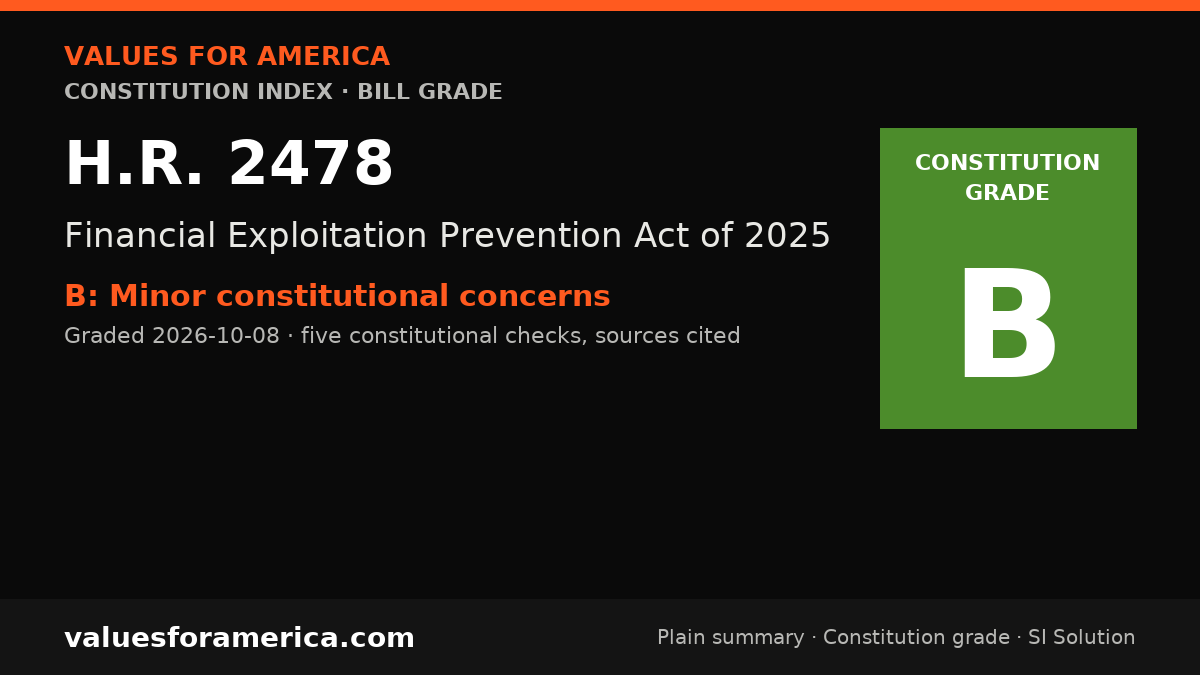
Financial Exploitation Prevention Act of 2025
Cosponsors: 11 (4 D, 7 R) · per Congress.gov, 2026-10-08
Introduced: 2025-03-27
Latest action (2026-07-13): Received in the Senate and Read twice and referred to the Committee on Banking, Housing, and Urban Affairs.
What H.R. 2478 does, in plain terms
Financial Exploitation Prevention Act of 2025 This bill establishes procedures for delaying the redemption of certain securities if an investment company or agent believes that an older individual or an individual with certain impairments has been financially exploited. Specifically, the bill allows for the delay of the redemption of a security issued by an open-end investment management company and serviced by a transfer agent if the company or agent reasonably believes the redemption involves the financial exploitation of an individual (1) age 65 or older, or (2) age 18 or older who is unable to protect his or her own interests due to a mental or physical impairment. (Open-end investment management companies offer securities in pooled investment vehicles such as mutual funds. Transfer agents facilitate certain transactions for corporations and investment companies, including dividend distribution and change of securities ownership.) The company may initially delay the redemption for up to 15 days and, upon making a determination of exploitation, may delay the redemption an additional 10 days. A state regulator, appropriate administrative agency, or court may extend this period. In the event of delay, the company must hold the amounts related to the redemption in a demand deposit account. The bill also establishes notification requirements. The bill requires the registered open-end investment company and transfer agent to notify the Securities and Exchange Commission (SEC) if they elect to comply with the procedures established under this bill. Additionally, the SEC must make recommendations to address the financial exploitation of these adults.
Official summary by the Congressional Research Service, via Congress.gov.
Constitution Index
“VFA Constitution grade”
Minor constitutional concerns
Graded 2026-10-08
SI-generated grade · five published checks · not individually reviewed by a person · methodology
Voluntary, time-limited federal procedure to pause suspected elder exploitation redemptions fits interstate commerce authority and preserves ownership with notice and court review. Minor tension remains from temporary loss of access to personal funds, warranting tight construction and prompt review, but no direct rights violation.
-
✓ Passes · Enumerated powers
Congress regulates open-end investment companies and transfer agents operating in interstate securities markets under Article I, Section 8, Clause 3, the Commerce Clause, together with Article I, Section 8, Clause 18, the Necessary and Proper Clause, to carry out securities oversight also reflected in SEC authority. The bill establishes voluntary delay and notice procedures rather than a general p… -
✓ Passes · Bill of Rights
No First, Second, Third, Sixth, Seventh, or Eighth Amendment violation. Fifth Amendment property interest is implicated because redemption proceeds are temporarily delayed, but funds are held in a demand deposit account for the owner rather than seized, with notice requirements and state regulator or court review. Any intrusion is brief and procedural, not a permanent taking or search under the Fo… -
✓ Passes · Individual sovereignty
The bill temporarily limits an adult owner, including those age 65 or older or adults with impairment, from receiving redemption proceeds for up to 25 days on suspicion of exploitation. The burden is significant but narrow, time-limited, preserves ownership, and serves the compelling purpose of preventing fraud against vulnerable persons, with notice and outside review. -
✓ Passes · Decentralization
Elder financial exploitation in mutual funds involves interstate securities markets that individuals, counties, and single states cannot fully police alone. The bill creates an optional federal safe-harbor procedure and preserves state regulator and court extension authority, so it does not consolidate power upward beyond the minimum needed under the Tenth Amendment. -
✓ Passes · Due process and takings
Procedural due process under the Fifth and Fourteenth Amendments is respected through reasonable-belief standard, 15-day plus 10-day limits, mandatory notice, holding of funds for the owner, and review by a state regulator, agency, or court. No presumption of guilt is imposed and no property is transferred without just compensation. Temporary delay is not a categorical taking.
Sources: Congress.gov: HR 2478 summary
Report an error in this grade
What should pass
“VFA SI Solution”
No solution yet
A sourced SI draft appears here once it passes automated checks (Constitution citation, source verification, independent SI critic). How publication works.
Related on VFA

For journalists and bloggers
“Embed this grade”
Free to use with the link back. The badge and card update when the grade changes. Embed terms →
