H.R. 2361 explained · 119th Congress · Pending in Congress
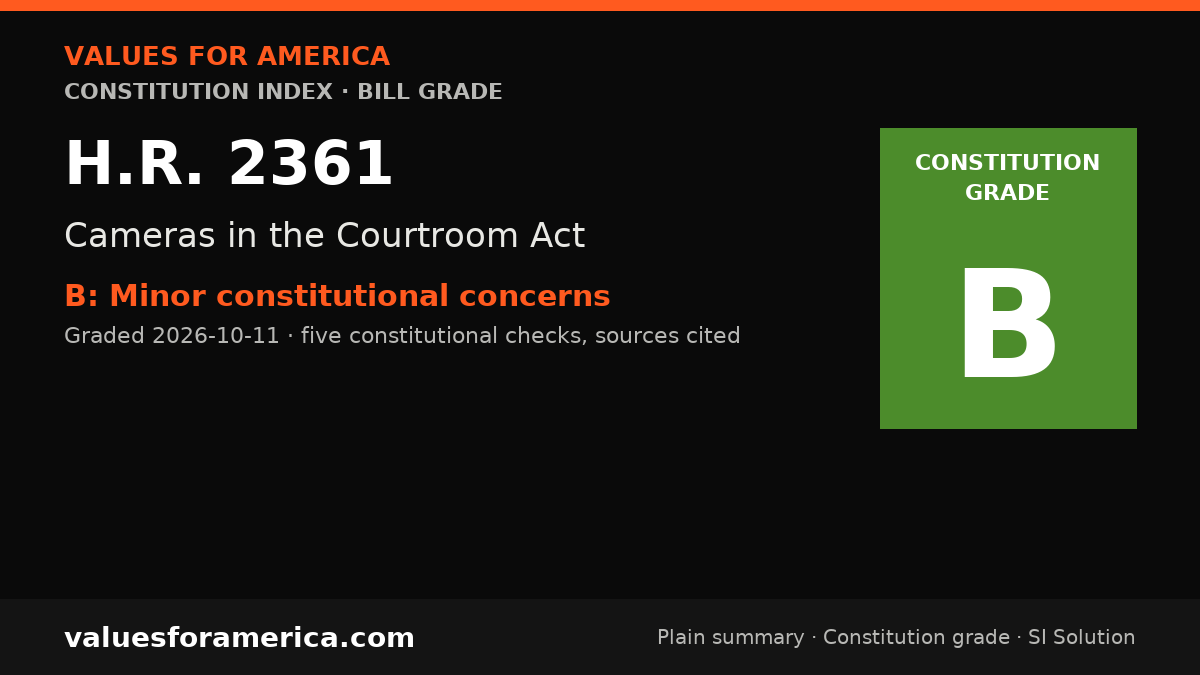
Cameras in the Courtroom Act
Cosponsors: 4 (4 D, 0 R) · per Congress.gov, 2026-10-12
Introduced: 2025-03-26
Latest action (2025-03-26): Referred to the House Committee on the Judiciary.
What H.R. 2361 does, in plain terms
Cameras in the Courtroom Act This bill requires the Supreme Court to permit television coverage of all open sessions of the Court unless it decides by majority vote that allowing such coverage in a particular case would violate the due process rights of any of the parties before the Court.
Official summary by the Congressional Research Service, via Congress.gov.
Constitution Index
“VFA Constitution grade”
Minor constitutional concerns
Graded 2026-10-11
SI-generated grade · five published checks · not individually reviewed by a person · methodology
The bill is a modest procedural requirement on the Supreme Court's own operations, likely within Congress's power to regulate the federal judiciary, and it does not infringe on individual rights. The main constitutional concern is that it may intrude on the Court's internal rule-making authority, but the bill includes a due process safeguard, making it mostly sound with minor tension.
-
✓ Passes · Enumerated powers
Congress has authority under Article I, Section 8, Clause 9 to constitute tribunals inferior to the Supreme Court, and under Article III, Section 1, Congress has the power to ordain and establish the federal judiciary. While the Supreme Court's internal operations are generally left to the Court, Congress has historically regulated the judiciary's procedures (e.g., the Rules Enabling Act). Requiri… -
✓ Passes · Bill of Rights
The bill does not infringe on any enumerated rights in the Bill of Rights. It actually protects due process by allowing the Court to deny coverage if it would violate due process rights. It does not implicate the First, Second, Third, Fourth, Fifth, Sixth, Seventh, Eighth, Ninth, or Tenth Amendments. The only potential concern is that televising proceedings could affect the fairness of trials, but… -
✓ Passes · Individual sovereignty
The bill does not restrict individual liberty. It imposes a requirement on the Supreme Court, not on individuals. It does not limit speech, property, labor, or belief. The only potential impact is on parties before the Court, but the bill includes a safeguard to protect their due process rights, so individual sovereignty is not undermined. -
✓ Passes · Decentralization
This is a federal action concerning the federal judiciary, so the decentralization test is less directly applicable. The action does not consolidate decision-making at a higher level than necessary; it is a federal law about a federal court. It does not involve state or local matters. The bill actually preserves some decentralization by allowing the Court to make case-by-case decisions. -
✓ Passes · Due process and takings
The bill explicitly protects due process by requiring the Court to deny coverage if it would violate due process rights. It does not take property or bypass procedural safeguards. The requirement to televise is not arbitrary and includes a clear exception for due process concerns, so it does not violate the Fifth Amendment's Due Process Clause.
Sources: Congress.gov: HR 2361 summary
Report an error in this grade
What should pass
“VFA SI Solution”
No solution yet
A sourced SI draft appears here once it passes automated checks (Constitution citation, source verification, independent SI critic). How publication works.
Related on VFA

For journalists and bloggers
“Embed this grade”
Free to use with the link back. The badge and card update when the grade changes. Embed terms →
