H.R. 2347 explained · 119th Congress · Pending in Congress
Survivor Justice Tax Prevention Act
Cosponsors: 3 (2 D, 1 R) · per Congress.gov, 2026-10-14
Introduced: 2025-03-25
Latest action (2026-09-30): Cloture motion on the motion to proceed to the measure presented in Senate. (CR S5241)
What H.R. 2347 does, in plain terms
Survivor Justice Tax Prevention Act This bill excludes from gross income certain damages received by an individual due to any sexual act or sexual contact and establishes the applicable burden of proof in court proceedings regarding the characterization of such damages for federal tax purposes. Under current law, amounts received as damages (other than punitive damages) from a judgment, award, or settlement of a claim may be excluded from gross income and, thus, are not subject to federal income tax, if attributable to a personal physical injury or physical sickness. The Internal Revenue Service (IRS) generally interprets personal physical injury to require observable bodily harm (e.g., bruising, cuts, swelling, or bleeding). Under the bill, amounts received as damages (other than punitive damages) from a judgment, award, or settlement due to any sexual act or sexual conduct, whether or not there are medical records or observable injuries of such act or contact, may be excluded from gross income. Further, if a judgment, award, or settlement states that damages are due to any sexual act or sexual conduct, then the IRS has the burden of proving otherwise in court proceedings related to the tax liability associated with such damages. Finally, the bill requires the IRS to promote public awareness of the exclusion from gross income of damages related to any sexual act or sexual contact.
Official summary by the Congressional Research Service, via Congress.gov.
Constitution Index
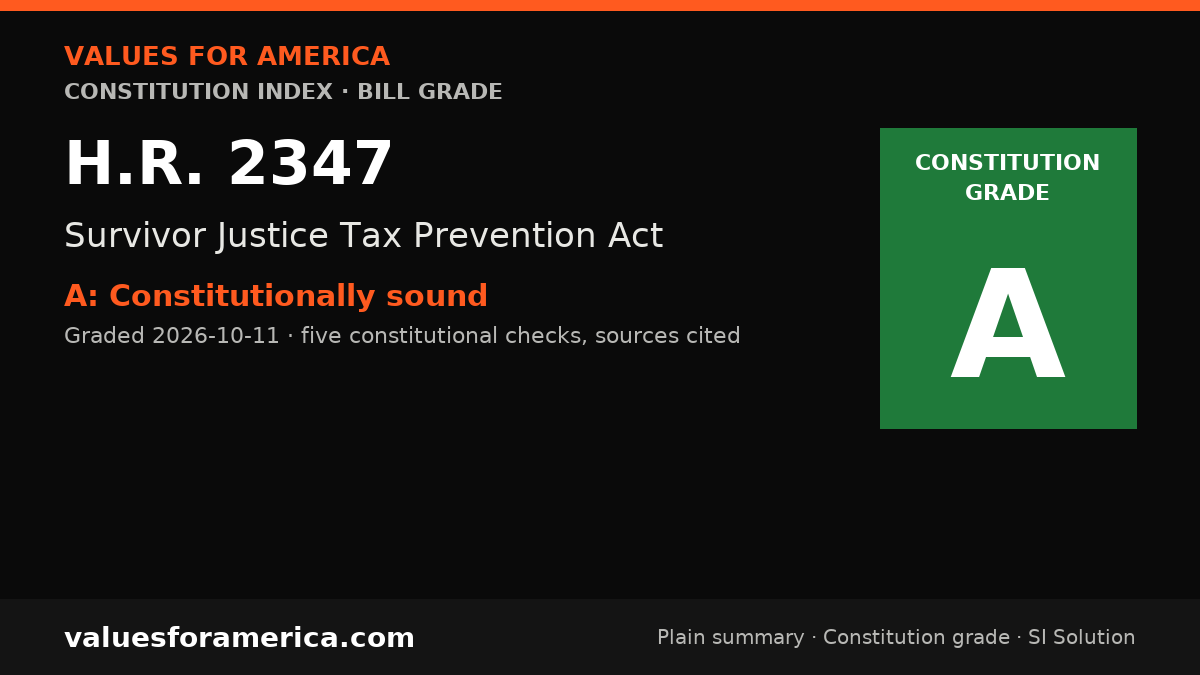
“VFA Constitution grade”
Constitutionally sound
Graded 2026-10-11
SI-generated grade · five published checks · not individually reviewed by a person · methodology
The Survivor Justice Tax Prevention Act is a federal tax measure that falls squarely within Congress's enumerated power to lay and collect taxes under Article I, Section 8, Clause 1. It does not infringe upon any constitutional right, does not restrict individual sovereignty, does not consolidate power improperly, and does not violate due process or takings protections. The bill's provisions regarding burden of proof in tax disputes are procedural and do not undermine constitutional protections.
-
✓ Passes · Enumerated powers
Congress has the explicit constitutional authority to lay and collect taxes under Article I, Section 8, Clause 1. This bill modifies the Internal Revenue Code to exclude certain damages from gross income, which is a direct exercise of Congress's taxing power. The bill also establishes rules of evidence and burden of proof in federal tax court proceedings, which is within Congress's power to consti… -
✓ Passes · Bill of Rights
The bill does not implicate any of the first ten amendments. It does not restrict speech, religion, assembly, press, or petition (First Amendment). It does not affect the right to keep and bear arms (Second Amendment), quartering of soldiers (Third Amendment), or search and seizure (Fourth Amendment). It does not compel self-incrimination, deny due process, or take property without just compensati… -
✓ Passes · Individual sovereignty
The bill expands individual rights by allowing survivors of sexual acts or contact to exclude damages from gross income, thereby reducing their tax burden. It does not restrict any individual's freedom over their person, property, speech, labor, or belief. The burden of proof shift in favor of the taxpayer in certain tax disputes is a protection of individual property rights, not a restriction. Th… -
✓ Passes · Decentralization
The bill concerns federal income tax, which is inherently a federal matter. The questions are answered as follows: (1) An individual cannot handle federal tax policy without government involvement; (2) a local community cannot handle federal tax policy; (3) a state cannot handle federal tax policy without federal involvement; (4) the action does not consolidate decision-making at a higher level th… -
✓ Passes · Due process and takings
The bill does not deprive any person of life, liberty, or property without due process of law. It does not take private property for public use without just compensation. The burden of proof provision in tax court is a procedural rule that provides a clear standard and does not deny taxpayers a fair hearing. The bill provides fair notice of the new exclusion and the burden of proof rule. It does n…
Sources: Congress.gov: HR 2347 summary
Report an error in this grade
What should pass
“VFA SI Solution”
No solution yet
A sourced SI draft appears here once it passes automated checks (Constitution citation, source verification, independent SI critic). How publication works.
Related on VFA

For journalists and bloggers
“Embed this grade”
Free to use with the link back. The badge and card update when the grade changes. Embed terms →
