H.R. 2312 explained · 119th Congress · Pending in Congress
Tipped Employee Protection Act
Cosponsors: 6 (0 D, 6 R) · per Congress.gov, 2026-10-09
Introduced: 2025-03-24
Latest action (2026-01-13): POSTPONED PROCEEDINGS - Pursuant to clause 1(c) of rule XIX, the Chair announced that further proceedings on H.R. 2312 is postponed.
What H.R. 2312 does, in plain terms
Tipped Employee Protection Act This bill modifies the definition of a tipped employee under the Fair Labor Standards Act of 1938 (FLSA) to exclude consideration of an employee's duties when determining if the employee is a tipped employee. Under current law, tipped employees may be paid less than the federal minimum wage (currently $7.25 an hour), but the total of their cash wage and tips must be at least equal to the federal minimum wage. Under the FLSA, a tipped employee is currently a worker who customarily and regularly receives more than $30 a month in tips. The bill broadens the definition of tipped employee to include any worker who receives tips and other cash wages for a work period at a rate that is at least the federal minimum wage, without regard to the duties of the employee. Under the bill, the work period is a work period that is determined by the employer.
Official summary by the Congressional Research Service, via Congress.gov.
Constitution Index
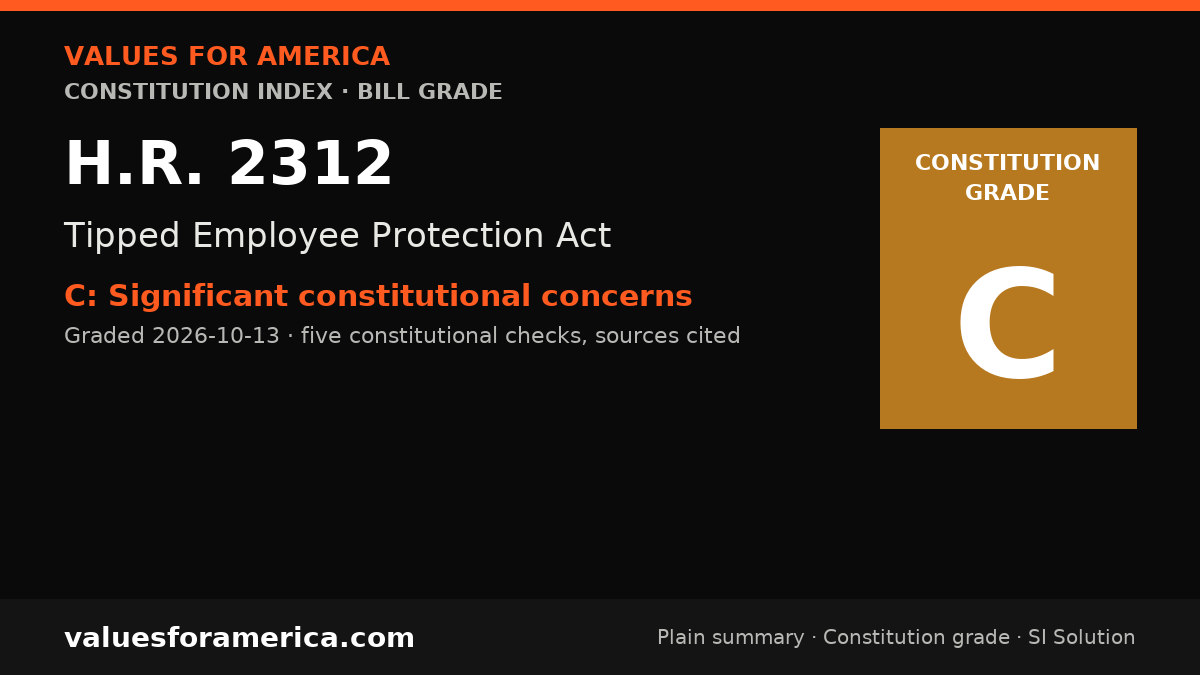
“VFA Constitution grade”
Significant constitutional concerns
Graded 2026-10-13
SI-generated grade · five published checks · not individually reviewed by a person · methodology
The Tipped Employee Protection Act raises significant constitutional concerns under the Fifth Amendment's Due Process Clause and the Tenth Amendment. By allowing employers to define the work period and broadening the tipped employee definition without regard to duties, the bill creates arbitrary classifications that may deprive employees of fair minimum wage protections without adequate procedural safeguards. The federal government's enumerated power under the Commerce Clause (Article I, Section 8, Clause 3) is stretched to regulate internal wage arrangements that could be handled at the state or local level, violating principles of decentralization.
-
✗ Concern · Enumerated powers
The bill relies on the Commerce Clause (Article I, Section 8, Clause 3) to regulate employer-employee wage arrangements. While the FLSA has been upheld under this clause, the bill's expansion to cover any worker receiving tips without regard to duties goes beyond traditional interstate commerce regulation. The connection to interstate commerce is attenuated when the bill allows employers to define… -
✓ Passes · Bill of Rights
The bill does not directly infringe any of the first ten amendments. It does not restrict speech, religion, assembly, press, petition, arms, quartering, search and seizure, self-incrimination, fair trial, jury, cruel and unusual punishment, or unenumerated rights. However, the Fifth Amendment's Due Process Clause is implicated indirectly through the arbitrary work period definition (see due_proces… -
✗ Concern · Individual sovereignty
The bill restricts an employee's right to fair compensation by allowing employers to define the work period without regard to duties. This undermines the individual's sovereignty over their labor and property (their wages). The government has not provided a compelling justification for allowing employers to unilaterally set work periods that could reduce effective wages below the minimum wage. The… -
✗ Concern · Decentralization
The bill fails three of the four decentralization questions. (1) Individuals cannot handle this without government involvement because wage protections require legal enforcement. (2) Local communities could handle tipped employee definitions without state involvement. (3) States could handle this without federal involvement, as many states already have their own minimum wage laws. (4) The bill con… -
✗ Concern · Due process and takings
The bill violates procedural due process under the Fifth Amendment by allowing employers to define the work period without any notice or hearing for employees. This creates an arbitrary classification that could deprive employees of the full minimum wage without a fair process. Substantive due process is also implicated because the bill lacks a rational basis for excluding duties from the tipped e…
Sources: Congress.gov: HR 2312 summary
Report an error in this grade
What should pass
“VFA SI Solution”
No solution yet
A sourced SI draft appears here once it passes automated checks (Constitution citation, source verification, independent SI critic). How publication works.
Related on VFA

For journalists and bloggers
“Embed this grade”
Free to use with the link back. The badge and card update when the grade changes. Embed terms →
