H.R. 2259 explained · 119th Congress · Pending in Congress
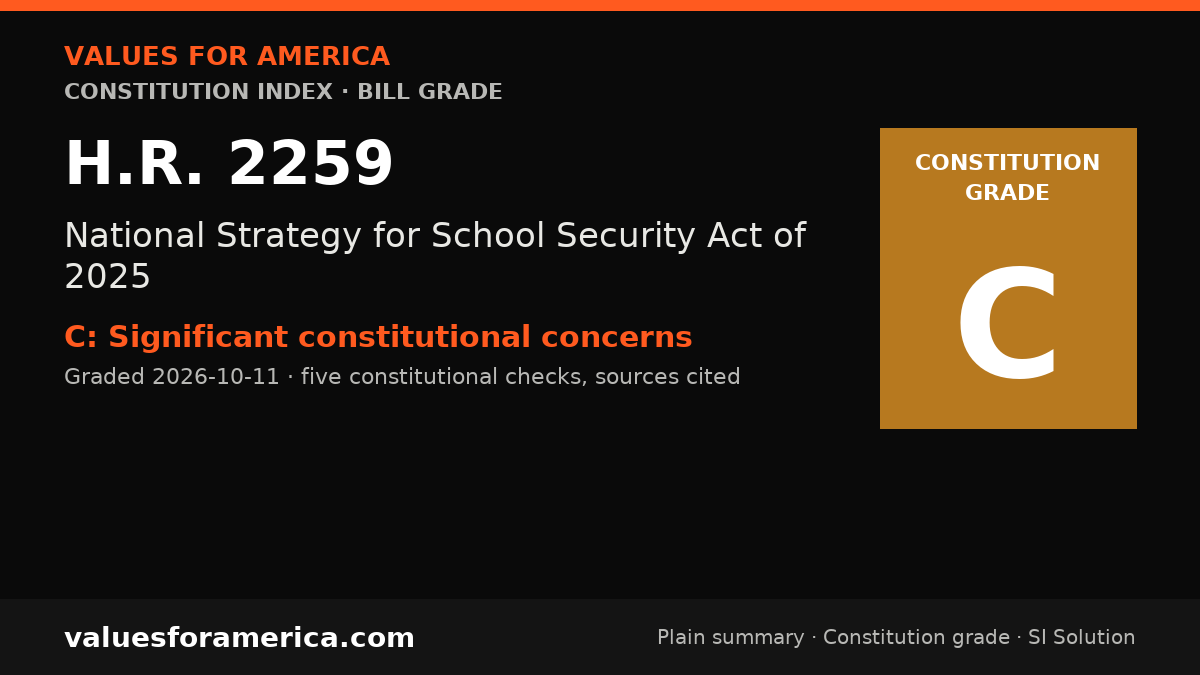
National Strategy for School Security Act of 2025
Cosponsors: 9 (4 D, 5 R) · per Congress.gov, 2026-10-10
Introduced: 2025-03-21
Latest action (2025-11-20): Received in the Senate and Read twice and referred to the Committee on Homeland Security and Governmental Affairs.
What H.R. 2259 does, in plain terms
National Strategy for School Security Act of 2025 This bill requires the Department of Homeland Security (DHS) to develop a national strategy to secure elementary and secondary schools from acts of terrorism. DHS must submit this strategy to Congress, annually update the strategy (if appropriate) through 2033, and provide annual briefings to Congress on those updates.
Official summary by the Congressional Research Service, via Congress.gov.
Constitution Index
“VFA Constitution grade”
Significant constitutional concerns
Graded 2026-10-11
SI-generated grade · five published checks · not individually reviewed by a person · methodology
The bill directs the Department of Homeland Security to develop a national strategy for school security against terrorism. While the federal government has some authority over terrorism, education and school security are traditionally state and local matters. The bill does not directly infringe on rights, but it centralizes planning and oversight at the federal level, raising Tenth Amendment and decentralization concerns. The mandate is broad and may lead to federal overreach into local school operations.
-
✗ Concern · Enumerated powers
The federal government's enumerated powers under Article I, Section 8 do not include general authority over education or school security. While the bill relates to terrorism, which may implicate the federal government's power to provide for the common defense and regulate foreign commerce, the direct regulation of school security is not an enumerated power. The Tenth Amendment reserves such powers… -
✓ Passes · Bill of Rights
The bill does not directly infringe on any of the first ten amendments. It does not restrict speech, religion, assembly, press, petition, arms, quartering, search and seizure, self-incrimination, due process, takings, fair trial, jury, cruel and unusual punishment, or unenumerated rights. The strategy development itself is a planning function, not a direct restriction on individual rights. -
✓ Passes · Individual sovereignty
The bill does not directly restrict individual liberty. It imposes no new restrictions on what individuals can do with their person, property, speech, labor, or belief. The requirement for a national strategy is a government planning exercise, not a direct regulation of individual conduct. However, the potential for future implementation of the strategy could lead to restrictions, but as written, … -
✗ Concern · Decentralization
The bill fails the decentralization test. (1) Individuals and families cannot handle national terrorism threats alone, but they can handle school security at the local level. (2) Local communities and counties can and do handle school security without state involvement. (3) States can handle school security without federal involvement. (4) The bill consolidates decision-making at the federal level… -
✓ Passes · Due process and takings
The bill does not bypass due process or take property without just compensation. It is a planning and reporting requirement, not an enforcement action. There is no deprivation of life, liberty, or property, and no procedural or substantive due process concerns are implicated.
Sources: Congress.gov: HR 2259 summary
Report an error in this grade
What should pass
“VFA SI Solution”
No solution yet
A sourced SI draft appears here once it passes automated checks (Constitution citation, source verification, independent SI critic). How publication works.
Related on VFA

For journalists and bloggers
“Embed this grade”
Free to use with the link back. The badge and card update when the grade changes. Embed terms →
