H.R. 2243 explained · 119th Congress · Pending in Congress
LEOSA Reform Act
Cosponsors: 18 (1 D, 17 R) · per Congress.gov, 2026-10-11
Introduced: 2025-03-21
Latest action (2025-05-15): Received in the Senate and Read twice and referred to the Committee on the Judiciary.
What H.R. 2243 does, in plain terms
LEOSA Reform Act of 2025 This bill broadens the authority for certain law enforcement officers to carry concealed firearms across state lines. Specifically, the bill allows qualified active and retired law enforcement officers to carry concealed firearms and ammunition (including magazines) in school zones; in national parks; on state, local, or private property that is open to the public; and in certain federal facilities that are open to the public. Further, the bill permits states to reduce the frequency with which retired law enforcement officers must meet certain qualification standards.
Official summary by the Congressional Research Service, via Congress.gov.
Constitution Index
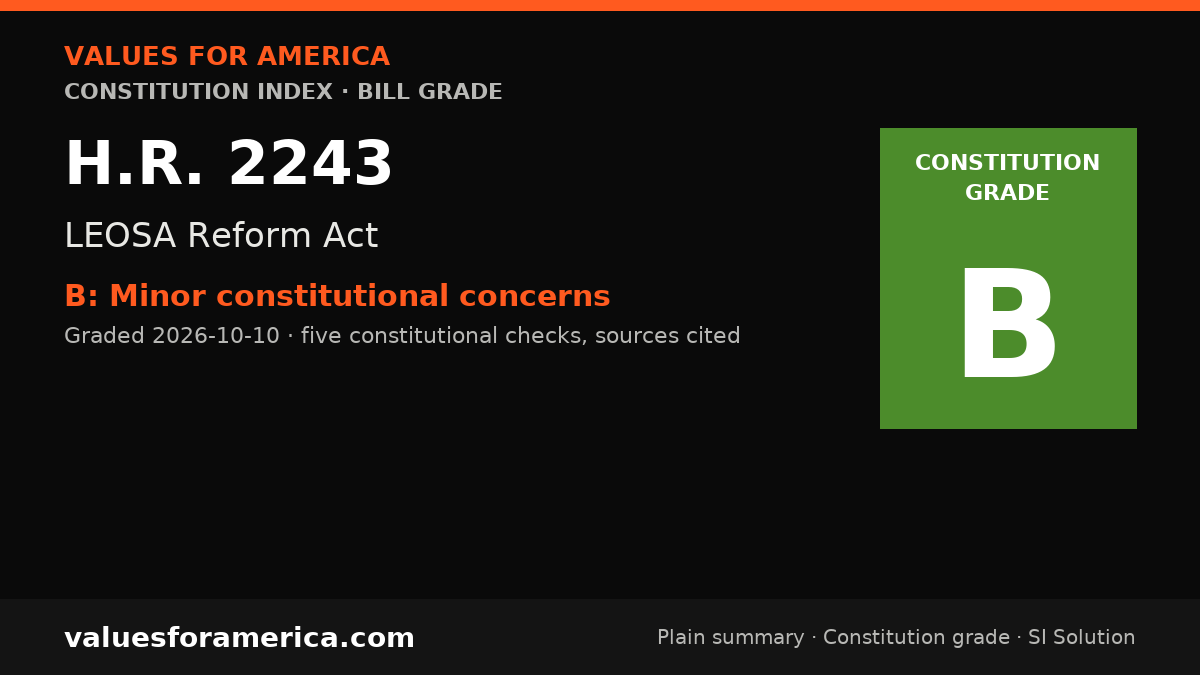
“VFA Constitution grade”
Minor constitutional concerns
Graded 2026-10-10
SI-generated grade · five published checks · not individually reviewed by a person · methodology
The LEOSA Reform Act raises significant federalism and Second Amendment concerns by expanding federal authority over state and local firearms regulation and by potentially weakening state qualification standards for retired officers. However, it does not outright violate the Constitution; it operates within Congress's enumerated powers over interstate commerce and federal property, and it does not directly infringe individual rights. The primary issues are the consolidation of decision-making at the federal level and the potential for undermining state sovereignty, which warrant a 'B' grade with recommendations for structural adjustments.
-
✓ Passes · Enumerated powers
Congress has authority under Article I, Section 8, Clause 3 (Commerce Clause) to regulate interstate commerce, which includes the carrying of firearms across state lines. Additionally, Article I, Section 8, Clause 17 grants Congress exclusive legislative authority over federal enclaves such as national parks and federal facilities. The bill's provisions regarding school zones are supported by the … -
✓ Passes · Bill of Rights
The bill does not infringe upon the Bill of Rights. It expands the ability of law enforcement officers to carry firearms, which aligns with the Second Amendment's protection of the right to keep and bear arms. It does not restrict speech, religion, assembly, or other rights. The provision allowing states to reduce qualification standards for retired officers does not implicate any enumerated right… -
✓ Passes · Individual sovereignty
The bill does not restrict individual sovereignty; rather, it expands the rights of a specific class of individuals (qualified law enforcement officers) to carry firearms. It does not impose new restrictions on individuals' use of their person, property, or labor. The burden of justification is not on the government to restrict rights, but here the government is expanding rights, so the check pass… -
✗ Concern · Decentralization
The bill fails the decentralization test because it consolidates decision-making at the federal level regarding firearms regulation, which has traditionally been a state and local matter. While an individual officer could carry a firearm without government involvement, the regulation of firearms in public spaces is a matter that local communities and states can handle. The bill preempts state laws… -
✓ Passes · Due process and takings
The bill does not bypass due process or take property without just compensation. It does not deprive any person of life, liberty, or property without due process of law. The provision allowing states to reduce qualification standards for retired officers does not implicate due process rights. There is no arbitrary government action; the bill is a clear legislative change. Therefore, the due proces…
Sources: Congress.gov: HR 2243 summary
Report an error in this grade
What should pass
“VFA SI Solution”
No solution yet
A sourced SI draft appears here once it passes automated checks (Constitution citation, source verification, independent SI critic). How publication works.
Related on VFA

For journalists and bloggers
“Embed this grade”
Free to use with the link back. The badge and card update when the grade changes. Embed terms →
