H.R. 22 explained · 119th Congress · Pending in Congress
SAVE Act
Cosponsors: 110 (0 D, 110 R) · per Congress.gov, 2026-10-11
Introduced: 2025-01-03
Latest action (2025-04-10): Received in the Senate.
What H.R. 22 does, in plain terms
Safeguard American Voter Eligibility Act or the SAVE Act This bill requires individuals to provide documentary proof of U.S. citizenship when registering to vote in federal elections. Specifically, the bill prohibits states from accepting and processing an application to register to vote in a federal election unless the applicant presents documentary proof of U.S. citizenship. The bill specifies what documents are considered acceptable proof of U.S. citizenship, such as identification that complies with the REAL ID Act of 2005 that indicates U.S. citizenship. Further, the bill (1) prohibits states from registering an individual to vote in a federal election unless, at the time the individual applies to register to vote, the individual provides documentary proof of U.S. citizenship; and (2) requires states to establish an alternative process under which an applicant may submit other evidence to demonstrate U.S. citizenship. Each state must take affirmative steps on an ongoing basis to ensure that only U.S. citizens are registered to vote, which shall include establishing a program to identify individuals who are not U.S. citizens using information supplied by certain sources. Additionally, states must remove noncitizens from their official lists of eligible voters. The bill allows for a private right of action against an election official who registers an applicant to vote in a federal election who fails to present documentary proof of U.S. citizenship. The bill establishes criminal penalties for certain offenses, including registering an applicant to vote in a federal election who fails to present documentary proof of U.S. citizenship.
Official summary by the Congressional Research Service, via Congress.gov.
Constitution Index
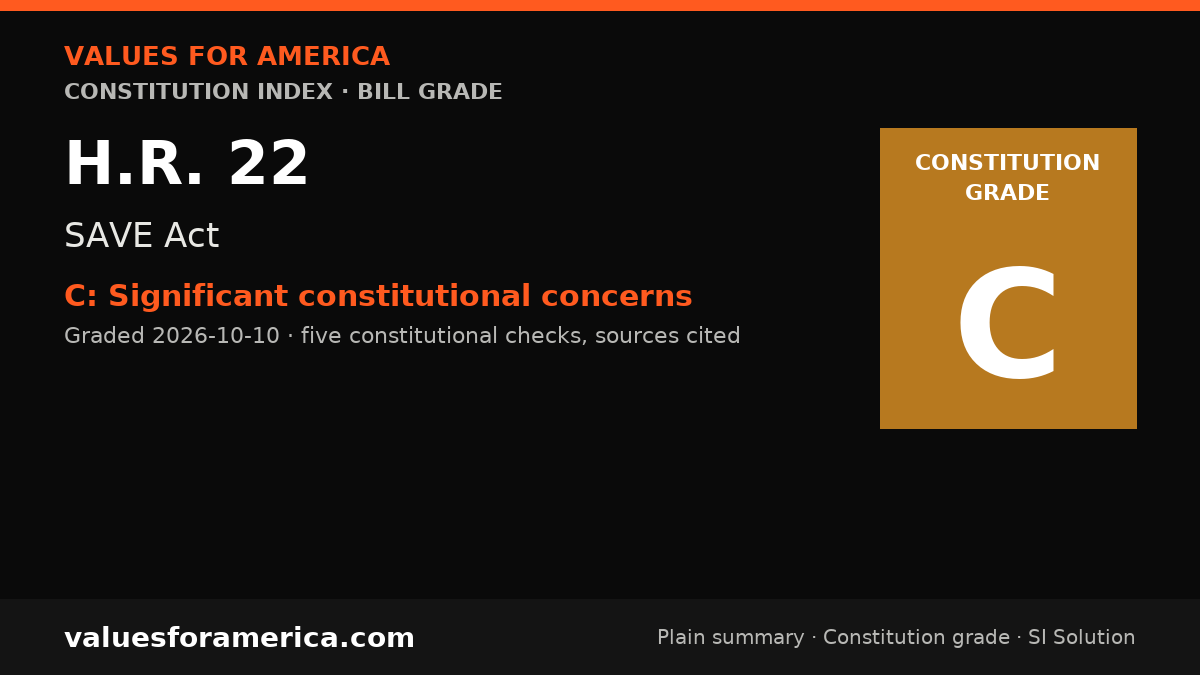
“VFA Constitution grade”
Significant constitutional concerns
Graded 2026-10-10
SI-generated grade · five published checks · not individually reviewed by a person · methodology
The SAVE Act raises significant constitutional concerns. While Congress has authority under Article I, Section 4 to regulate the times, places, and manner of federal elections, the bill's requirements impose substantial burdens on the right to vote, potentially violating the Fourteenth Amendment's Equal Protection Clause and the fundamental right to vote. The bill's delegation of enforcement to private citizens and criminal penalties for election officials could chill voter registration and undermine due process. The decentralization analysis shows that while the federal government has a role in federal elections, the bill unnecessarily centralizes voter registration procedures that states have traditionally managed, and the burdens imposed on individuals are significant. The bill is not a direct violation of the Bill of Rights, but it creates serious structural and rights-based issues that require careful reconsideration.
-
✓ Passes · Enumerated powers
Congress has explicit authority under Article I, Section 4, Clause 1 to regulate the 'Times, Places and Manner of holding Elections for Senators and Representatives.' This includes the power to set voter qualifications for federal elections, as affirmed by the Supreme Court in cases like Arizona v. Inter Tribal Council of Arizona (2013). The bill's requirement for documentary proof of citizenship … -
✗ Concern · Bill of Rights
The bill does not directly infringe on the First, Second, Third, Fourth, Fifth, Sixth, Seventh, Eighth, or Ninth Amendments. However, the right to vote is a fundamental right protected by the Fourteenth Amendment (not the Bill of Rights per se), and the bill's requirements could impose an undue burden on that right, particularly for citizens who lack the required documents. The Supreme Court in ca… -
✗ Concern · Individual sovereignty
The bill restricts an individual's ability to exercise their right to vote without providing documentary proof of citizenship. While the government has a compelling interest in ensuring only citizens vote, the burden is on the government to justify the restriction. The bill imposes a significant burden on citizens who may not have easy access to the required documents, such as the elderly, the poo… -
✗ Concern · Decentralization
The bill fails the decentralization test. While the federal government has a role in federal elections, the bill consolidates voter registration procedures at the federal level, overriding state discretion. States have traditionally managed voter registration, and the bill's one-size-fits-all approach may not account for state-specific circumstances. The bill also imposes burdens on individuals th… -
✗ Concern · Due process and takings
The bill raises due process concerns. It creates a private right of action against election officials who register applicants without documentary proof, and imposes criminal penalties. This could lead to arbitrary enforcement and chill the performance of official duties. The bill also requires states to remove noncitizens from voter rolls, but the process for doing so may not provide adequate noti…
Sources: Congress.gov: HR 22 summary
Report an error in this grade
What should pass
“VFA SI Solution”
No solution yet
A sourced SI draft appears here once it passes automated checks (Constitution citation, source verification, independent SI critic). How publication works.
Related on VFA

For journalists and bloggers
“Embed this grade”
Free to use with the link back. The badge and card update when the grade changes. Embed terms →
